
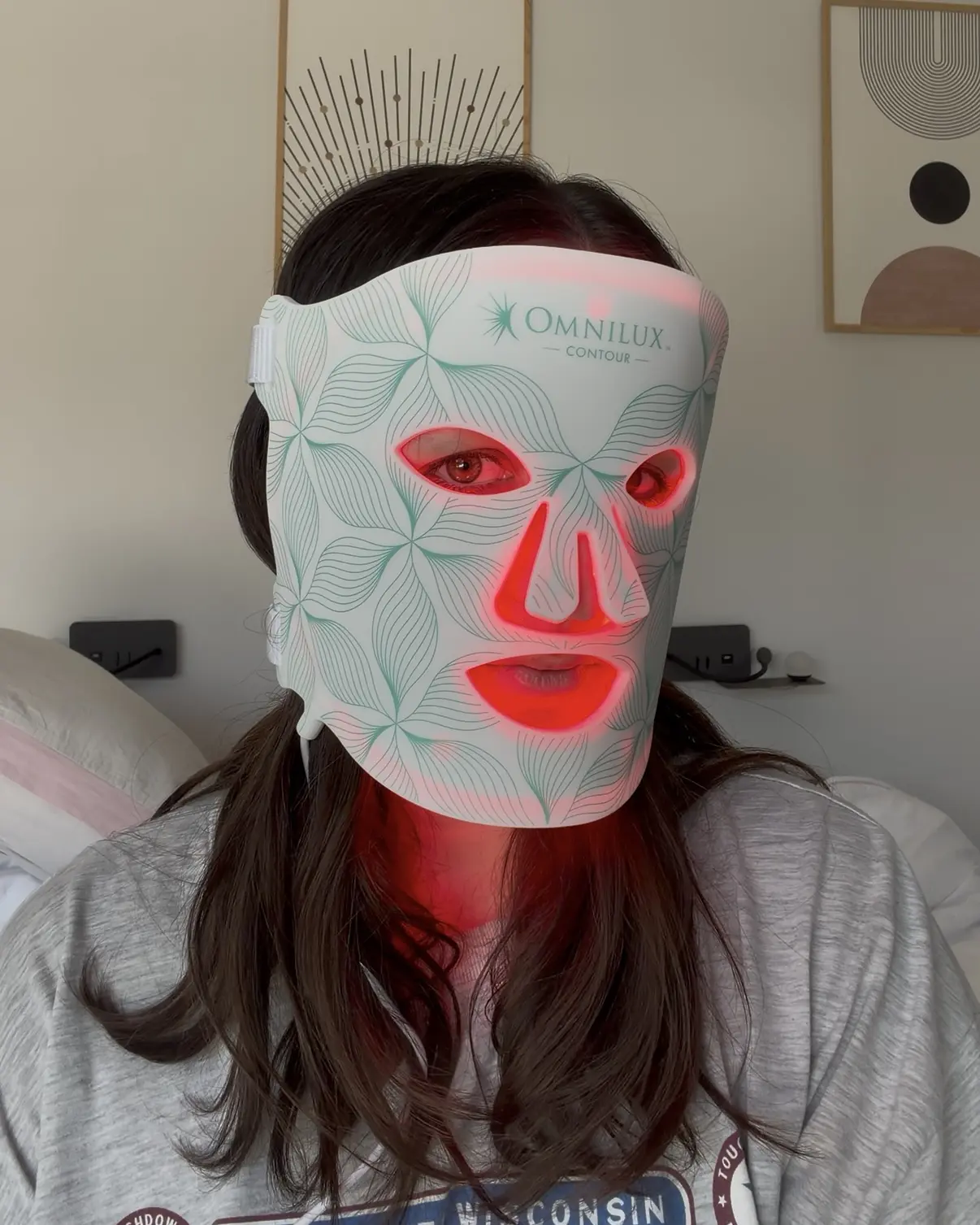
I buy the devices I test unless the article says otherwise. Some links and discount codes on this site are paid links: if you buy through one, I earn a commission. It never changes a score or a verdict.
The Omnilux Clear is the acne version of the Omnilux Contour Face: the same flat silicone LED mask and the same 66 light points, but with blue light at 415 nm and red at 633 nm instead of red and near-infrared. I paid $395 for it on Omnilux’s website.
So here is my review after a month on my own breakouts, what the FDA file and the brand’s study really say, and the LED mask I’d pick instead if you want blue light.
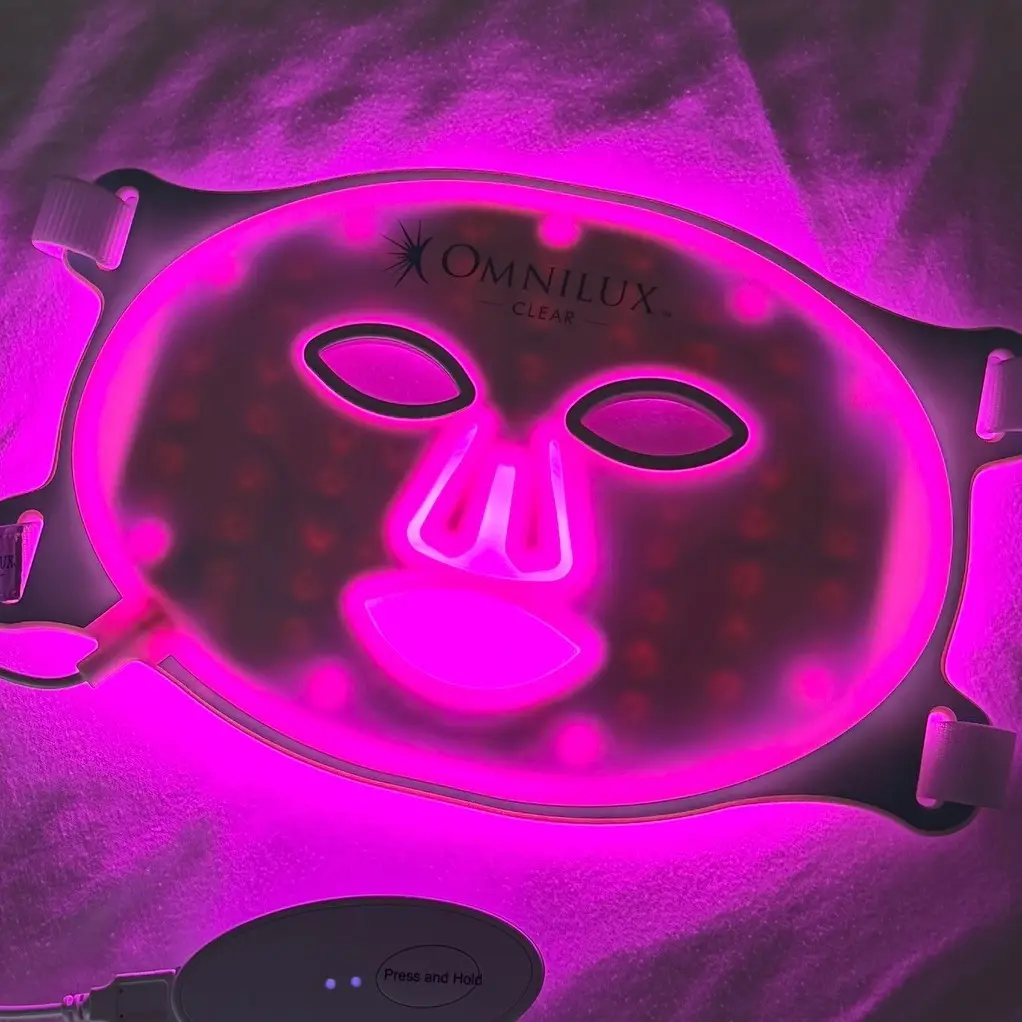
54/100
Shelved since November 2026I used it for a month, 4 sessions a week, on a few inflammatory breakouts, and nothing changed. The light is decent, with 28 mW/cm² of blue irradiance and eye shields built into the mask, which is a real upgrade on the Contour Face. But it’s still the same flat panel with 66 light points, and in my opinion a blue light on the skin can’t do much for breakouts that follow your hormones.
Buy it if
- You want an LED mask with eye protection already built in.
- You’ve already tried a lot of really different acne care and want to try blue light.
Skip it if
- Your breakouts get worse around your period: it’s hormonal acne.
- You haven’t tried a complete acne routine yet.
- You also want near-infrared light for anti-aging.
What I tested: the Omnilux Clear LED mask
I bought the Omnilux Clear on Omnilux’s US website, for $395, and there’s no affiliate link to Omnilux on this page. In the box: the mask, its controller, the charger with plug, the straps and a carry bag.
I used it 4 times a week, 10 minutes each, which is Omnilux’s own recommendation and also what my protocol gives for a mask around 40 mW/cm². Omnilux recommends 6 weeks of use, and I stopped after 4: nothing had changed on my skin, and I wanted to get back to my number one LED mask to keep following its results.
Some context on my skin: I have a few inflammatory breakouts, probably hormonal since they get worse around my period. For light therapy itself, I’ve only done red and near-infrared for years, as these are the most studied types of light.
Results: 2.5/5
What changed on my face following my test, including my before-and-after photos. I also evaluate the “before-and-after” examples provided by the brand being tested, as well as the results of any studies that may have been conducted on the mask.
Read my results guideMy results with the Omnilux Clear after a month
Nothing changed on my skin. My acne is most likely hormonal, it flares around my period, and that’s exactly where I see the limit of the Omnilux Clear.
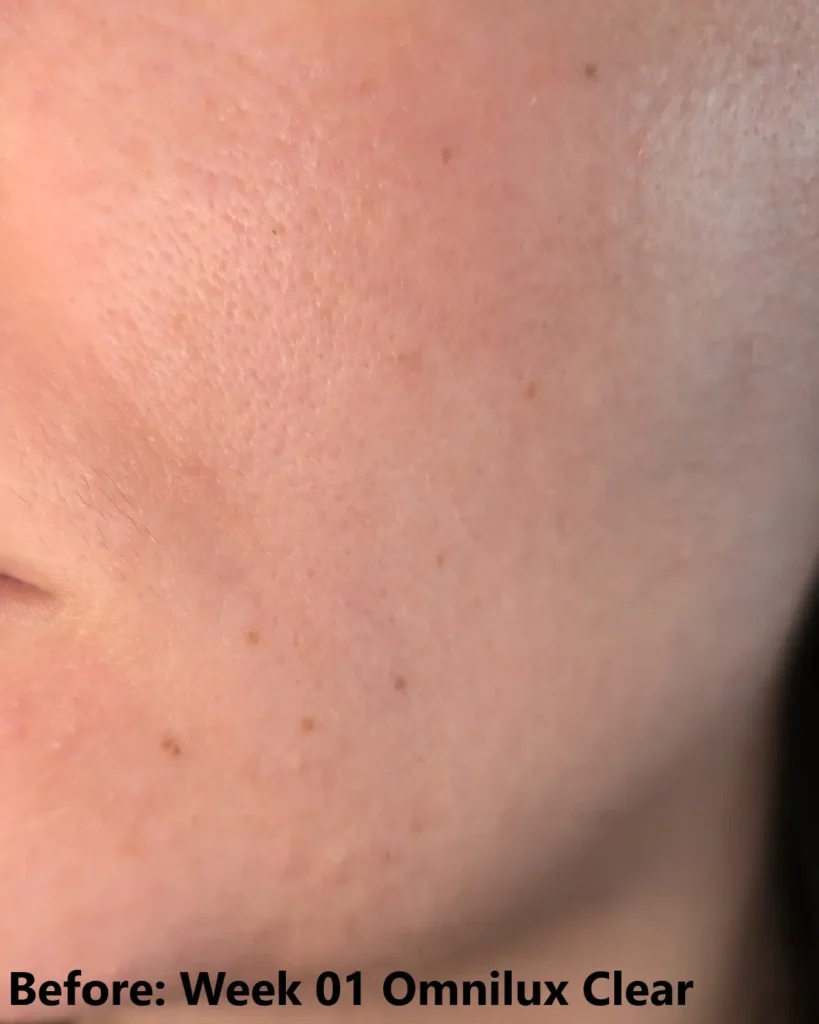
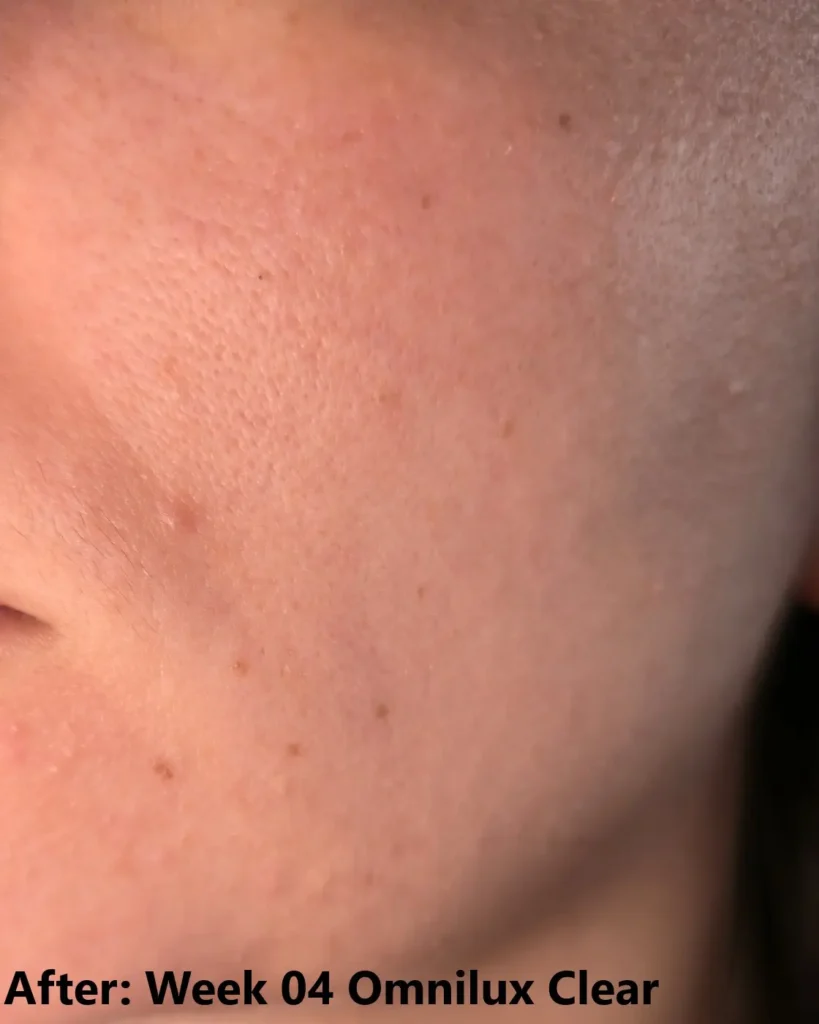
To be honest, I’m not convinced by blue light, as I often say in my videos. Yes, blue light can kill one of the bacteria involved in acne. But acne has several causes (hormones, oil, clogged pores, inflammation…), and bacteria on the surface are only one of them.
In my opinion, the best approach for acne is a complete routine: topical care adapted to your acne and, depending on the case, supplements, ideally with a dermatologist, so you work on the breakouts you see and on what causes them inside the body. So an LED mask built around blue light, for me, it’s a no.
What the Omnilux Clear study really shows
This time the study is on the right mask, and it’s published in a dermatology journal (JCAD, October 2025): 29 patients aged 14 to 45, 4 sessions a week for 7 weeks, at the Ablon Skin Institute in California.
Inflammatory spots went from 23 to 10 on average, and 86% of patients improved by at least one grade on the dermatologist’s scale.
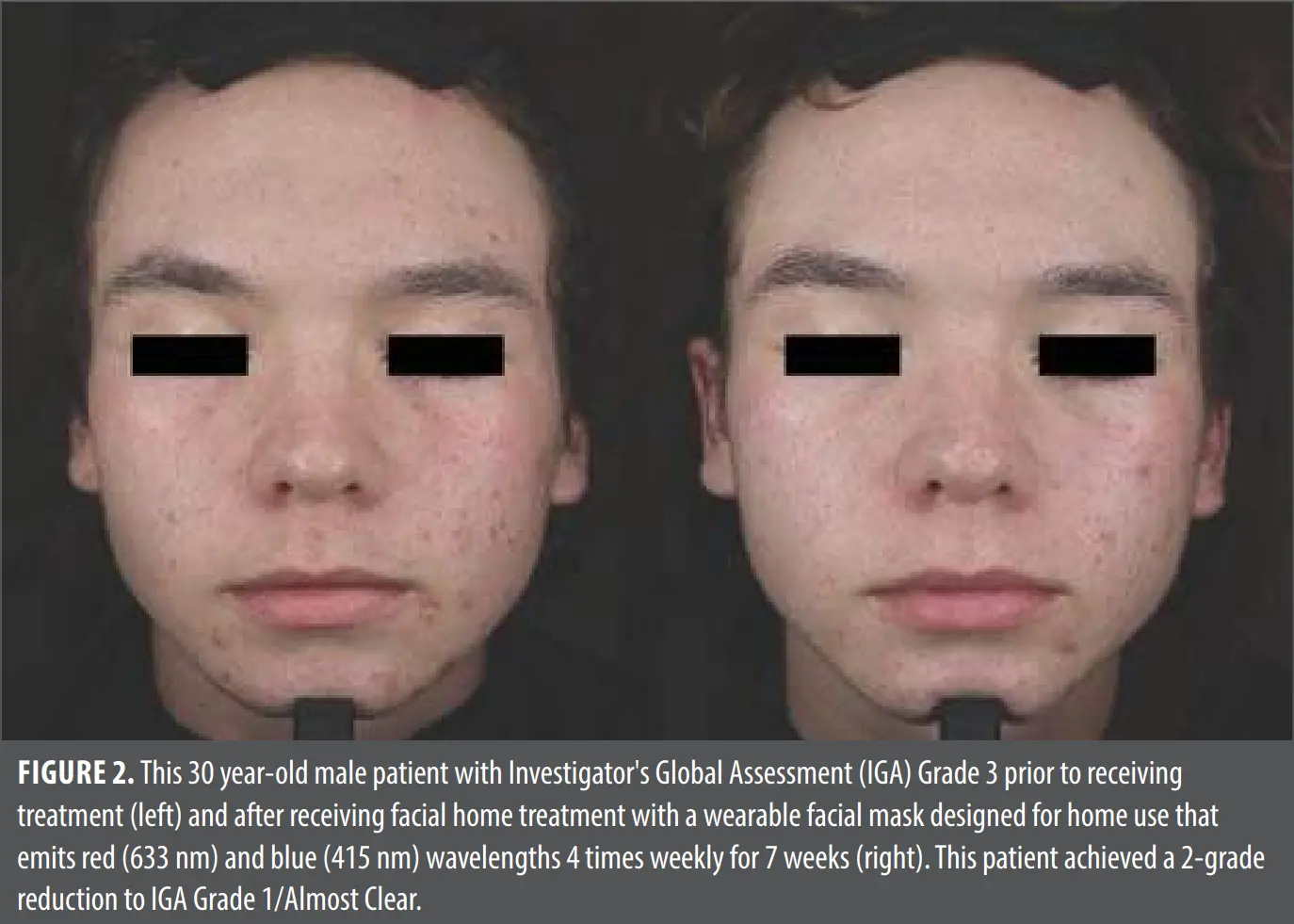
That’s a good result on paper. However, the study was paid for by the company that holds the FDA clearance, and there’s no placebo group. Every patient also got a new routine for the 7 weeks, a gentle cleanser, a moisturizer and an SPF 30.
Without a comparison group you can’t tell what came from the light and what came from a softer routine and being followed by a doctor. That’s what bothers me about this study, which doesn’t properly isolate the effects of the Omnilux Clear LED mask…
Irradiance: 3/5
How much light reaches the skin, in mW/cm²? I evaluate this value, as well as how the information is presented, the conditions under which it was measured, and the total dose received in a single session. If the brand does not communicate it, I give it a severe rating.
Read my irradiance guideI didn’t find any info about the irradiance (mW/cm²) on the Omnilux Clear product page. The figures are in its FDA file: 28 mW/cm² of blue and 16 mW/cm² of red, so 44 in total, which gives about 17 J/cm² of blue in a 10-minute session. Red flag is that the file doesn’t say at what distance they were measured.
Honestly, I expected less, as I thought the light output would be the same as the Contour Face, around 30 mW/cm². The blue value (28) is quite good, but the red value (16) is low. I assume the measurement was taken at skin level, else it is very low.
- Nooance Elite X600 50
- Omnilux Clear (28 blue + 16 red) 44
- CurrentBody Series 3 40
- Omnilux Contour Face 30
The Contour Face figure comes from my Omnilux Contour Face review.
Coverage: 1/5
How many points of light does the mask actually feature, how evenly are they distributed, and which areas remain uncovered? Note that I am counting “bulbs” and not LEDs, because the number of LEDs often includes two, three or more diodes per bulb, which inflates the apparent coverage area.
Read my coverage guideOmnilux writes the number of LEDs on its own page: 132 LEDs, 2 per bulb, so 66 bulbs/light points. That’s the same count and the same layout as the Contour Face, just with one blue and one red diode in each bulb, and 66 light points is still very few to cover a whole face (I expect at least 120 light points from a LED mask).

The shape is the other problem because a flat panel doesn’t really stick to the face, so the light crosses air before it reaches your skin, and your jawline, nostrils and chin end up with very little.
For acne, it’s a shame, because hormonal breakouts often sit along the jaw and the chin!
Proof: 4/5
What the brand clearly displays and what I check in the FDA file: wavelengths (in nm), emitted dose, FDA clearance number, product study, safety tests, warranty.
Read my proof guideWhat Omnilux publishes about the Clear
- Published: Wavelengths in nm: 415 nm and 633 nm
- Published: Dose per session calculable: about 17 J/cm² of blue in 10 minutes, from the FDA file
- Missing: FDA clearance number printed by the brand
- Published: A clinical study on this exact model
- Published: That study documented: 29 patients, 7 weeks, named clinic, peer-reviewed journal
- Published: Photobiological safety: IEC 62471 listed in the FDA file
- Published: Warranty and support: 2 years on the device and the controller
Proof: 4/5
Is the Omnilux Clear FDA approved?
No, it’s FDA cleared, which is common for LED masks (I’ve never seen any FDA-approved LED masks).
FDA file is K210948, for mild to moderate acne on the face, with red and blue light. Omnilux doesn’t print the number on its product page, so you have to look it up yourself.
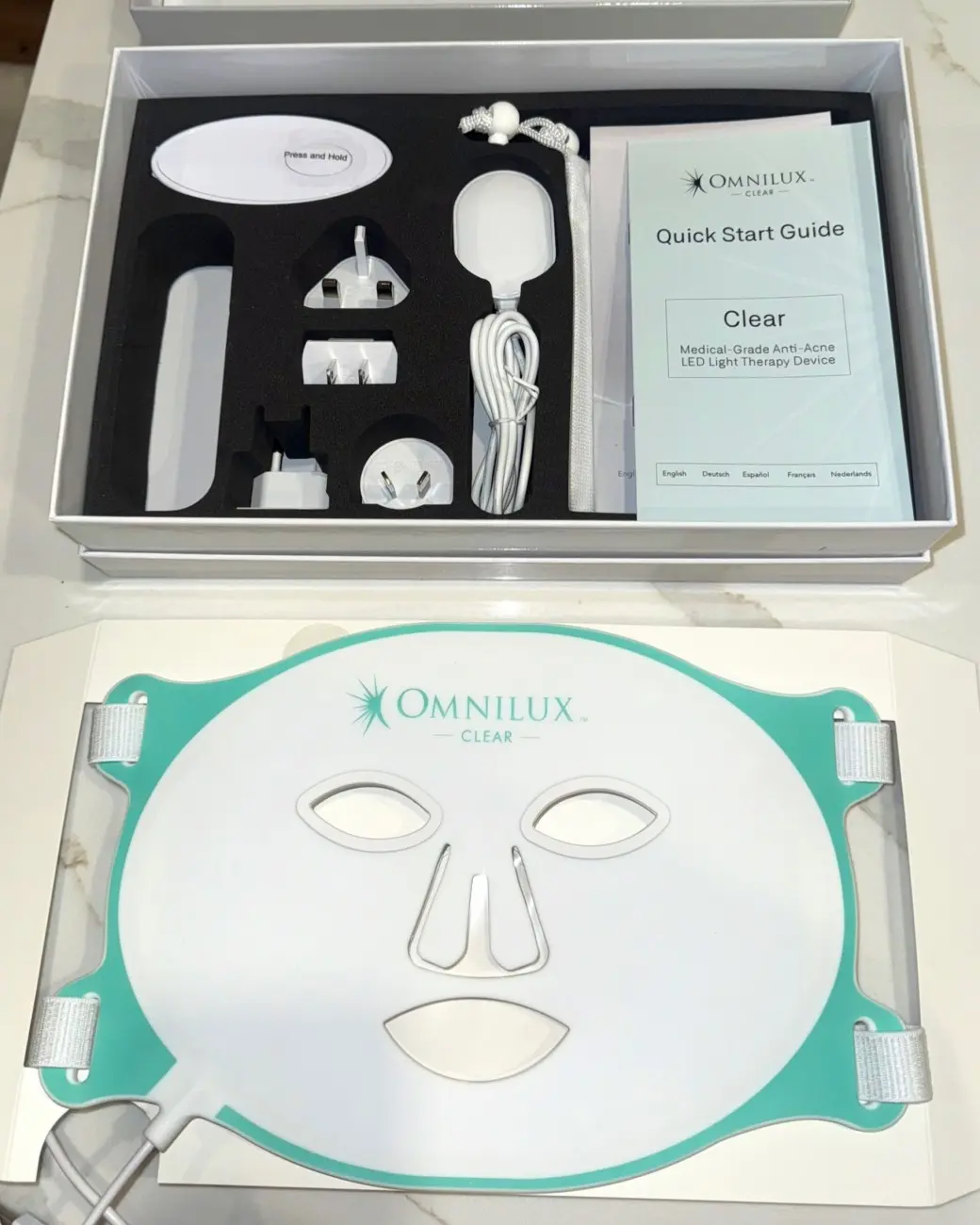
Comfort: 3.5/5
Fit, weight, heat, eye comfort and minor inconveniences: straps, timer, battery. A mask that becomes a chore to wear several evenings a week scores poorly in these areas, as using it should be a pleasant experience!
Read my comfort guideOn the face, it feels like the Contour Face: fairly comfortable, because the mask is light, but I feel some pressure on the nose because of the opening. It’s not really bothering, and 10 minutes 4 times a week is easy to fit into a week.
Do you need eye protection with the Omnilux Clear?
On this point, Omnilux has done things right this time, as there’s no need to wear additional glasses. The silicone eye protectors fit snugly around the eye openings and block out light effectively. I can keep my eyes open without any problem.
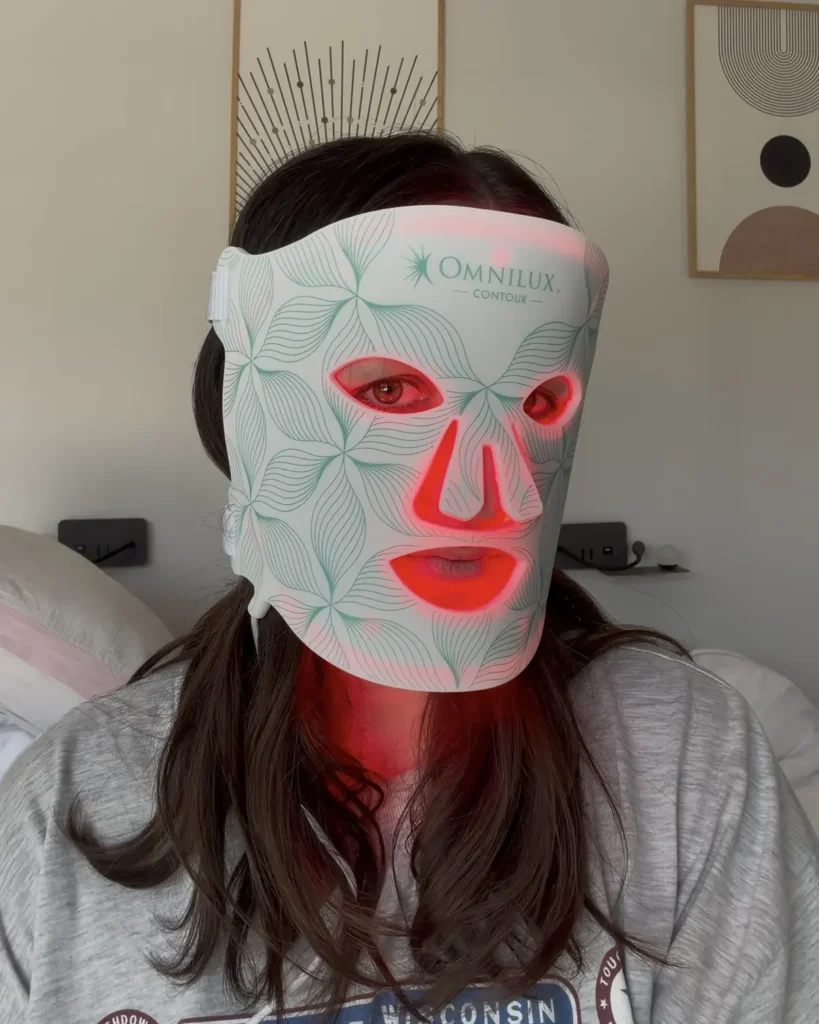
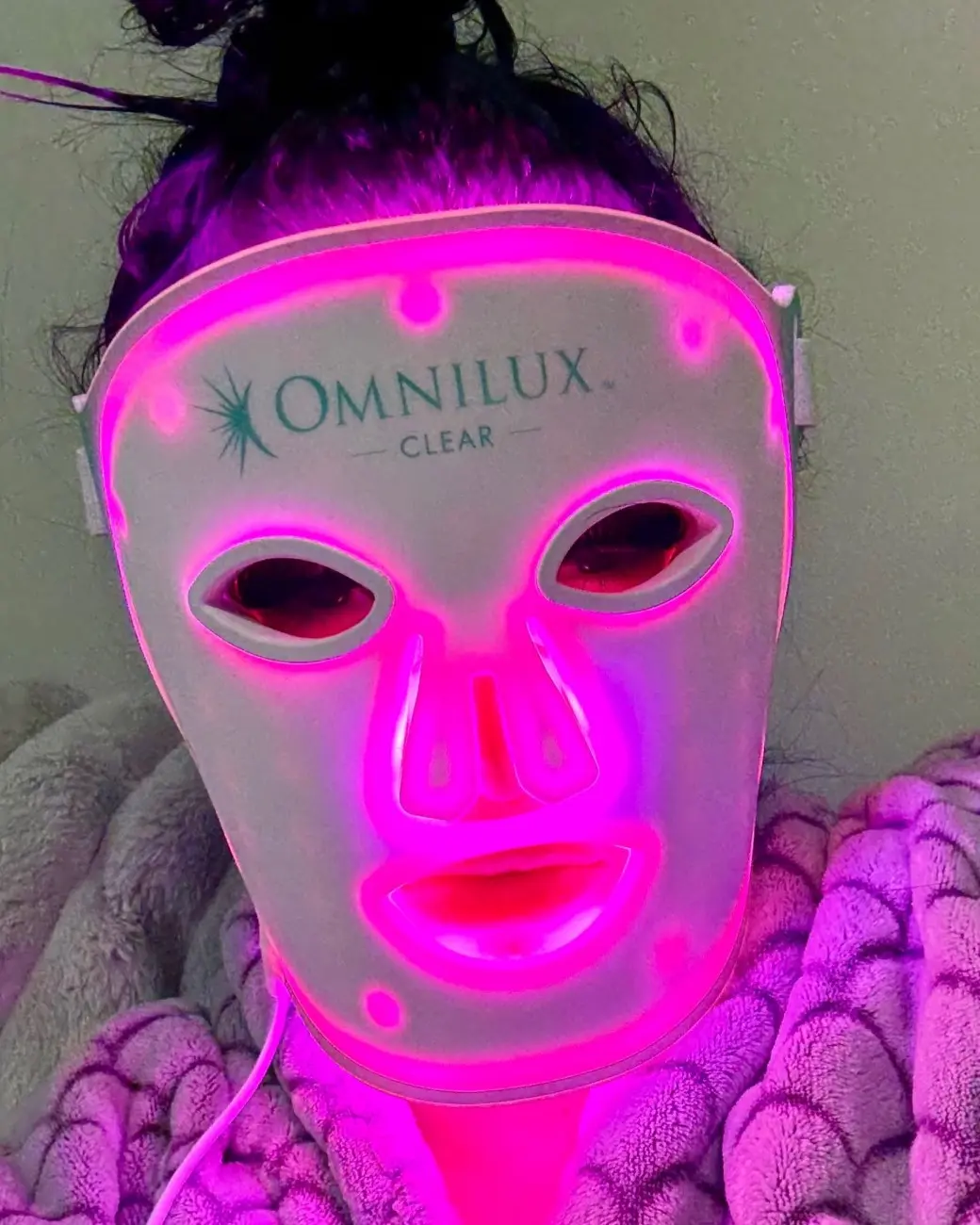
Personally, I always wear eye protection, and I’d recommend this kind of shield even on red and near-infrared masks, just for visual comfort.
Value: 2/5
The price I paid, when viewed in the context of the results achieved and compared to other masks I have tested, both within this price range and at different price points.
Read my value guideThe LED mask sells for $395, offering blue and red light without near-infrared, 66 light points on a flat panel, and no effect on my skin after a month.
Based on the features alone, it’s expensive for what it is, especially compared to other products on the market. For around $570, the CurrentBody Series 3 also offers blue light, as well as red and near-infrared light, with twice as many light points and a 3D mask shape.
Safety & support: 3.5/5
Eye protection, build quality, warranty, returns, responsiveness of customer support, and the mask’s ability to remain functional over time.
Read my safety & support guideThe Omnilux Clear does better than the Contour Face on the safety aspect, since the eye protection is in the mask and you don’t have to buy goggles. It’s FDA cleared, you get 2 years of warranty on the device and the controller, and Omnilux tells you not to use it more than 6 weeks in a row.
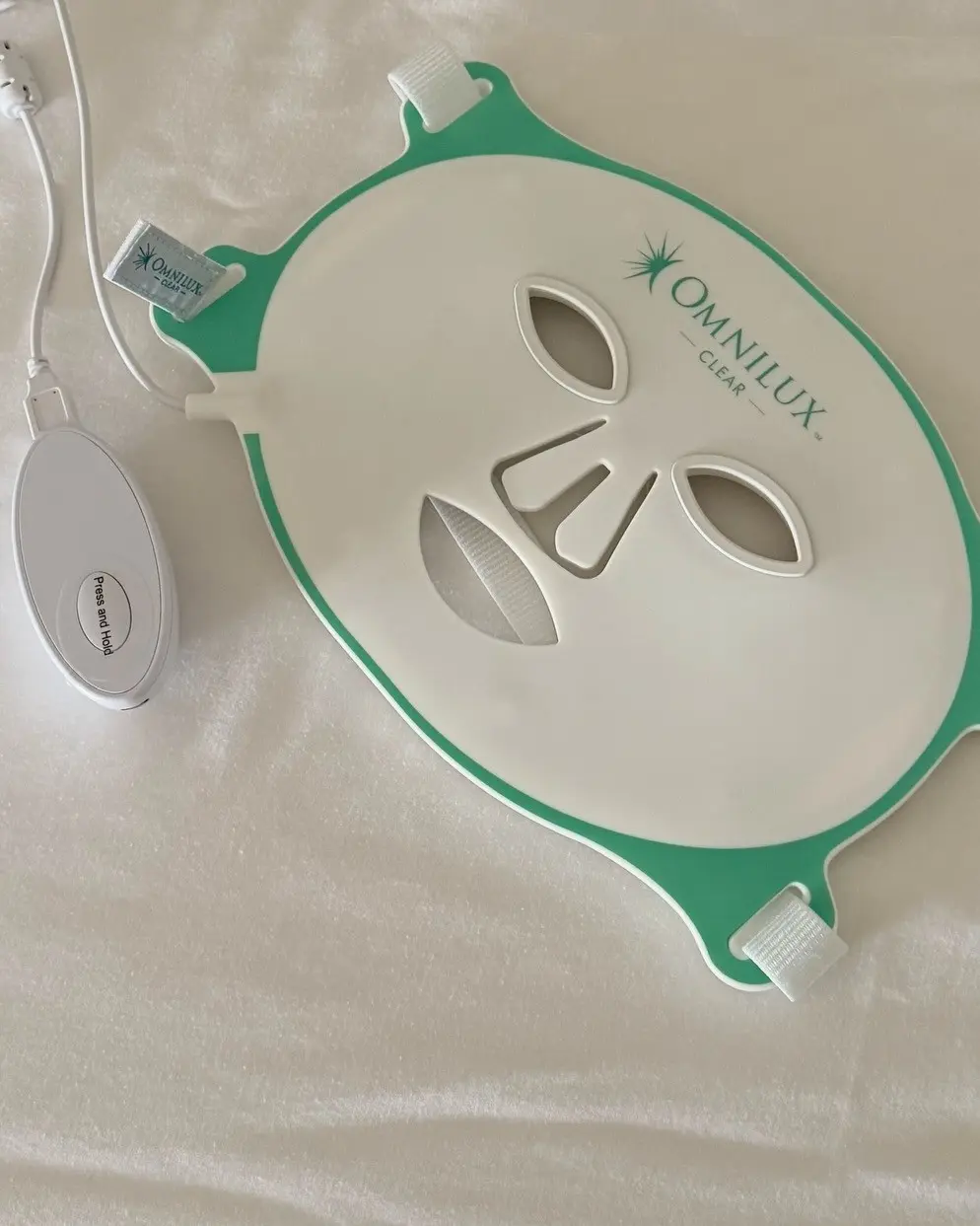
However, Omnilux only takes back unopened products within 30 days, so you can’t try it and return it. And the controller feels cheap, with its single Press and Hold button.
To be honest, this mask is starting to show its age, and the newer LED masks on the market are better made.
Who shouldn’t buy the Omnilux Clear
Skip this one if you recognize yourself
- Your breakouts follow your cycle. That’s my case, and a month of blue and red light changed nothing on them.
- You haven’t built a real acne routine yet. Start with topical care adapted to your acne, ideally with a dermatologist, before spending $395 on a light.
- You want anti-aging light too. There’s no near-infrared in the Omnilux Clear, and the red runs at only 16 mW/cm².
- Your spots are on your jaw and chin. A flat panel with 66 light points delivers the least light exactly there.
Am I still using the Omnilux Clear?
Updated November 2026. No. I stopped at 4 weeks, with no change on my skin, and picked my number one LED mask again, the Nooance Elite X600, to keep following its results.
I don’t recommend the Omnilux Clear. If you’ve already tried a lot of acne care, and really different products, and you still want blue light, take an LED mask that does red, near-infrared and blue.
The CurrentBody Series 3 (I tested it here) will suit you better than the Omnilux Clear. And if you don’t need blue, the Nooance Elite X600 (my review) is the one I use myself.
Omnilux Clear LED mask: your questions
Does the Omnilux Clear work on hormonal acne?
Not on mine. My breakouts get worse around my period, and after a month of sessions nothing had changed. The brand’s study doesn’t say how many of its patients had hormonal acne.
What’s the difference between the Omnilux Clear and the Contour Face?
The light and the eye shields. For acne, the Clear uses blue at 415 nm and red at 633 nm, while the Contour Face uses red and near-infrared for anti-aging, and only the Clear has eye protection built in. Both share the same panel and its 66 light points.
How often should you use the Omnilux Clear?
Omnilux recommends 4 sessions of 10 minutes a week for 6 weeks, and no more than 6 weeks in a row. I followed the 4 sessions a week and stopped after 4 weeks.
Is the Omnilux Clear worth $395?
Not for me. For blue light, I’d rather pay more for the CurrentBody Series 3, which adds near-infrared and more light points, and if you don’t need blue, I use the Nooance Elite X600 myself.
Test log
- Exact model
- Omnilux Clear, bought on the US site, 415 nm and 633 nm lit together
- How I got it
- Bought on omniluxled.com, $395. No affiliate link to Omnilux on this page
- Sessions
- 4 a week, 10 minutes, 4 weeks, 16 sessions.
- FDA file
- K210948, Omnilux CLEAR, GlobalMed Technologies, cleared 24 June 2021, product code OLP, OTC, mild to moderate acne vulgaris on the face. IEC 62471:2008 listed
- Study
- Ablon G., J Clin Aesthet Dermatol 2025;18(10):25-32, NCT06936332. Funded by GlobalMed Technologies

About Emilie
I have tested LED masks since 2023. I buy the devices, use them for weeks, and read the spec sheets nobody reads, because this market runs on numbers most brands never publish. Not a dermatologist, and I say so whenever a question needs one.