I buy the devices I test unless the article says otherwise. Some links and discount codes on this site are paid links: if you buy through one, I earn a commission. It never changes a score or a verdict.
An LED mask costs between $250 and $800 in the US, and the price tells you almost nothing about the light inside! I’ve paid $799 for 50 LEDs that never touch the skin, and $449 for 126 light points with a published irradiance and a study on the exact model.
So Value, on my grid, is the price compared to what the LED mask actually delivers, and to the masks I’ve already tested for the same money. Here’s how I read a price, what it buys on an LED mask, the comparisons I make before scoring, and 4 LED masks compared with the price in mind.
Value: One of the 7 criteria on my grid
Value is one of the 7 criteria that make up every score on this site. A few of you told me the grid was hard to follow from the reviews alone, so I’ve given each criterion its own page, with the masks I’ve tested as examples. Here are the 7, in the order of my grid from my How I test page:
- Results, 24% of the score
- Irradiance, 16% of the score
- Coverage, 14% of the score
- Proof, 14% of the score
- Comfort, 12% of the score
- Value, 12% of the score, this page
- Safety & support, 8% of the score
What the price of an LED mask actually buys
For every LED mask, I list what the money gets:
- The light first: light points, irradiance, whether the mask touches the skin.
- Then everything around the light: the shell and straps, the battery, the eye protection, the warranty, the study on this model.
- And finally the safety net, including the return window.

What justifies a high price is the actual amount of light delivered to the skin and the studies that prove it: a study conducted on the LED mask, high light density, calibrated power… But caution is advised because many brands play on numbers or features to inflate prices: a screen, an app, additional colors (which have no proven effect), cooling pads instead of LEDs…
For example, the Shark CryoGlow is a well-built device with an excellent remote control, but its value for money is poor for light therapy because its design prevents the LEDs from making direct contact with the face.
I compare the price of each LED mask in my tests
It’s difficult to assess a price without a benchmark, so I always compare it to a tested LED mask at the same price point and to other price ranges. This is an important point in my opinion because you can find better-designed LED masks at equivalent or even lower prices. And you can also see the compromises made compared to higher-priced models.

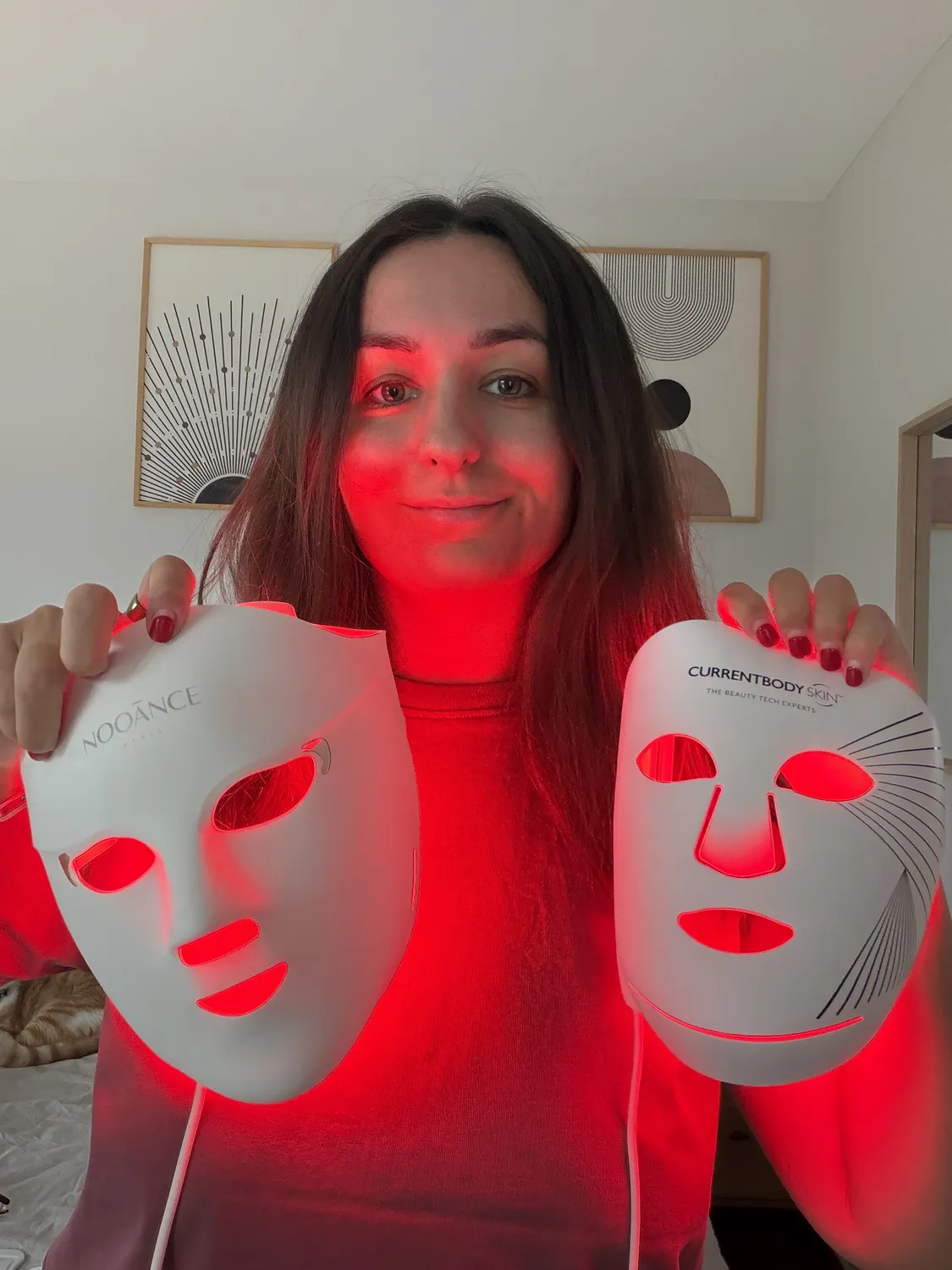
I always quantify the differences to be concrete: for example, the Currentbody Series 2 mask costs $279 less than the X600 but has 190 fewer LEDs and significantly lower irradiance (my Nooance VS Currentbody comparison).
The Series 3 costs $100 more than the Series 2 and offers three colors, an app, and a screen, but all on the same LED mask… (Currentbody Series 3 VS Series 2 here).

4 LED masks I assessed on value
- FOREO FAQ Swiss 202 $799
- Nooance Elite X600 $749
- CurrentBody Series 2 $470
- Nooance Aurion X252 $449
- iRestore Illumina $399
Best: Nooance Aurion X252
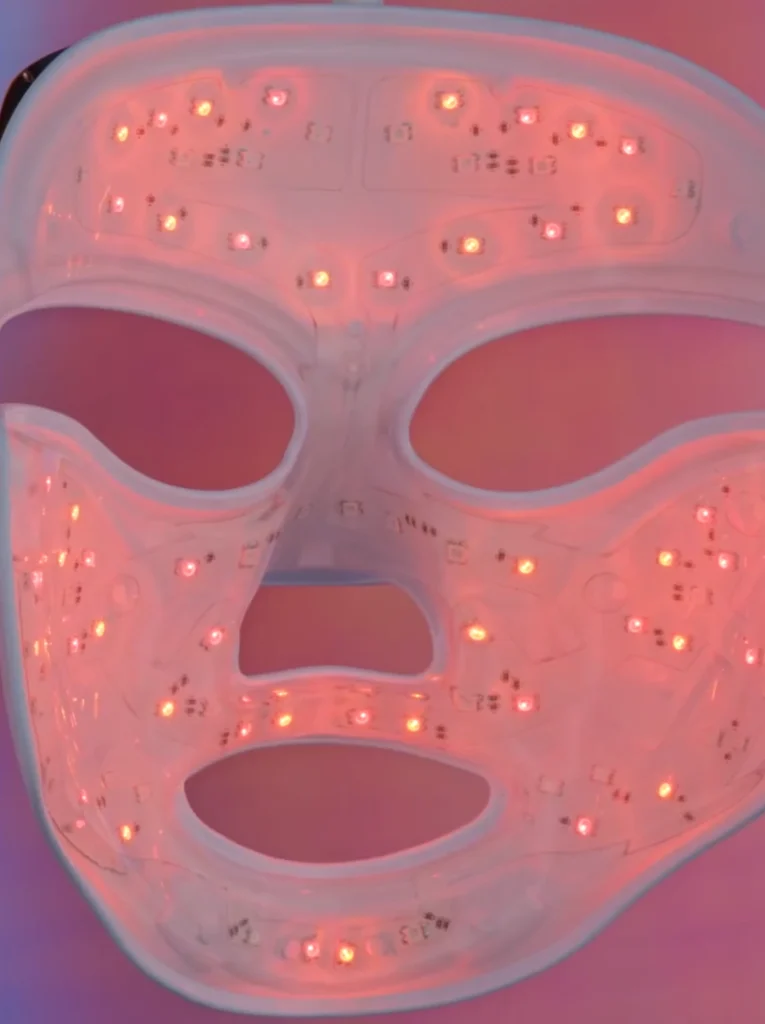
I paid $449 on Nooance’s US store, and for that you get 126 dual-core light points at 45 mW/cm², a GREDECO study on this model, an FDA file that names it, eye shields in the box and 2 years of warranty, on a thin rigid shell that still touches the skin.
On coverage it’s right at my minimum, and the Elite X600 is better on every line for $300 more. But if $449 is your budget, it’s the LED mask I’d buy: 4/5. My review of the Nooance Aurion X252 has the 8 weeks.
Okay: CurrentBody Series 2
At $470, this LED mask is pretty good: flexible molded shell, eye inserts, a 2-year warranty, and a clinical study on the model. However, it lacks light in the areas I’m most interested in: 110 points at 30 mW/cm², with cutouts around the nose and lips. Honestly, I’d rather pay this price for denser coverage, hence my 3.5/5 rating My CurrentBody Series 2 review lays out the details.
Mid: iRestore Illumina
The actual price is $399, as it’s still on sale. For that price, you get 120 LEDs on a rigid case that doesn’t stick to your face, but does have a visor that allows you to keep your eyes open. It’s overpriced for these features, and what saves it is the 100-day money-back guarantee. Rating: 3/5, see the details in my iRestore Illumina review.
Worst: FOREO FAQ Swiss 202
This one is honestly the worst I’ve tested in every aspect, including the price… The Foreo FAQ Swiss 202 is sold for $799 for a silicone sheet that doesn’t contain any LEDs! There are only 50 LEDs integrated into the headband, which diffuse light into the sheet.
There’s no information on irradiance, a study that uses an additional serum, and a strap with a goggle buckle… I absolutely do not recommend it, and you have all the details of my test in my FOREO FAQ Swiss 202 review.
If value is the criterion you care about most, sort my LED mask picker on it, and read my ranking of the best LED masks for the mask I would buy at each budget.
The mistakes I see buyers make when buying LED masks
Taking expensive for better. The $799 LED mask is the worst one I’ve tested. Price follows the brand’s marketing budget more than its light.
Taking cheap for a bargain. A $250 LED mask with no irradiance and 108 light points on a flat sheet isn’t cheap, it’s $250 for a routine that may do nothing. The question is always what the money buys.
Ignoring the return window. A brand that won’t publish its irradiance but gives you 100 days to return the mask at least lets you find out. A brand that only accepts returns of unopened masks doesn’t allow for proper testing.
LED mask prices: your questions
How much should a good LED mask cost?
Starting at $450, you can already find a very good value option that I’ve tested: 126 LEDs for a power output of 45 mW/cm² (published data) and a study on the model.
The best LED mask I’ve worn costs $749, and the worst, $799. Below $400, I haven’t yet found one I would recommend, mainly because the specifications are too poor below that price point.
Are expensive LED masks better?
Not always. In this market, the price is more closely linked to the brand than to the quality of the LED mask. When considering the price, what you should look for are the mask’s light points, documented irradiance with its measurement conditions, a shell that fits snugly against the face, a study on the model, and a warranty.
Is a multicolor LED mask worth more?
No, and that’s the marketing trap. Red and near-infrared are the wavelengths whose effectiveness has been proven. Blue is starting to show promise for acne, but it remains more complex. As for the rest, several brands themselves state that their other colors have no effect, and each additional color reduces the power of the LEDs that are actually effective. In my tests, no additional color showed any benefit…
Sources
- Prices
- Each brand’s US store, as paid or checked for the review linked above
- Checked
- November 2026

About Emilie
I have tested LED masks since 2023. I buy the devices, use them for weeks, and read the spec sheets nobody reads, because this market runs on numbers most brands never publish. Not a dermatologist, and I say so whenever a question needs one.