I buy the devices I test unless the article says otherwise. Some links and discount codes on this site are paid links: if you buy through one, I earn a commission. It never changes a score or a verdict.
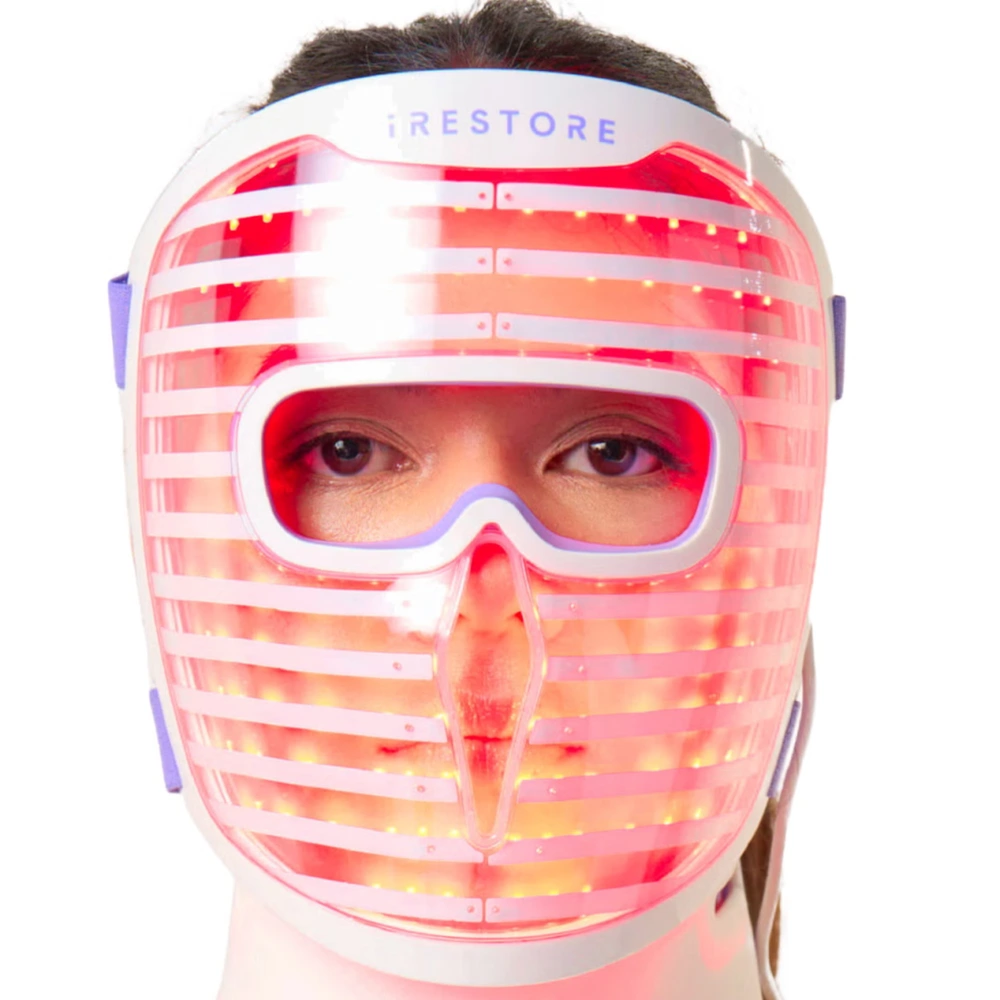
The iRestore Illumina LED Face Mask is sold as the one you can use with your eyes open, and I ran it for 8 weeks, 5 evenings a week, 40 sessions in all. It’s the only LED mask I’ve tested that treats the gap between the LEDs and your skin as a selling point rather than a problem.
So here is my full review, the score, and what I found in iRestore’s own clinical trial that isn’t on their product page.
49/100
Shelved since August 2026I ran the Illumina for 8 weeks and 40 sessions and got nothing I could photograph. It’s genuinely comfortable and you really can keep your eyes open, but that comes from a rigid shell hovering off your face and a wide visor with almost no LEDs behind it. iRestore publishes no irradiance, and the FDA clearance they point at belongs to their Chinese manufacturer.
Buy it if
- You want to read or move around during a session instead of lying still for 10 minutes.
- You want blue light and red light in the same 10 minutes without switching devices.
- You want a long window to test it on yourself, because the 100 day return is the best in the category.
Skip it if
- You want to know how much light lands on your face, because iRestore does not publish it.
- Your forehead and eye contour are what you are treating, since the eye visor sits right over them.
- You have a narrow jaw, as the shell sits too far off it to be worth much.
What I tested: the iRestore Illumina LED Face Mask
I tested the Illumina LED Face Mask, the $399 unit on iRestore’s own site. I own the bundle with the Neck & Chest device, which Costco sells as a pair for $699, but I left the chest panel out of this review because I don’t need it yet and I refuse to score something I haven’t used properly.
I paid for it myself and there is no affiliate link anywhere in this article. The $799 you see struck through on the product page is a list price the mask doesn’t actually sell at, so treat $399 as the real number.
I ran 5 sessions a week for 8 weeks, 10 minutes each, on Mode 1 and Mode 2. 5 sessions a week is what my grid calls for when a brand doesn’t publish its irradiance, and iRestore doesn’t, so I gave the mask the most generous schedule the grid allows rather than the 3 sessions their manual also accepts.
Results: 2.5/5
After 40 sessions I have nothing I can photograph. My tone didn’t shift, my pores didn’t tighten, and the two fine lines I’ve been photographing every Sunday morning are exactly the same.
That’s my face, not a verdict on yours, and 8 weeks is the short end of my window. I stopped there because nothing was moving in any direction, and I only extend to 12 weeks when something starts to appear.
What keeps this from being a 2 is that iRestore actually ran a study on this mask, and they registered it and posted the results where anyone can check them. Study NCT07025837 ran 12 weeks on 38 women aged 25 to 55, 36 of whom finished, sponsored by Freedom Laser and run by Citruslabs.
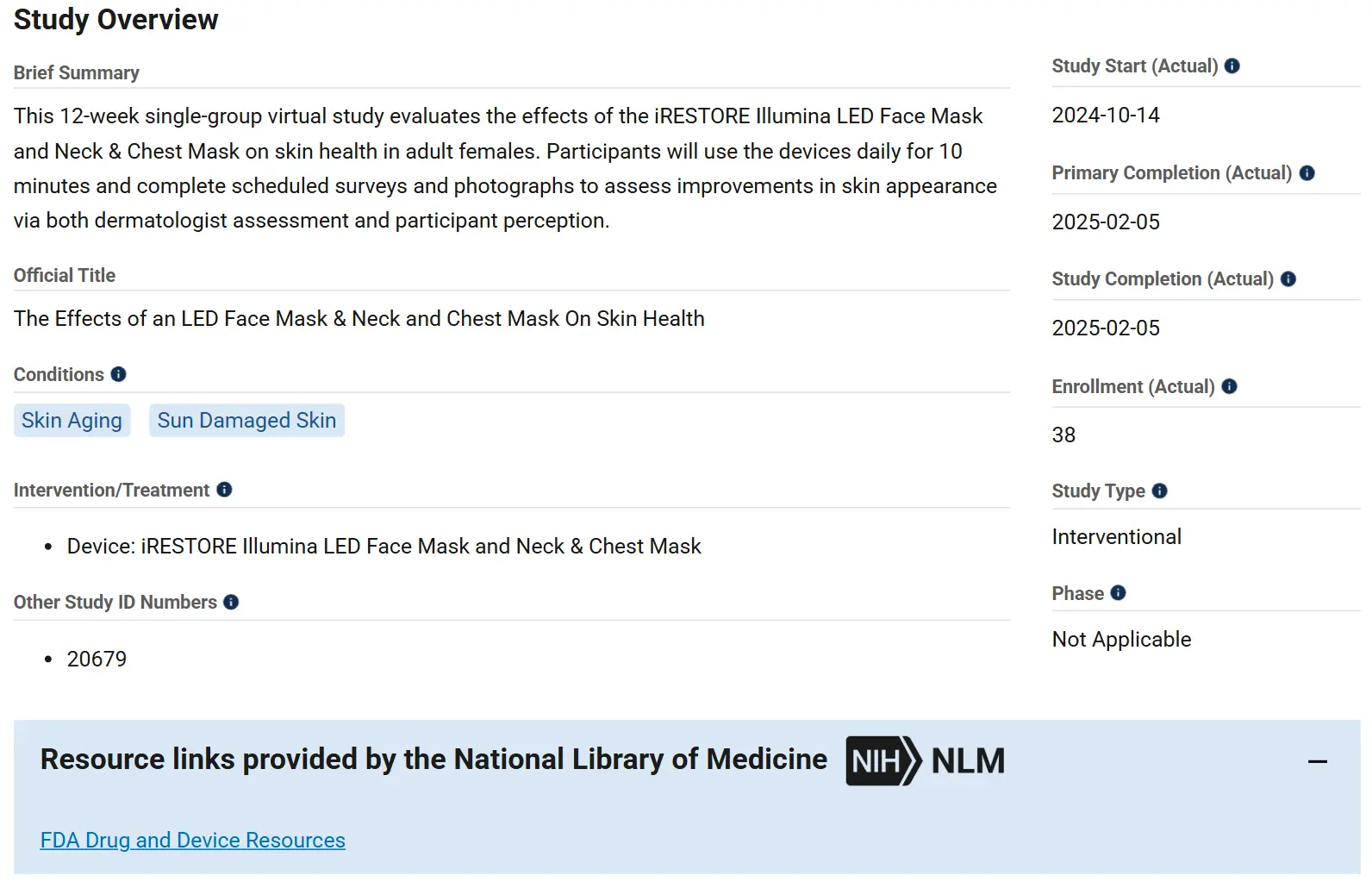
However, the study has several important weaknesses: on the dermatologist graded endpoint for fine lines and wrinkles, 17 women out of 36 improved, which is 47%, while the marketing headline on the same device says over 90%… which is a lie.
The other graded endpoints came in higher, at 81% for overall skin health, 72% for redness and 67% for pigmentation. But it’s all photos, with no instrumental measures and no macro-photography shared.
It also comes from a single group with no control arm and no blinding, where participants photographed themselves at home and dermatologists graded the photos, so there’s a lot of room for error in that process.
Irradiance: 1/5
I read the Technical Specifications block line by line and there’s no irradiance figure anywhere on it. You get three wavelengths, three modes, a LED count, a session length and a warranty, and not one number that tells you how much light reaches your skin. Irradiance is the light power, and its value (in mW/cm²) is key to assessing its effectiveness.
That matters more here than on most masks, because the Illumina is built to hover rather than touch. Light spreads as it travels, so every millimeter of air between an LED and your cheek is intensity you paid for and didn’t receive, and only the brand can tell you what’s left at the end of that gap.
As a reminder, a good LED mask (see how I test) needs an irradiance of 30 to 50 mW/cm², so a 10 minute session can provide 18 J/cm² to 30 J/cm², 3 to 5 times a week to reach around 90 J/cm² per week. The formula is:
Dose (J/cm²) = Power density (mW/cm²) × Time (s) / 1000
But since iRestore publishes nothing, my score reflects the silence rather than its power.
Coverage: 2/5
The shell is rigid, curved but rigid, and it bridges the face instead of following it, so the distance from LED to skin changes depending on which part of you is underneath.
iRestore doesn’t hide this, and their own comparison table lists “Hovers perfectly” for the Illumina against “Sticks on face” for Omnilux, Qure, Dr. Dennis Gross and CurrentBody. Selling the gap as a feature is fair on comfort, because it really is more comfortable, but it’s also why the light arrives weaker on the skin.
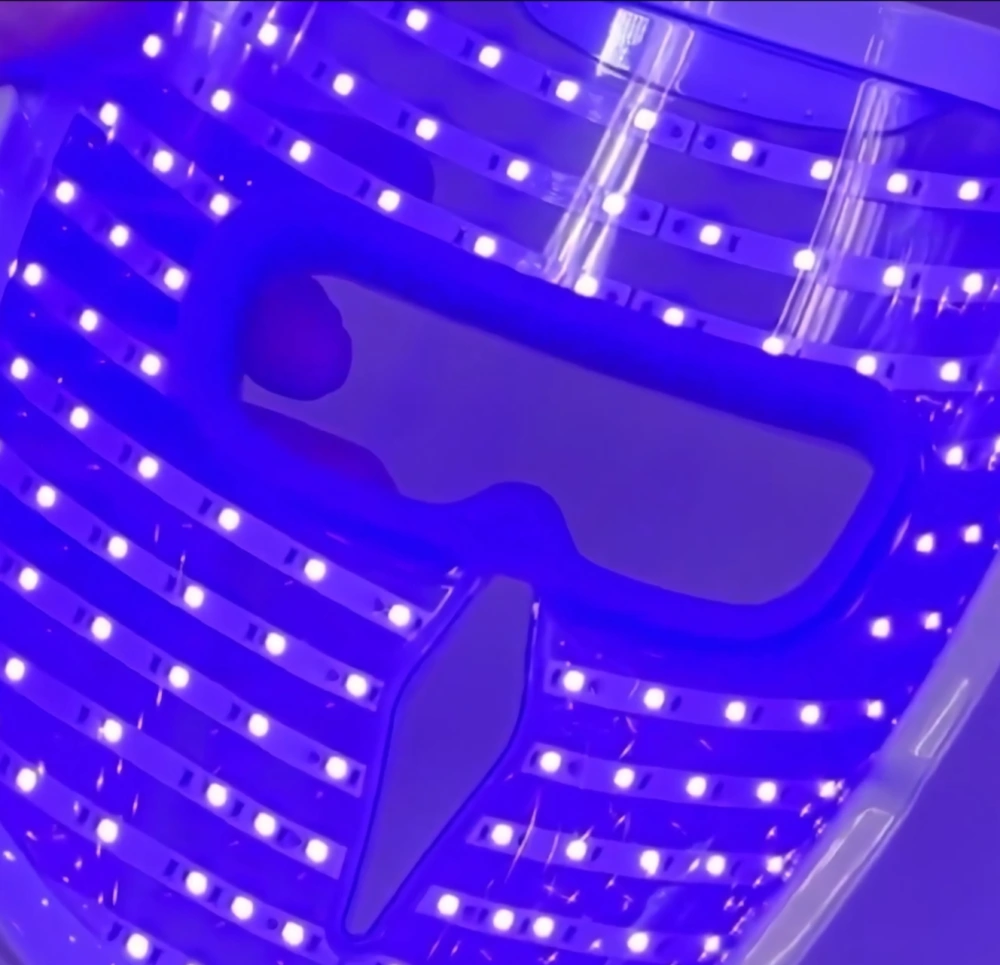
The second problem is the visor. That wide clear band across the eyes is what lets you keep them open, but it also removes most of the LEDs over the crow’s feet and the lower forehead, the zones that crease first on most faces.
You don’t have to accept that trade, since masks like the CurrentBody Series 2 (my own review) use built-in eye protection, so you keep your eyes open and the LEDs stay over your eye contour.
The third issue is size, because the Illumina is a large shell: on a narrow face like mine the jaw and chin sit a long way from the LEDs, and the underside of the chin gets nothing at all since the shell stops above it.
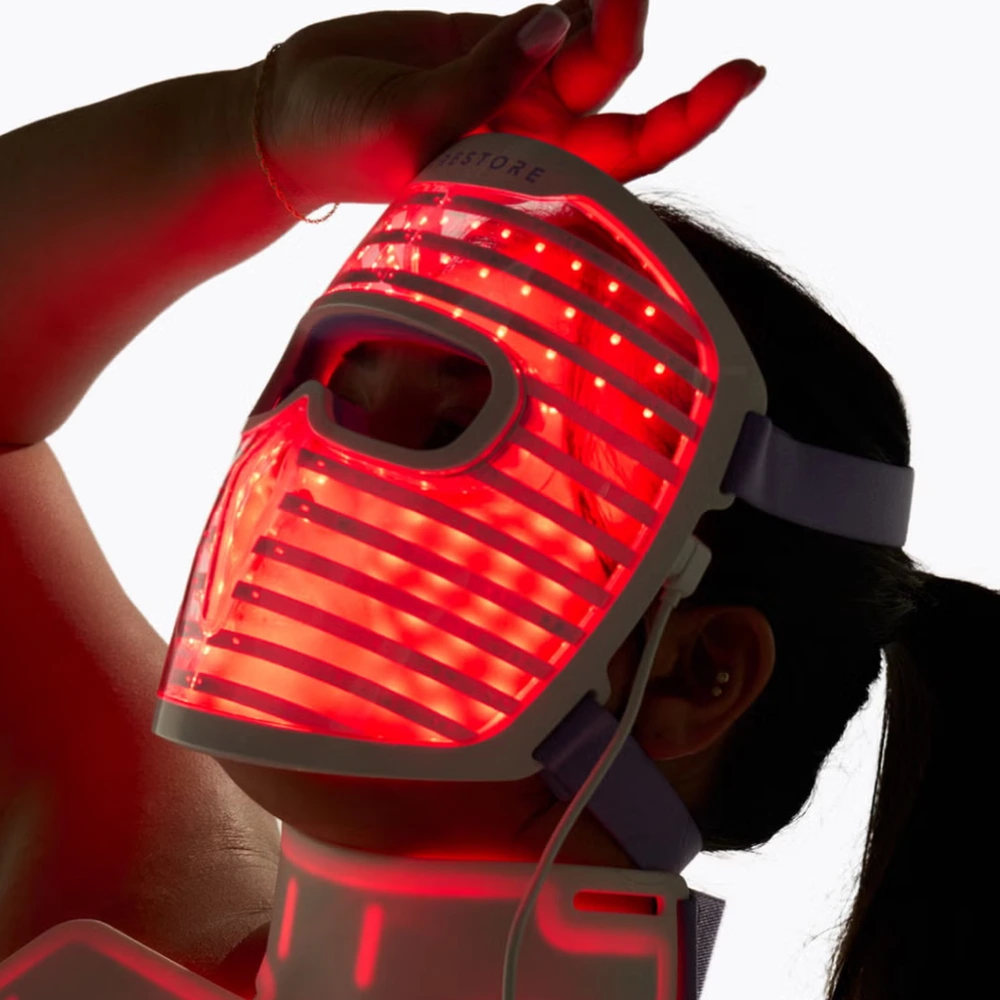
iRestore Illumina LED count: is it 360 LEDs or 120?
This matters, because more LEDs means better coverage: the beams overlap instead of leaving gaps, the treatment is even across the face, and the photon density goes up.
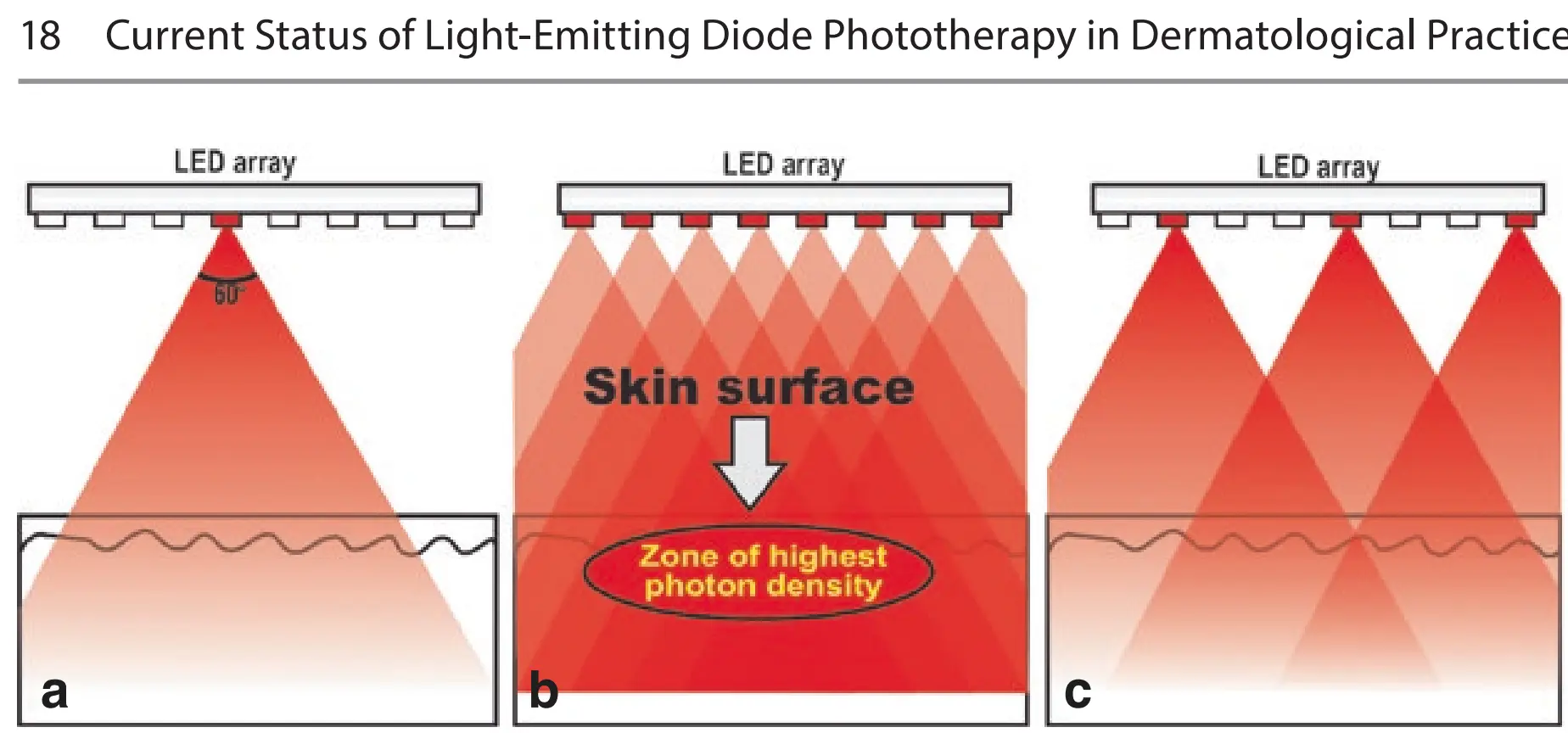
On the iRestore Illumina there are 120 LEDs on the shell, and each one contains 3 light chips, one red, one infrared and one blue. That’s how you get to the 360 LED chips printed on the box.
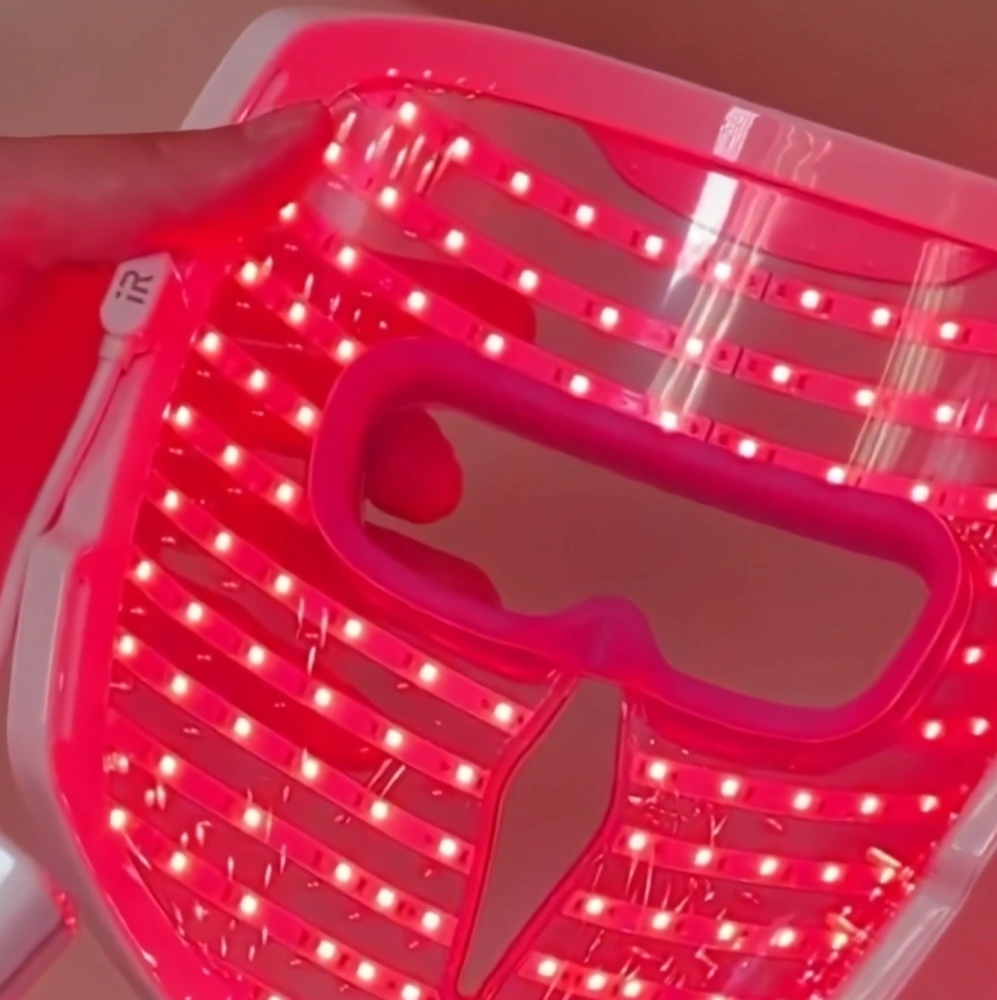
The whole category counts light chips, so iRestore is following the convention rather than inventing it. But 120 LEDs is the number that decides whether the beams overlap on your face or leave dim patches between them, and CurrentBody counts the same way with its 236 chips on 110 LEDs. As a reference, the Nooance Elite X600 that I have tested here, has 600 dual-core LED for 300 light points.
Proof: 3/5
What the brand publishes
- Published: Wavelengths in nm: 635, 830, 415
- Missing: Dose per session in J/cm², which needs an irradiance figure they do not print
- Missing: An FDA clearance number for this mask
- Published: A clinical study on this exact model: NCT07025837
- Published: Study documented: 38 enrolled, 12 weeks, Citruslabs named
- Published: Photobiological safety: IEC safety tested
- Published: Warranty and returns: 1 year, 100 day money back
Proof: 3/5
iRestore takes 5 of the 7 points, and the registered trial is genuinely better than what most of this category offers, since posting your own results where anyone can check them is a real commitment. What pulls the score back down is that the two headline claims on the product page are misleading, and most importantly, there’s no info at all on the irradiance (light power).
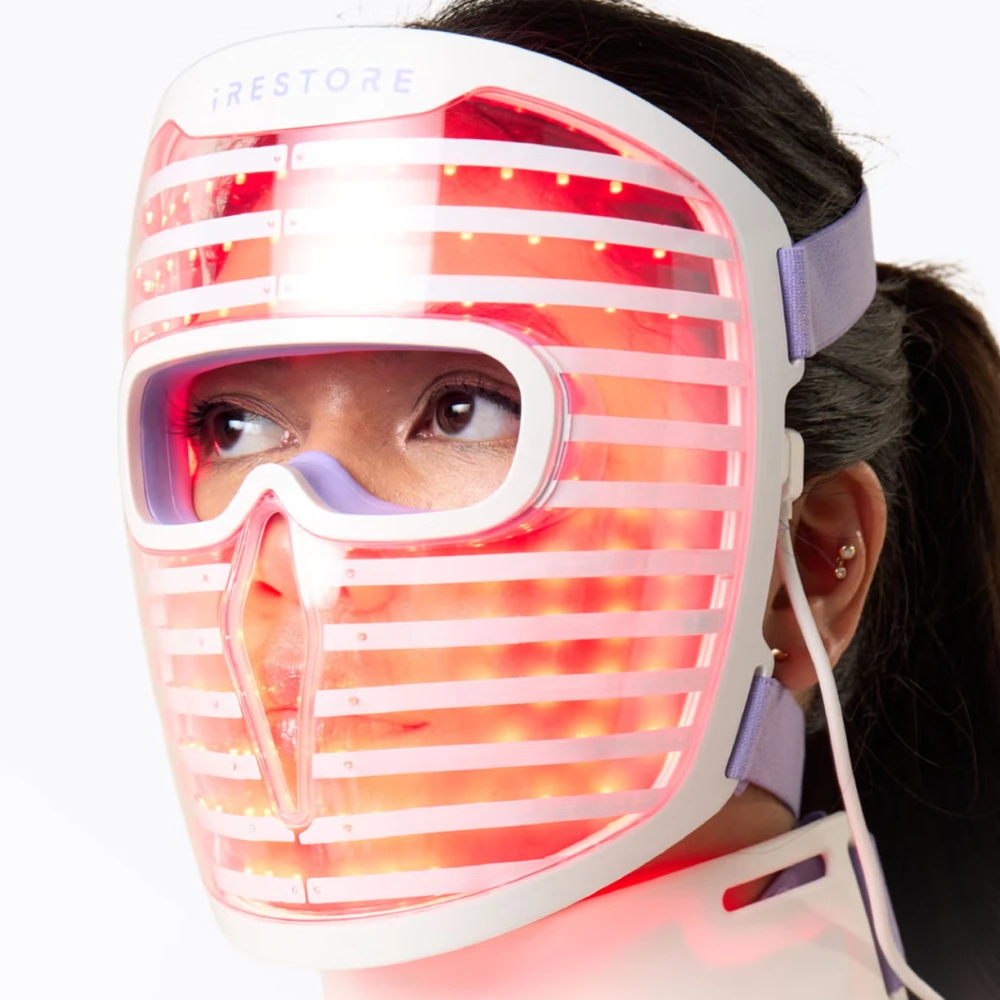
Is the iRestore Illumina LED mask actually FDA-cleared?
No, and it took me an afternoon to pin down. The product page carries a badge reading “Cleared Technology” rather than “FDA-cleared”, and iRestore’s own social posts spell out what sits behind it: “Built on FDA 510(k) Cleared Technology (K250830)”.
K250830 isn’t iRestore’s file. The applicant is Shenzhen Sungrow Led Technology Co., Ltd., decided 9 June 2025, product code OHS under 21 CFR 878.4810, and the device name lists 13 model codes: G15, G15P, G15K, G11P, G11, G10, G13, G14, G17, VISO, PRANA, Chin2Chest and BBL-FACEMASK.
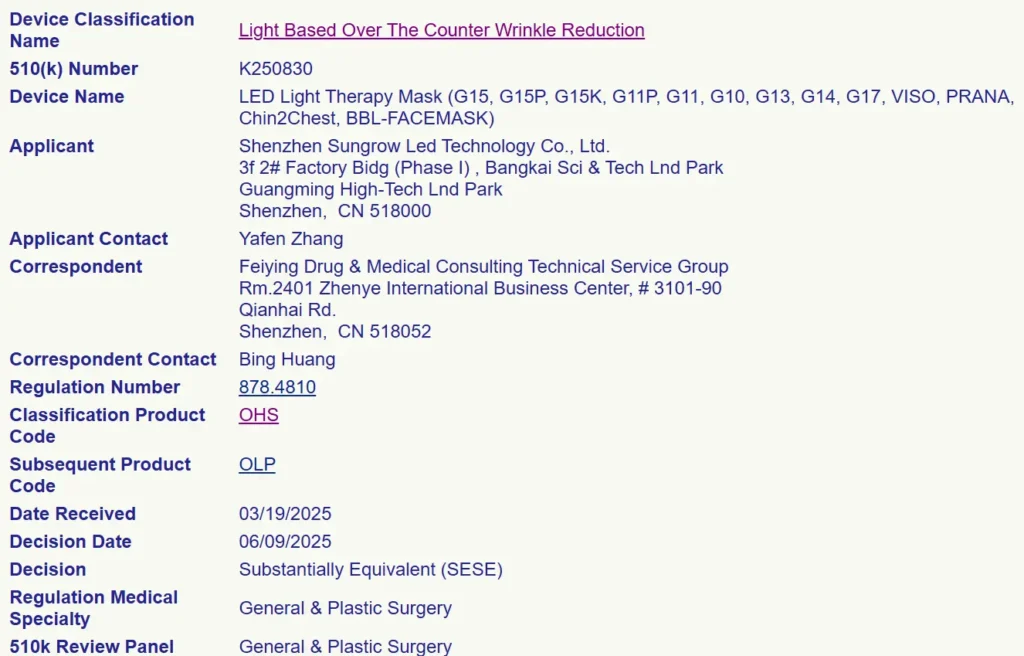
You can even pull up the page of that Shenzhen company on Alibaba: it’s a Chinese manufacturer selling LED masks to any brand that wants to put its name on one, which is what the industry calls “white labelling“.
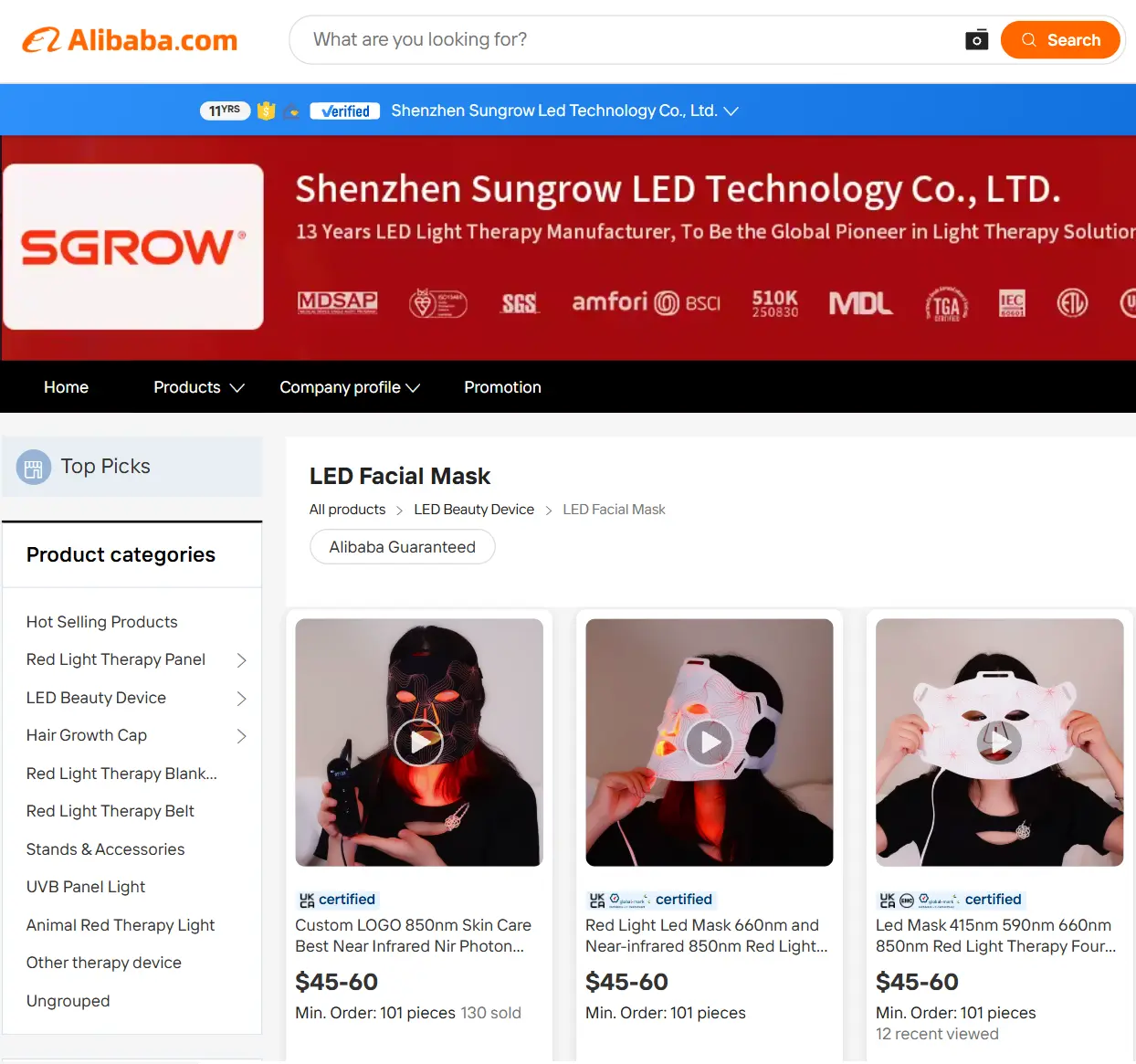
What matters is whose name is on the file, and Illumina isn’t on that one. iRestore’s parent company, Freedom Laser Therapy, does hold 4 clearances of its own, K151662, K183417, K213094 and K222081, and every one of them is product code OAP for hair growth, not a face mask and not wrinkles.
The strongest confirmation comes from iRestore themselves: on the clinical trial they registered for this mask, the sponsor ticked “Is FDA regulated device: No”.
Where does the 83% acne figure come from?
I honestly don’t know, because it isn’t from the registered trial, the only study iRestore names for this mask. That study ran Mode 1 only, red and infrared, so the 415 nm blue light was never switched on for a single participant.
Acne wasn’t one of its endpoints either, and the study ran 12 weeks rather than the 8 weeks the claim cites. So a number about blue light, on a timeline that doesn’t match, sits next to a study where the blue light stayed off, and I can’t find the source it does come from.
Comfort: 3/5
At 181 grams, this is a light LED face mask, and the 10 minute session with an automatic cut off is short enough that it slots into an evening instead of taking one over. I genuinely liked wearing it.
Two things bother me, though. The bridge of my nose is sore by the end of every session, since the nose cutout is narrow and the dual strap system pulls the shell down onto it as you tighten the second strap.
The other is the magnetic power connector, which is a lovely idea until you brush against it: it pops off, and on a 10 minute timer that means restarting rather than resuming. I lost a session more than once just by turning my head toward the mirror.
Can you really keep your eyes open in the iRestore Illumina?
Yes, and it’s the best thing about this mask. The visor is wide enough and diffuse enough that I could read, answer messages and cook through a session without squinting once, and I never finished one with that ache behind the eyes a badly shielded mask leaves.
Value: 3/5
At $399 the Illumina is priced too high. The shell is properly made, the silicone hasn’t yellowed, and the battery sits in the detachable controller rather than inside the mask, but the most important criteria aren’t met.
No irradiance, no dose, no clearance of its own, and a low number of LEDs. For about $637, the price of a Nooance Elite X600 with my Nooance discount code, you get 300 emitters, a published irradiance and a clearance in the brand’s own name.
The 100 day money back guarantee is what rescues this score, and it’s the honest way to read the offer: iRestore can’t tell you the dose, so they give you 3 months to find out on your own face.
Safety & support: 3.5/5
The eye visor is the safety story here, and their registered trial backs it up: 1 participant out of 38 reported dry eyes, with no serious adverse events across 12 weeks of daily use.
Support is where it slips. The warranty is 1 year, with 3 years offered as a $49 upgrade, on a product whose own marketing promises it will last for years, and two of the competitors in iRestore’s own comparison table ship 2 years as standard.
Against that, the returns policy is excellent and the company has been shipping light therapy devices since 2016, with 4 FDA clearances on the hair growth side of the business. They know how to file a 510(k), which is why its absence on this mask bothers me.
Who shouldn’t buy the iRestore Illumina
Skip this one if you recognize yourself
- Your forehead and eye contour are what you are treating. The visor sits exactly there, and masks with built-in eye protection cover those zones without asking you to shut your eyes.
- You have a narrow face or a fine jaw. The shell is sized large, so your jaw, chin and the skin under it sit further from the LEDs than anyone else’s.
- You want to know the dose you are getting. iRestore publishes wavelengths and a LED count and stops there, so no amount of reading will get you a J/cm² figure.
- You bought it because a headline said FDA-cleared. That badge belongs to a Shenzhen factory’s file for other models, and iRestore’s own trial paperwork says this is not an FDA regulated device.
- You already own a mask that sits against your skin. You’d give up light on your skin to gain comfort you already have.
Am I still using the iRestore Illumina LED mask?
Updated August 2026: No. I finished the 8 weeks and the mask went back in its pouch. The Neck and Chest panel is still in the box, and I’ll get to it when I have a reason to.
What I still want to know about the iRestore Illumina
One number would change this whole review, and it’s the irradiance measured at the skin. If iRestore published it with the distance it was measured at, the Irradiance score moves and the Coverage argument becomes arithmetic instead of observation.
The second is where the 90% wrinkle figure comes from, since the trial iRestore registered on this mask reports 47% on the graded endpoint. Their product page doesn’t source it anywhere, and iRestore is the only party who can.
If you like the idea of keeping your eyes open, you don’t need this shell to get it. Look for built-in eye protection instead of a bare window, because it’s well executed on the serious references and it doesn’t cost you the LEDs over your eye contour.
That’s the version of this mask I’d actually want, and the masks I’ve scored so far get closer to it than the Illumina does.
iRestore Illumina LED mask: your questions
Is the iRestore Illumina LED face mask FDA-cleared?
No. iRestore uses the phrase “Cleared Technology” and cites K250830, which belongs to Shenzhen Sungrow Led Technology Co., Ltd. and names 13 model codes that don’t include Illumina. On their own registered clinical trial, iRestore answered that this is not an FDA regulated device.
What is the irradiance of the iRestore Illumina?
iRestore doesn’t publish one anywhere, including in its own Technical Specifications. A good LED mask sits in the 30 to 50 mW/cm² band my grid treats as useful, and without that figure you can’t calculate the dose a session gives you.
Does the iRestore Illumina really have 360 LEDs?
It has 120 LEDs, each containing 3 light chips, which makes 360 LED chips in total. The whole category counts chips this way, so it isn’t a trick, but 120 is the number that decides whether the beams overlap on your face.
How long does it take to see results with the iRestore Illumina?
iRestore says 6 to 12 weeks. I ran 8 weeks and 40 sessions and photographed no change, while their own 12 week trial found improvement in fine lines for 17 of 36 participants under dermatologist grading.
Can you keep your eyes open with the iRestore Illumina?
Yes, the clear visor is wide enough to read and move around through a session. The catch is that the visor is the part of the shell with almost no LEDs behind it, and masks with built-in eye protection give you the same freedom without that trade.
Test log
- Exact model
- iRestore Illumina LED Face Mask, US version, face mask only
- How I got it
- Bought on iRestore’s US site, $399 plus tax. No affiliate link in this article, no contact with the brand
- Test window
- June to August 2026, 8 weeks
- Sessions
- 5 evenings a week, 10 minutes, 40 in total. Modes 1 and 2
- Why 5 a week
- iRestore publishes no irradiance, and my grid sets the frequency at 5 when the figure is missing
- Photo protocol
- Same camera, same lamp, same distance, Sunday mornings, no makeup
- Sources checked
- FDA 510(k) database for K250830 and for Freedom Laser Therapy, checked 21 August 2026. ClinicalTrials.gov NCT07025837, results posted 14 October 2025. iRestore product page and Technical Specifications, read 21 August 2026
- Not tested
- The Illumina Neck & Chest device, which I own and have not used enough to score

About Emilie
I have tested LED masks since 2023. I buy the devices, use them for weeks, and read the spec sheets nobody reads, because this market runs on numbers most brands never publish. Not a dermatologist, and I say so whenever a question needs one.