

I buy the devices I test unless the article says otherwise. Some links and discount codes on this site are paid links: if you buy through one, I earn a commission. It never changes a score or a verdict.
I tested the Qure Q-Rejuvalight Pro Facewear for 4 weeks, 5 evenings a week, and I stretched every session to 9 minutes because the 3 minutes Qure recommends felt like nothing. It’s the LED mask with 5 colors, an app, and a session shorter than brushing your teeth, which is exactly the pitch that made me want to check it.
So here is my full review after testing it, with the score, what I found in its FDA file, and why I don’t recommend it.
42/100
Shelved since September 202620 sessions of 9 minutes over 4 weeks, and my skin didn’t move. The 160 LEDs are 80 bulbs (light points) on a mask too small for most faces, and the 3 study figures come from other devices. Qure does not provide any data on irradiance, and its specifications fall well short of those on the market…
Buy it if
- You want a 200 g LED mask with eye inserts that let you keep your eyes open.
- You want blue light and red light in the same device, and 3 minutes is all you’ll ever give it.
Skip it if
- You want light on your whole face.
- You want a dense LED layout, since 80 bulbs is among the lowest counts I have tested.
- You want a clinical study run on the LED mask you’re paying for.
What I tested: the Qure Q-Rejuvalight Pro LED mask
The exact model is the Q-Rejuvalight Pro Facewear, model P19-0023, the only LED face mask Qure sells. I bought it on Qure’s US site at $399, with no contact with the brand. Qure later gave me a discount link that you can access here, but I do not recommend to buy this LED mask as you will read below.
Qure’s protocol is 3 minutes once a day, and the LED mask switches itself off at 3 minutes. I ran it in the Skin Rejuvenating preset, and I never used the Skin Clearing, because I don’t run blue light on my skin. After the first evening I decided that 3 minutes was too short to give it a fair chance, so I relaunched it twice each time and did 9 minutes, 5 evenings a week.
Results: 2/5
What changed on my face following my test, including my before-and-after photos. I also evaluate the “before-and-after” examples provided by the brand being tested, as well as the results of any studies that may have been conducted on the mask.
Read my results guideMy own results and before & after
After 20 sessions I have nothing to show: same tone, same pores along the nose. I didn’t expect wrinkles to fade considering I don’t have any, but I expected at least a hint on tone, and there was none. But I was convinced I wouldn’t get any results given the low power of the LEDs, so I didn’t continue the treatment then.
A trial is only worth continuing beyond the first month if results start to appear. In this case, however, the dose per session was low, coverage was partial, and I was only spending 9 minutes on it each evening, while my usual LED mask sat at the bottom of a drawer.
Qure’s before and after
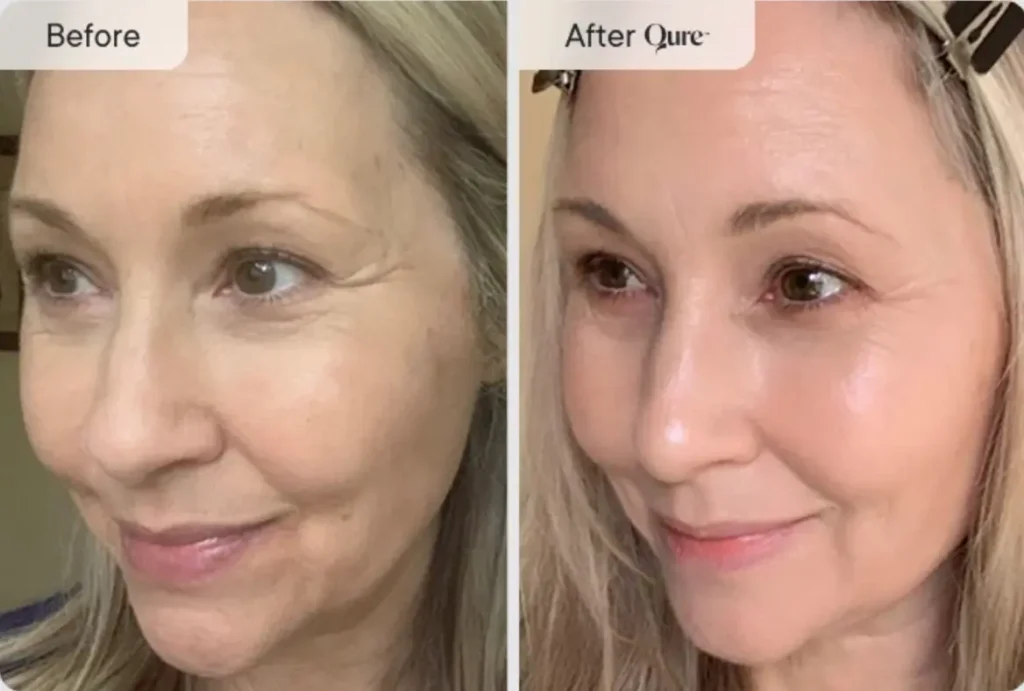
The before and after Qure publishes is the kind I can’t use. Its 2 photos are shot by a customer and not by a profesionnal, with no dates and no protocol. Moreover, the woman does not have a neutral expression…
A good “before-and-after” consists of a macro photograph taken on specific dates, ideally accompanied by test results from a recognized laboratory.
Irradiance: 2.5/5
How much light reaches the skin, in mW/cm²? I evaluate this value, as well as how the information is presented, the conditions under which it was measured, and the total dose received in a single session. If the brand does not communicate it, I give it a severe rating.
Read my irradiance guideThe product page for the Qure LED mask does not list any irradiance values. However, these figures are included in the FDA summary (file K230042):
- 15 mW/cm² of amber light at 605 nm,
- 20 mW/cm² of red light at 630 nm,
- 25 mW/cm² of dark red light at 660 nm,
- and 10 mW/cm² of near-infrared light at 880 nm,
- For a theoretical total of 70 mW/cm² in “wrinkle” mode and 45 mW/cm² in “acne” mode.
But in reality, the combined power levels vary because a single chip cannot emit each wavelength at full power simultaneously. And the documentation does not specify where this value was measured: at the LED, at the skin, or at a certain distance between the two.
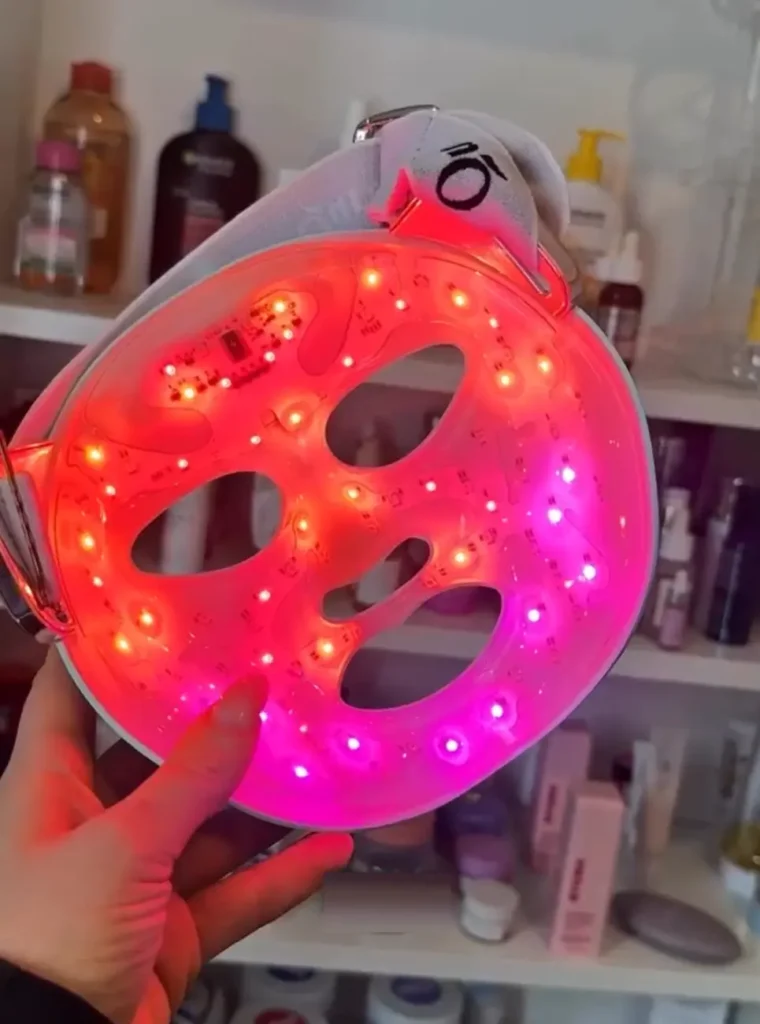
Still, Qure’s red at 630 nm alone is 20 mW/cm² of irradiance, which is similar to CurrentBody Series 2 and well below the 35 mW/cm² Nooance gives, measured at skin level. So I’m disappointed because Qure seems to have the data but isn’t sharing it.
Finally, even if Qure delivers 70 mW/cm², the recommended 3 minutes deliver about 12.6 J/cm². Most light therapy studies sit around 30 J/cm² per session for results, and that gap is why I tripled the session length.
Coverage: 1.5/5
How many points of light does the mask actually feature, how evenly are they distributed, and which areas remain uncovered? Note that I am counting “bulbs” and not LEDs, because the number of LEDs often includes two, three or more diodes per bulb, which inflates the apparent coverage area.
Read my coverage guideQure LED mask: 160 LEDs or 80?
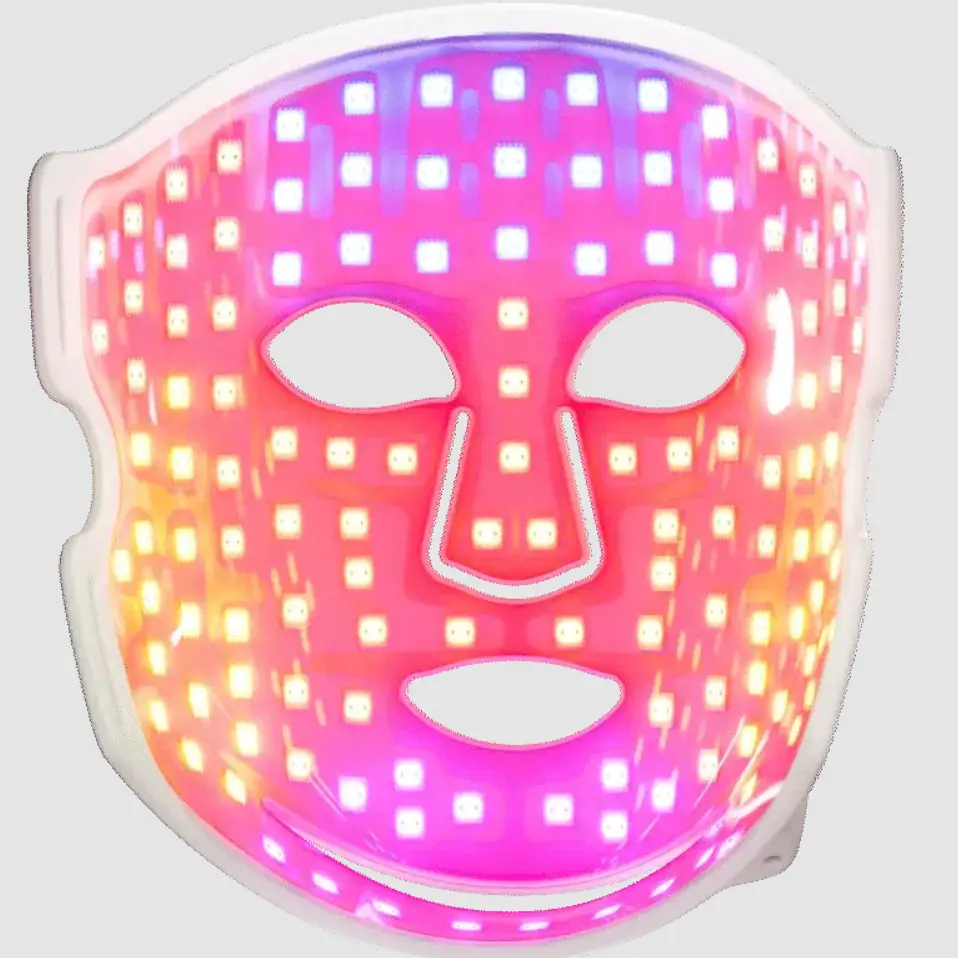
Qure advertises 160 dual-core LEDs: that’s 80 bulbs with 2 chips each. The FDA file gives the split with 30 bulbs carry red plus blue, 25 carry red plus amber, and 25 carry deep red plus near-infrared.
So 80 is the number to compare, although on the Qure LED mask I count 46 bright points, and I have to look closely to find the smaller ones that make up the 80.

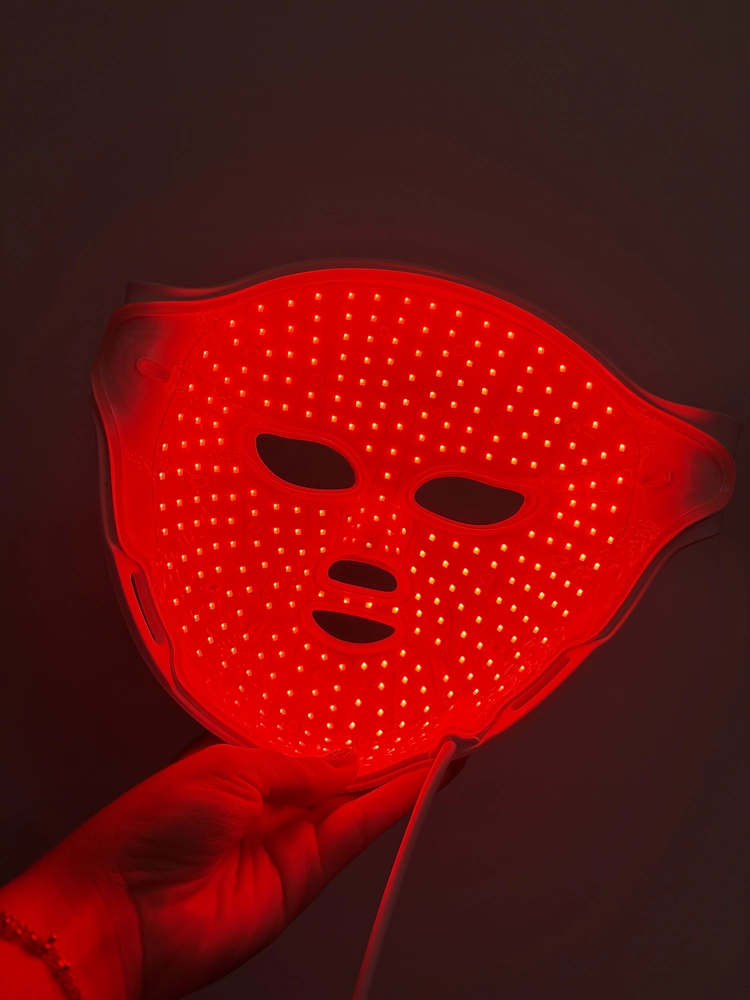
For scale, the CurrentBody Series 3 has about 125 light points and the Nooance Elite X600 has 300. Fewer emitters means the beams stop overlapping on the skin and leave gaps between them. Here the gaps are wide enough to see with the naked eye.
The Qure LED mask is too small for most faces
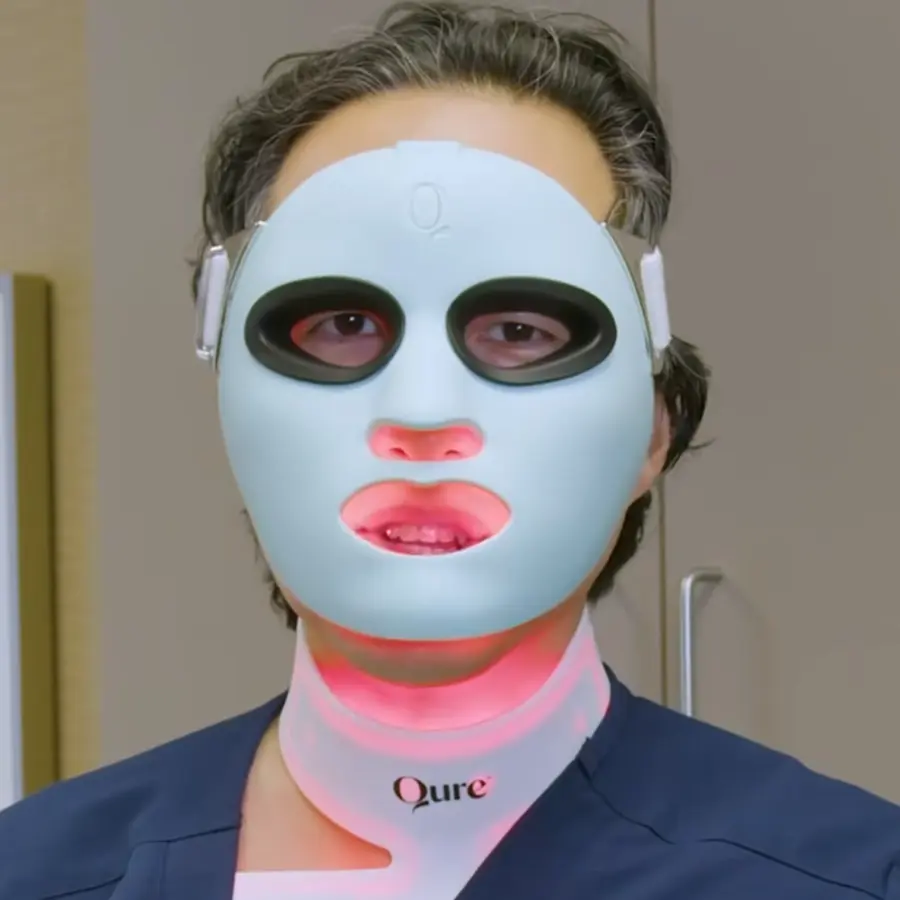
The second problem is the shape. The shell is hard, so it does not properly sit on the face, and it’s small: on my face the top edge lands well below the hairline and the lower edge sits on the chin, so the upper forehead and the jawline get nothing.
Proof: 2.5/5
What the brand clearly displays and what I check in the FDA file: wavelengths (in nm), emitted dose, FDA clearance number, product study, safety tests, warranty.
Read my proof guideThe clinical study on Qure LED mask
Results supported by light therapy studies… Qure’s own page cites the papers, and they are not related to Qure LED mask itself :
- The 87% is Barolet 2009, a split-face study on a pulsed 660 nm device.
- The 83% for breakouts matches Goldberg and Russell 2006, 24 people on blue 415 nm and red 633 nm, with 20-minute sessions.
- The skin tone figure comes from Russell 2007, on 633 plus 830 nm.

None of the 3 was run on the Q-Rejuvalight Pro, and the acne one was run at more than 10 times the blue dose this LED mask delivers in its 3 minutes. The FDA file confirms it from the other side: the safety section lists bench testing only. So when the product page says 87% of users reported smoother wrinkles, the users in question were wearing something else.
Furthermore, the studies cited are based on self-assessments, whereas I would prefer to see instrumental measurements accompanied by macro photography. And honestly, I don’t think it’s right for Qure to use these figures this way: it’s clearly misleading!
Is the Qure LED mask FDA approved?
No, it’s FDA cleared, which is common for LED masks. The file is K230042, decided for over-the-counter use on wrinkles and mild to moderate inflammatory acne.
The applicant isn’t Qure: the file is held by Light Tree Ventures Europe, the manufacturer is Shenzhen Kaiyan Medical, and Qure Skincare, in Sydney, appears as the distributor. What counts is that the model in the file is the one in the box, and it is.
What the brand publishes
- Published: Wavelengths in nm: 415, 605, 630, 660 and 880
- Published: Dose per session calculable, from the irradiance in the FDA file rather than the product page
- Published: FDA clearance K230042, verifiable in the 510(k) database for this exact model
- Missing: A clinical study on this model: the 3 figures on the page come from other devices
- Missing: A documented study, with sample size, duration and a named laboratory, on this model
- Published: Photobiological safety: IEC 62471 declared in the FAQ and in the FDA file
- Published: 1-year warranty and 30-day return policy, both documented
Proof: 2.5/5
Comfort: 2.5/5
Fit, weight, heat, eye comfort and minor inconveniences: straps, timer, battery. A mask that becomes a chore to wear several evenings a week scores poorly in these areas, as using it should be a pleasant experience!
Read my comfort guideAt 200 g the shell is light, but it’s rigid and doesn’t mold to the face, so it never gets really comfortable. The eye inserts are the best thing about this LED mask: 2 silicone cups clip into the eye openings, they block the light completely, and I kept my eyes open for every session. I always use eye protection when a mask offers it, and this one makes it easy.
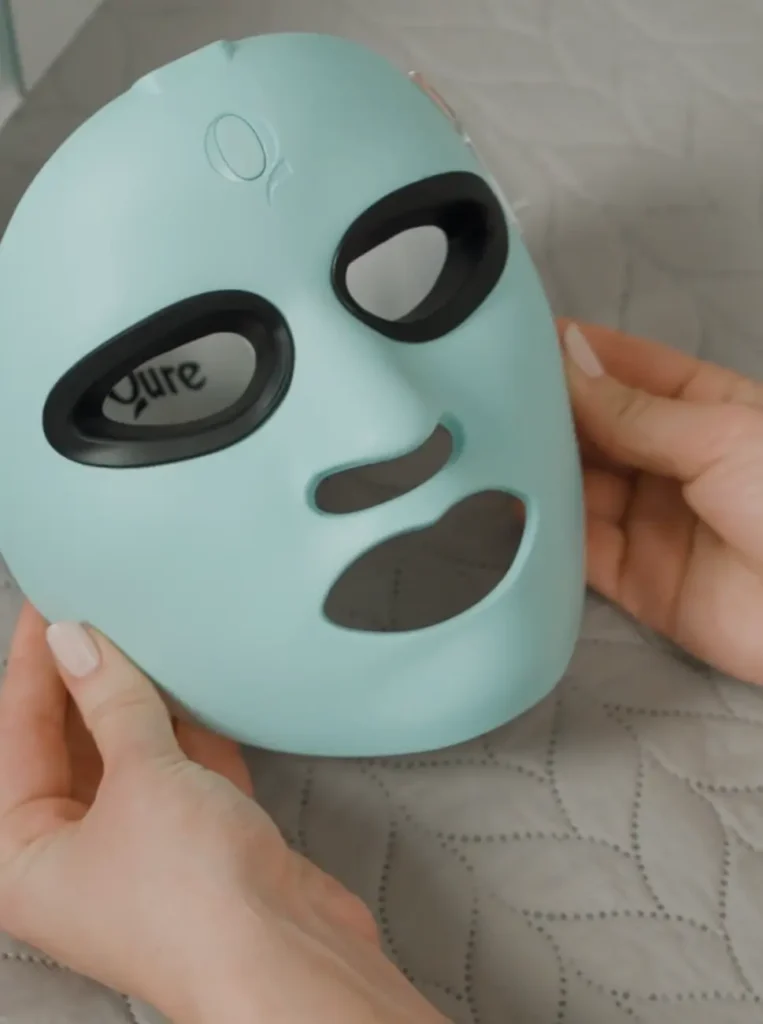
But I don’t like the strap, which is an elastic ski-goggle strap with a buckle that you adjust by hand. It looks cheap, and you have to use both hands and apply some force to tighten or loosen it. At this price, that’s really a shame…
I ended up leaving it at a single setting rather than struggling with it, and a Velcro strap, like on good LED masks, would be much better.
Do you need the Qure app?
No, and I mostly didn’t use it. The button runs the 2 presets, and the app is only needed for the custom mode where you pick a color per zone. I’m not a fan of apps on an LED mask anyway.
The point of doing a red light therapy at home instead of in a clinic is a quick session on the couch in the evening, and pairing a phone first is one step too many for me.
Finally, the other comfort issue I had was related to the session length. To get my full 9 minutes, I had to restart it twice every night, and by the third use, the mask felt slightly warm around the battery.
Qure states that a single charge lasts for up to 10 sessions, and since I needed three sessions a day to get my 9 minutes, I was recharging it twice a week… Many customers also complain about defective batteries after a year, and I understand why—if they do what I did, it really wears out the battery!
Value: 1.5/5
The price I paid, when viewed in the context of the results achieved and compared to other masks I have tested, both within this price range and at different price points.
Read my value guide$399 for 80 light output on a LED mask that skips the upper forehead and the jaw, no irradiance stated, no study, and a 1-year warranty. That’s the same price as the iRestore Illumina (read my review), which I didn’t recommend either, and about $170 less than the CurrentBody Series 3, which at least puts 125 light points.
What you’re paying for is the app, the 5 colors and the 3-minute promise, but the 3 minutes promise is not effective, and the 5 colors are the part I trust least.
The amber at 605 nm is one I haven’t seen on any other LED mask I’ve tested. The multicolor layout is the same idea I criticized on the Currentbody Series 3: several colors at low intensity, blended across the face, instead of red and near-infrared at a dose that does something. I never recommend that design. At 42 out of 100 the Qure lands in the bottom third of my ranking of the best LED masks.
Safety & support: 2.5/5
Eye protection, build quality, warranty, returns, responsiveness of customer support, and the mask’s ability to remain functional over time.
Read my safety & support guideOn safety, the FDA file lists the IEC 62471 photobiological test, and the eye inserts are well made. Support is not as good. The warranty is 1 year, which is short for a $399 device, and returns are accepted for 30 days minus a fee of $29 to $49 plus your own shipping.
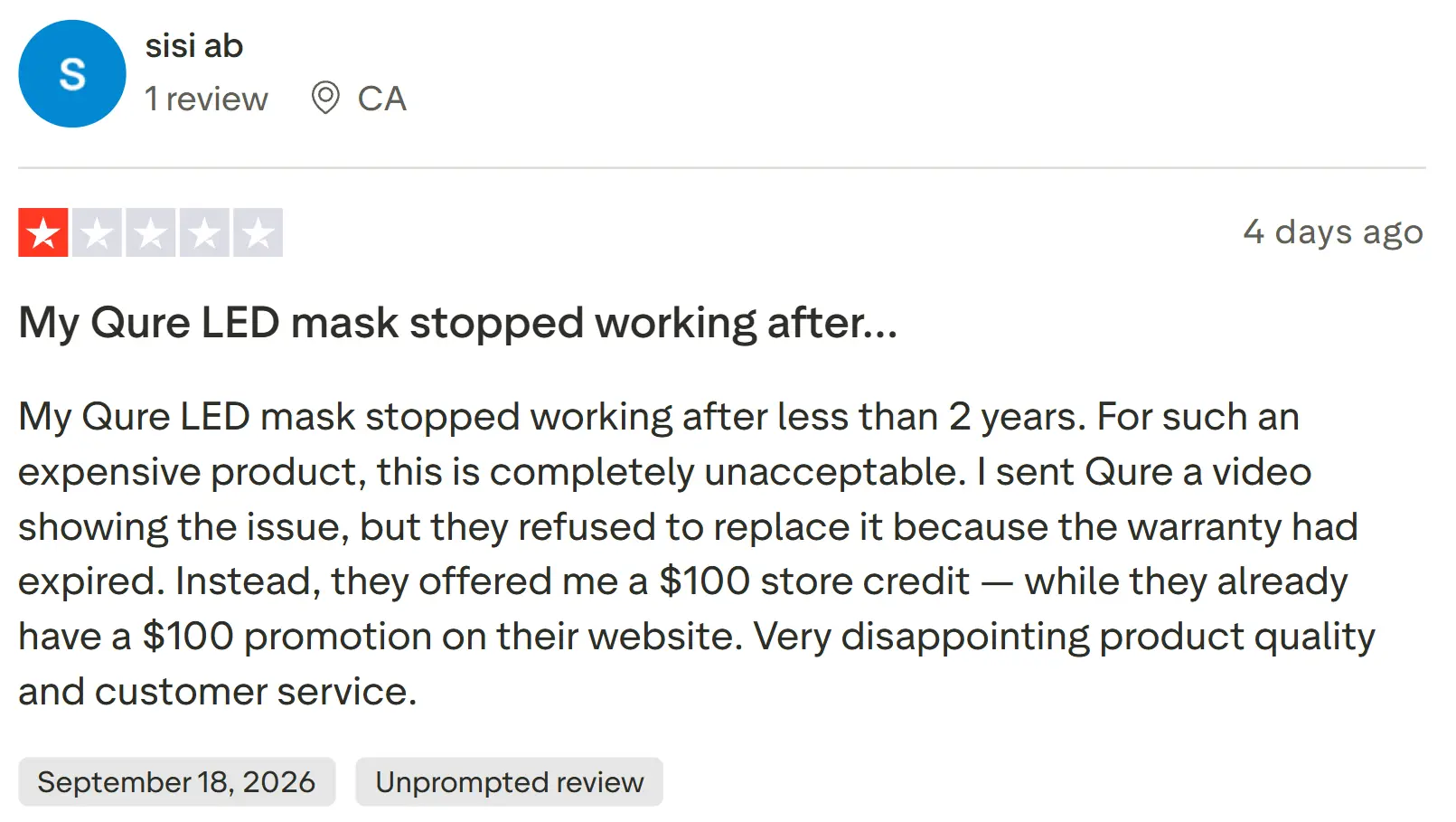
The pattern reported by customers on Reddit and Trustpilot is an LED mask that stops holding a charge at 12 to 18 months, just past the warranty, with Qure offering $100 toward a new one rather than a repair. I can’t confirm the failure rate from a 4-week test, but a 1-year warranty on LED mask is not much.
Who shouldn’t buy the Qure Q-Rejuvalight Pro
Skip this one if you recognize yourself
- Your forehead lines or your jawline are the target. The shell stops halfway up the forehead and short of the jaw.
- You want a dense LED layout against your skin. 80 bulbs is among the lowest counts I’ve tested.
- You already own an LED mask that fits your face. Qure LED mask is a step down on coverage, density and dose.
- You are pregnant or breastfeeding. Qure’s FAQ asks you to check with your doctor first, and I’d follow that.
Am I still using the Qure LED mask?
Updated November 2026. No. The Qure went back into its pouch after week 4, and my evenings went back to the Nooance Elite X600, which is the LED mask I actually use.
Before you pay for another five-color layout, open my LED mask picker and sort the grid on coverage: it shows which masks put their LEDs against the skin.
What I still want to know about the Qure LED mask
- How much light reaches the skin per wavelength, with the measurement condition.
- A clinical study run on the Q-Rejuvalight Pro itself, with its sample size, its duration and a named laboratory.
- Why 3 minutes, when the acne study Qure cites used 20-minute sessions.
- A second shell size, or a bigger one.
Qure Q-Rejuvalight Pro LED mask: your questions
How many LEDs does the Qure LED mask really have?
Qure advertises 160 LEDs, and its FAQ and its FDA file both say that’s 80 dual-core bulbs with 2 chips each. On the lit shell I count 46 bright points, with the smaller ones harder to spot.
Is the Qure LED mask FDA approved?
No. It’s FDA cleared under file K230042 for wrinkles and mild to moderate inflammatory acne. The file is held by Light Tree Ventures Europe, and Qure is listed as the distributor.
Is 3 minutes a day enough with the Qure LED mask?
With Qure’s own figures, 3 minutes deliver about 12.6 J/cm² spread over 4 colors, so under 4 J/cm² of red, when most light therapy studies use around 30 J/cm² of red per session. I ran 9 minutes and still saw nothing after 4 weeks.
Does the Qure LED mask fit every face?
No. The shell is small: it stops halfway up the forehead and short of the jaw, on Qure’s own model in its video and on me. The FDA file lists a treatment area of 140 cm² in the wrinkle mode.
Do you need the app to use the Qure LED mask?
Only for the custom mode where you pick a color per zone. The button on the LED mask runs both presets, and that’s how I used it for almost every session.
Test log
- Exact model
- Qure Q-Rejuvalight Pro Facewear, model P19-0023
- How I got it
- Bought on Qure’s US site, $399. No contact with the brand
- Test window
- September 2026, 4 weeks
- Sessions
- 5 evenings a week, 3 runs of 3 minutes back to back, Skin Rejuvenating preset.
- Eye protection
- Silicone inserts in for every session, eyes open
- Price and documents
- Qure’s US site and the FDA summary of K230042
About Emilie
I have tested LED masks since 2023. I buy the devices, use them for weeks, and read the spec sheets nobody reads, because this market runs on numbers most brands never publish. Not a dermatologist, and I say so whenever a question needs one.