
I buy the devices I test unless the article says otherwise. Some links and discount codes on this site are paid links: if you buy through one, I earn a commission. It never changes a score or a verdict.
The Shark CryoGlow costs $120 less than the CurrentBody Series 2, and on paper it has more LEDs, more light points, and a bigger irradiance. So I tested both, with 32 sessions on Shark Cryoglow, and about 50 on the Currentbody.
So here’s the full comparison, criterion by criterion, with both scores, the reel LED density, and the one important number to compare.
Shark CryoGlow vs CurrentBody Series 2
| Device | Shark CryoGlow | CurrentBody Series 2 |
|---|---|---|
| Price on the brand’s US site | $350 | $470 |
| Model | FW312 | MK-90H |
| Wavelengths | 415 nm blue, 630 nm red, 830 nm near-infrared | 633 nm red, 830 nm near-infrared, 1072 nm deep near-infrared |
| LEDs advertised | 480 | 236 |
| Light spots on your face | 160 tri-wick packages | 110 |
| Irradiance published | 128 mW/cm², every wavelength added together, measured at the LED level | 30 mW/cm², no measurement condition given |
| Red light on its own | 64 mW/cm² in Better Aging, 17 in Skin Sustain | not split out |
| Session length | 4 to 8 minutes depending on the routine | 10 minutes, fixed |
| Shell | Rigid, held off the skin | Flexible silicone, in contact with the skin |
| Under-eye cooling | 2 Peltier pads, 3 levels | None |
| FDA 510(k) | K242796, filed by SharkNinja Operating LLC | K250966, filed by Shenzhen Kaiyan Medical Equipment |
| Photobiological safety | IEC 62471:2006 declared | Not published |
| Clinical study on this model | 119 adults, 12 weeks, laboratory not named | 35 subjects, 56 days, laboratory named |
| Warranty | 2 years | 2 years |
| Score | 63/100, Shelved | 72/100, Emilie Approved |
Buy the Shark CryoGlow LED mask if you want shorter sessions, better remote and $120 back, as long as you accept that the strip under your eyes hide your skin from light, and that your face is centimeters away from the LED.
Buy the CurrentBody Series 2 LED mask if you want the LED near to your face. That’s the whole argument, and after wearing both I think it’s worth it: the silicone follows your cheeks and your jaw, nothing crosses air on the way to your skin, and you can walk around more easily.
Buy neither if your first concern sits on your nose bridge, your upper lip or the skin right under your eyes. And if you’re waiting on a clear Before & After, neither of them gave a good one.
What I tested: the Shark CryoGlow and the CurrentBody Series 2
I bought both LED masks with my own money, at full price, from each brand’s US site.
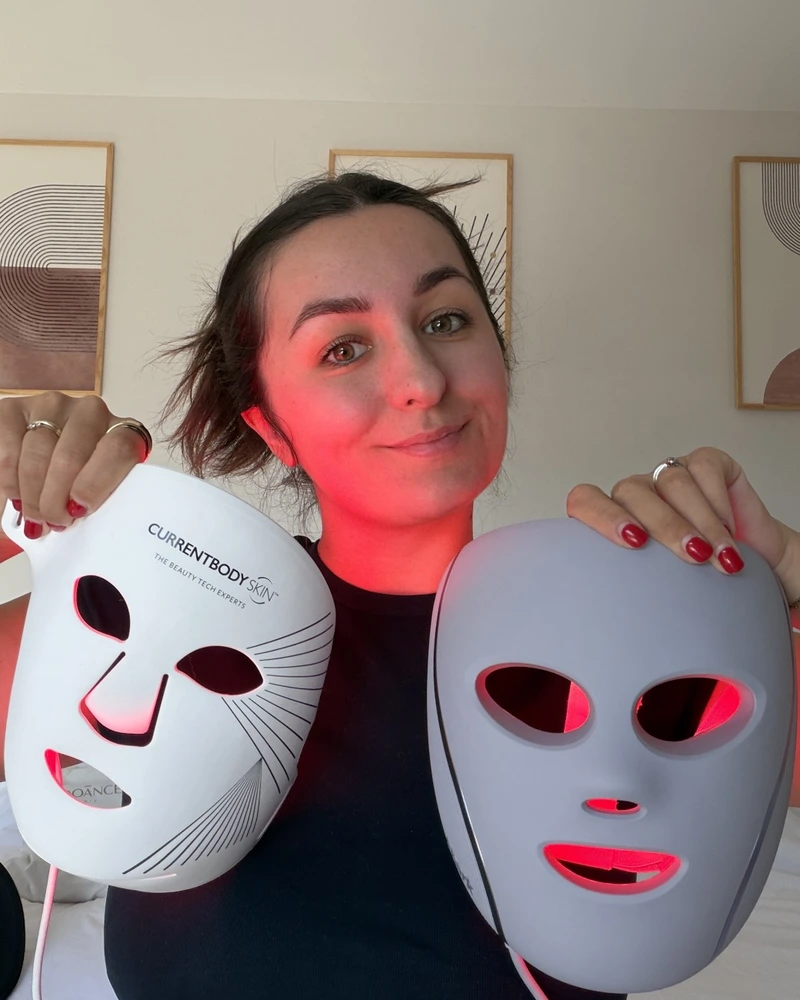
I tested the Currentbody for 12 weeks and about 50 sessions of 10 minutes, every other day. I tested then the Shark Cryoglow for 8 weeks and 32 sessions of 6 minutes, 4 times a week, on Better Aging only, which is the Shark routine running red and near-infrared, similar to Currentbody’s one. You can see more details on my test conditions on my LED mask testing page.
Results: Shark 2.5/5 · CurrentBody 3/5
What changed on my face following my test, including my before-and-after photos. I also evaluate the “before-and-after” examples provided by the brand being tested, as well as the results of any studies that may have been conducted on the mask.
Read my results guideShark CryoGlow: my Before & After
After 8 weeks of testing, the pores along my nose appear slightly more enlarged in the “after” photo than in the “before” photo, and my complexion has lost some of its radiance. This is a gradual change, not a deterioration, because I usually use a more intense LED mask, so my skin had already reached its full potential before the test began.
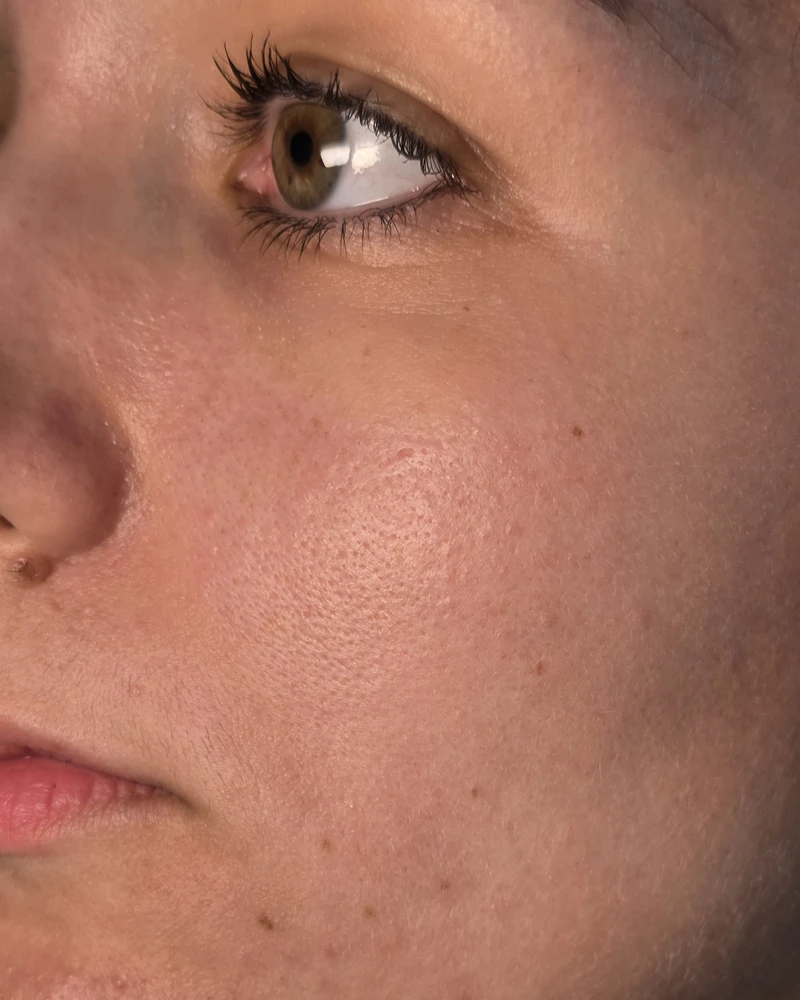
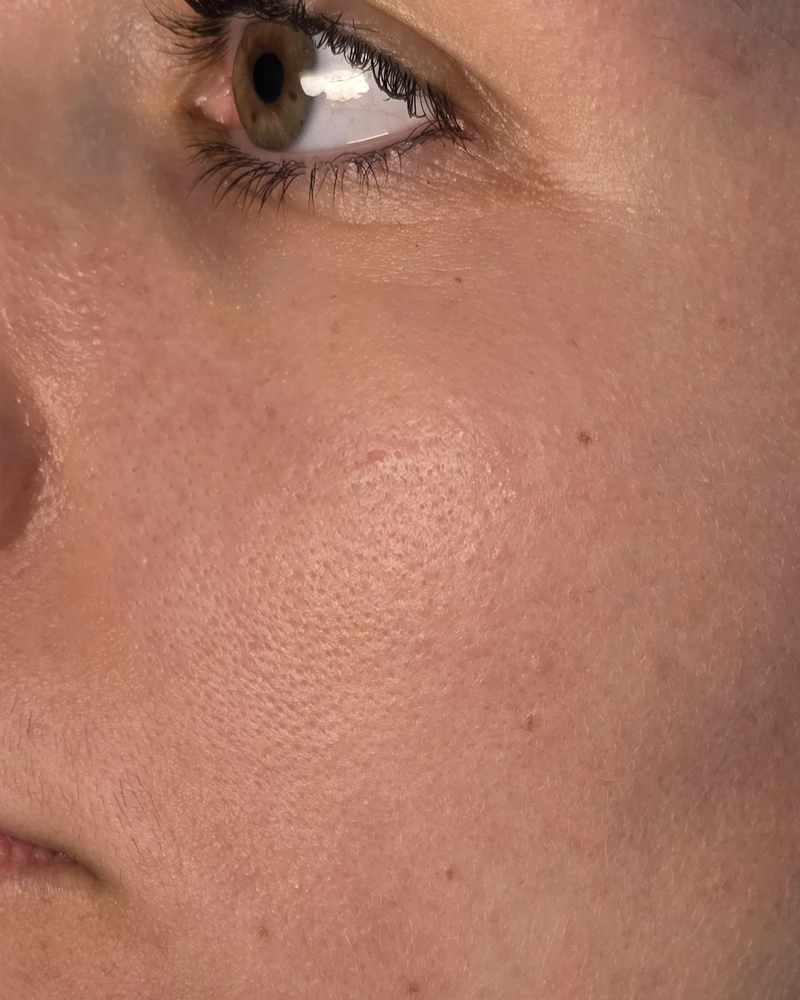
Shark’s own before & after from trial
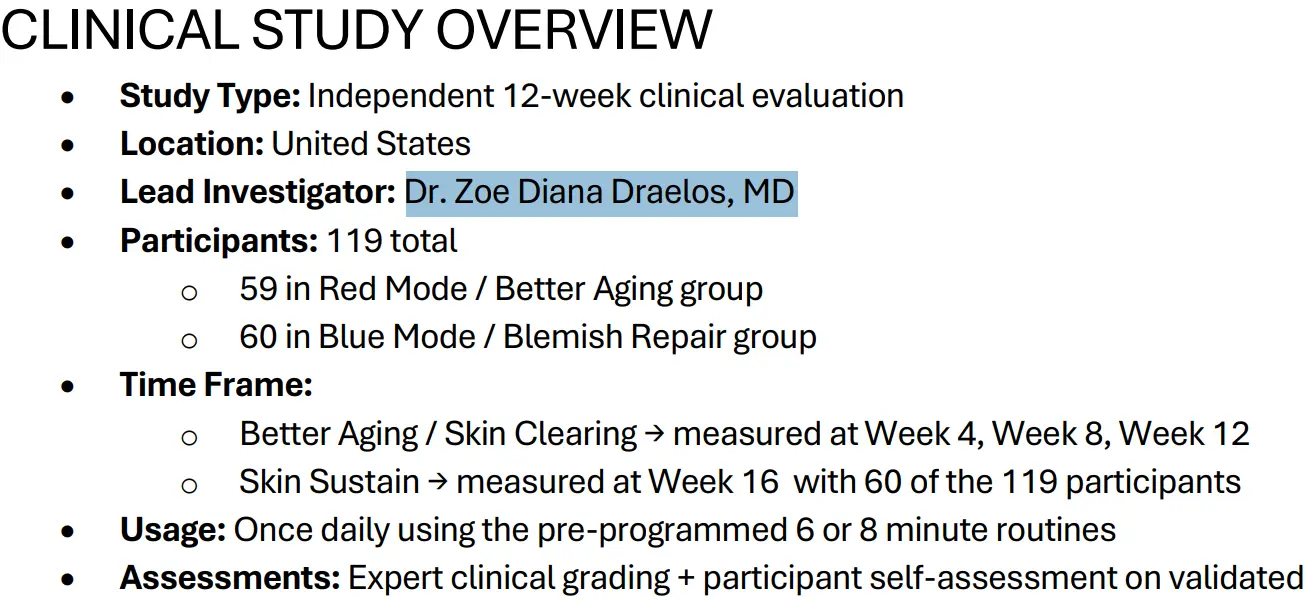
Shark hosts a summary of a 12-week evaluation on 119 adults, run once daily on Better Aging or Skin Clearing, with expert grading, participant questionnaires, standardized photography and instrumental testing. It reports improvement in fine lines, firmness, radiance and smoothness at week 8 in the anti-aging arm.
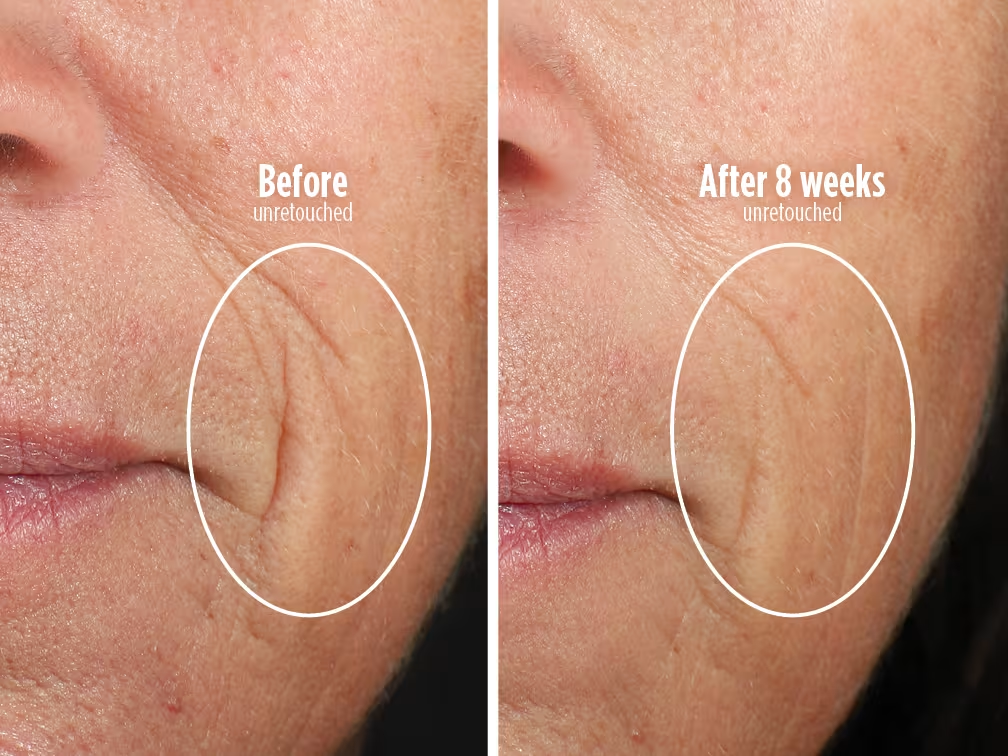
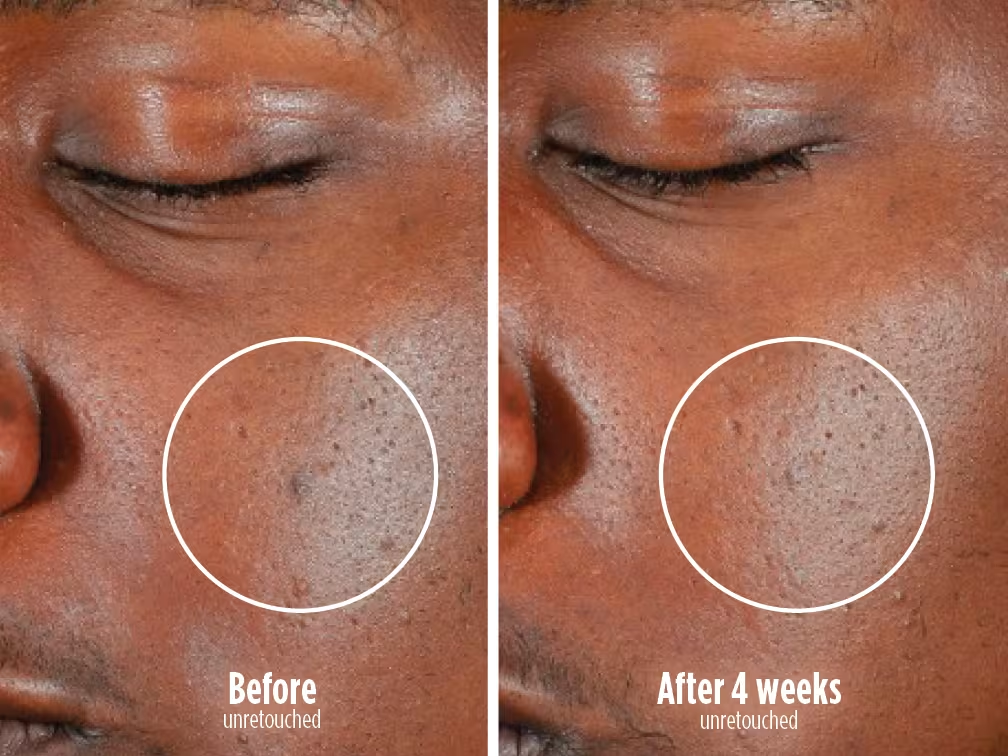
But there is no control group, no named laboratory, no numerical tables, and no paired macrophotographs at fixed dates. The product page advertises 24% fewer visible fine lines and 20% firmer skin, but we are missing important measures conditions here.
CurrentBody Series 2: my before & after
12 weeks gave me nothing to show you either: no texture tightened and no line softened, and I’ve got no standardized before and after from that window to put in front of you. My skin seemed a little redder and less even-toned by the end, but since the season changed during the test and I was no longer using my usual LED mask, I’ve come to the same conclusion as in my Shark review.
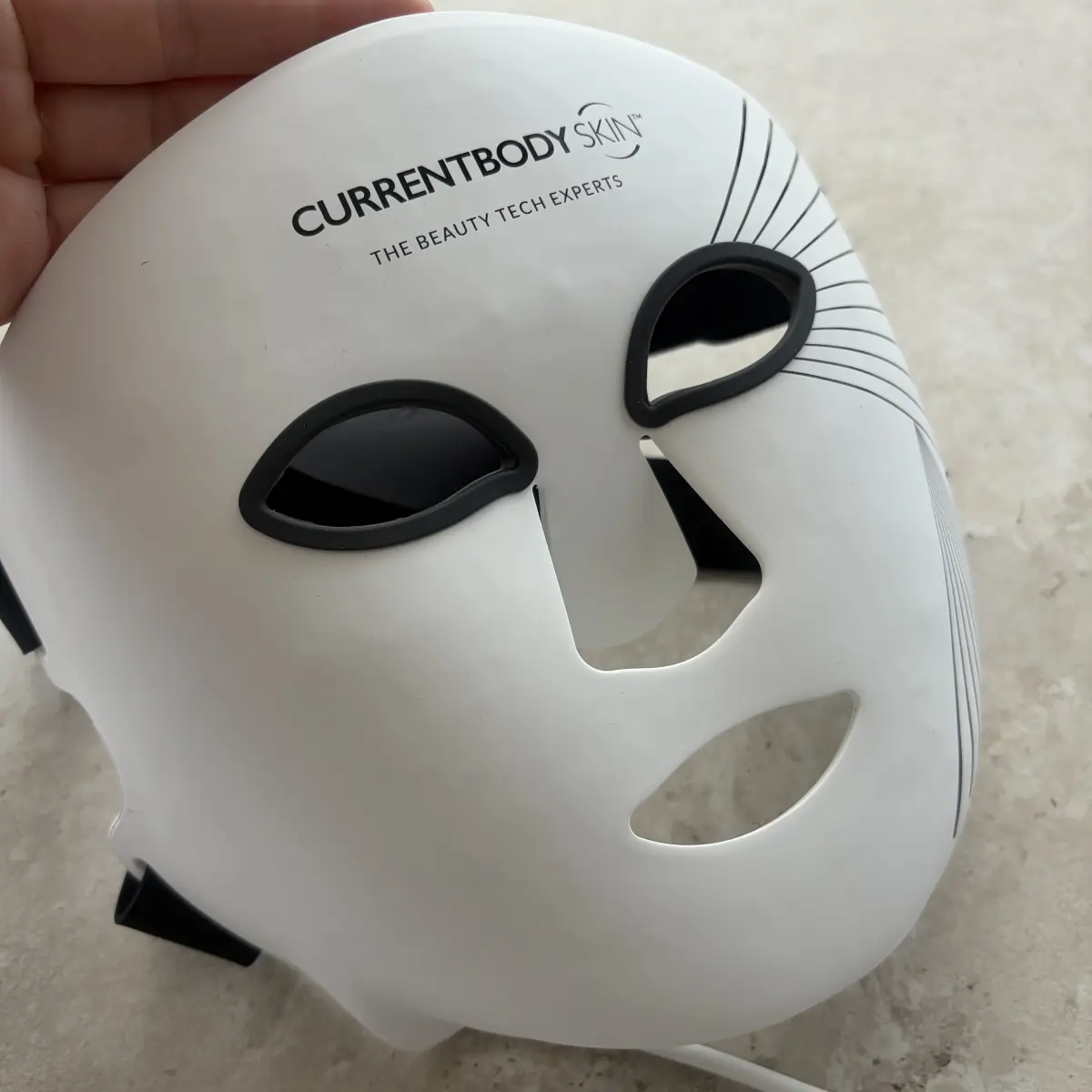
CurrentBody’s own study and before & after
CurrentBody’s ran 35 subjects over 56 days, names the laboratory (University of Manchester’s Centre for Dermatology Research), lists the measurement points and reports instrument readings (VISIA-CR imaging, Primos-CR 3D wrinkle mapping…).
However, the only images available are those provided by customers, whereas I would like to see the photographs from the study itself, since customers are not a reliable source in this regard.
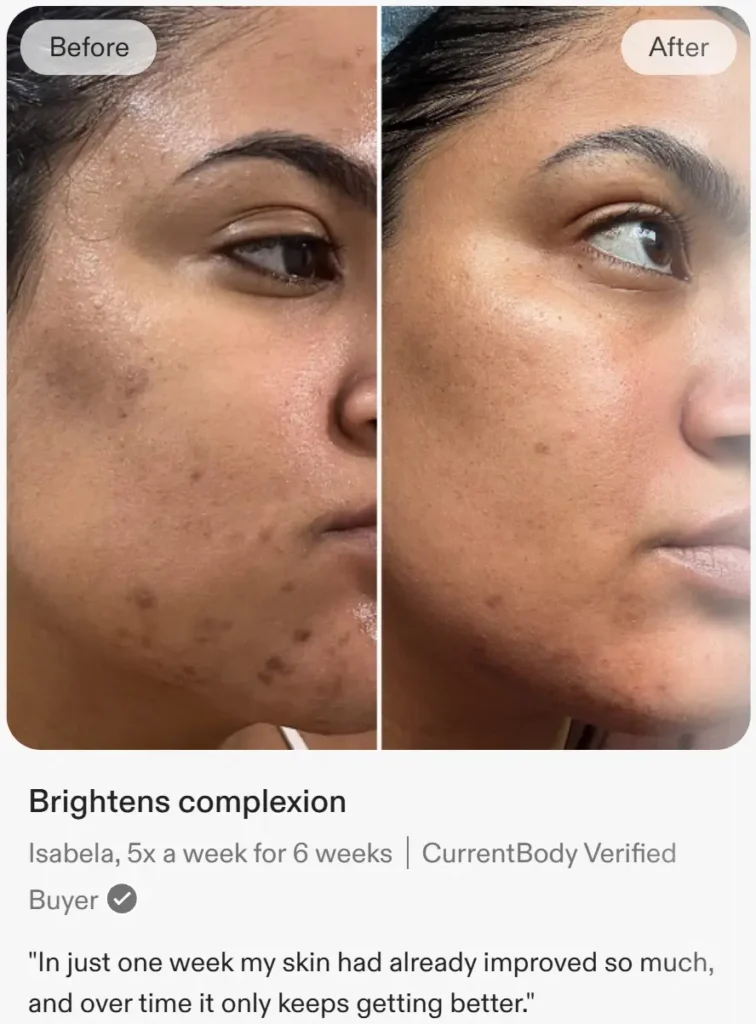
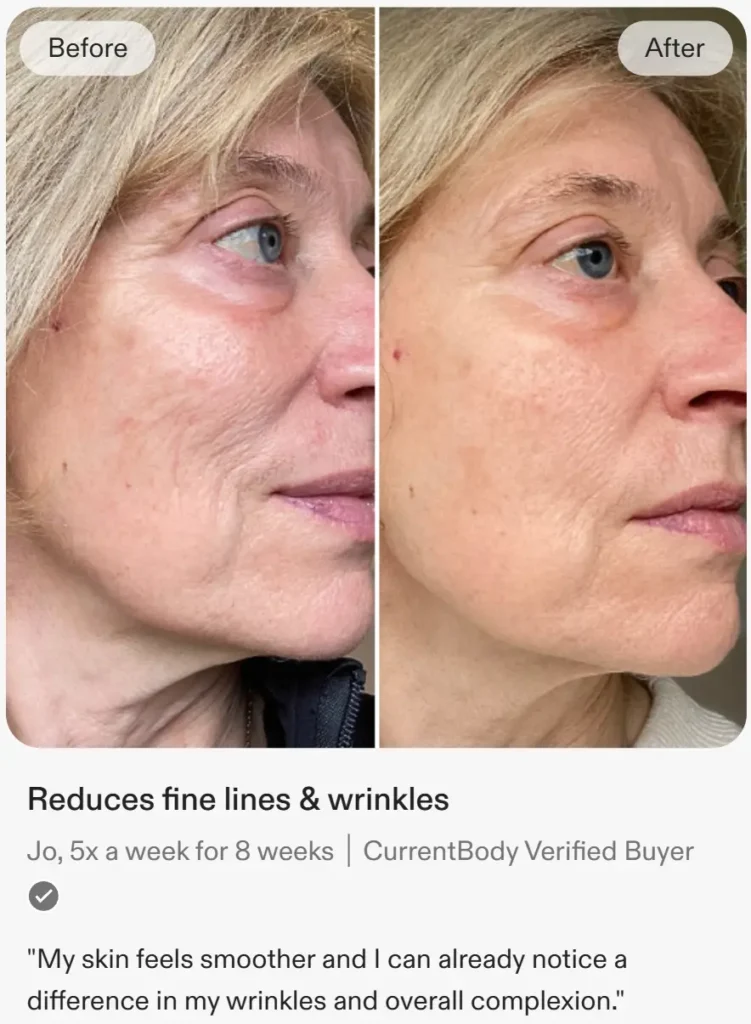
Neither of these LED masks did anything for my face. The CurrentBody keeps the half point because it left my skin where it found it, and the Shark lost it because mine came out slightly worse than it went in.
Irradiance: Shark 3.5/5 · CurrentBody 3.5/5
How much light reaches the skin, in mW/cm²? I evaluate this value, as well as how the information is presented, the conditions under which it was measured, and the total dose received in a single session. If the brand does not communicate it, I give it a severe rating.
Read my irradiance guide
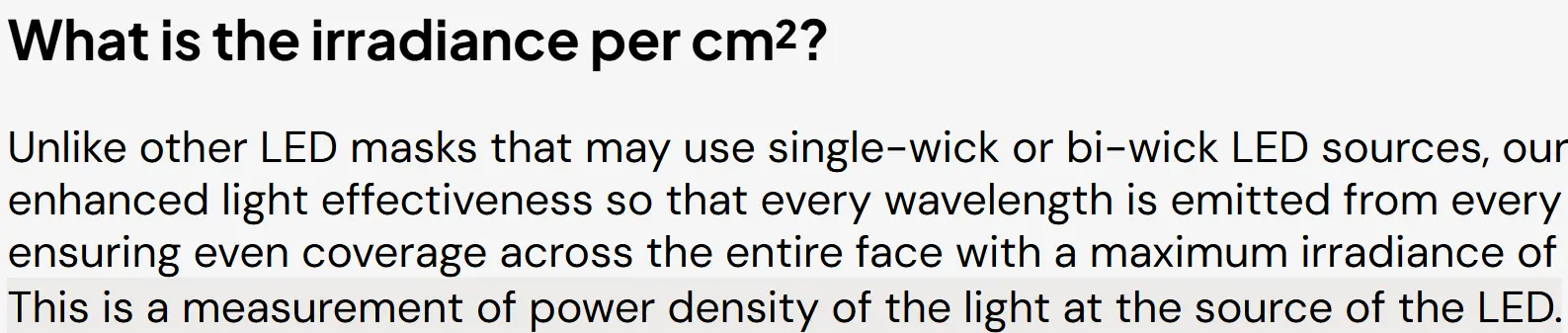
Shark CryoGlow: 128 mW/cm², at the LED level
128 mW/cm² is a large figure for a home LED mask, as usual stand from 30 to 50 mW/cm². This gap comes from that it’s the power density at the source of the LED… So it’s a sum of every wavelength running at once, so Better Aging is really 64 red + 64 infrared, and a reading taken on a chip is not reliable since light spreads on the way out to the skin…
CurrentBody Series 2: 30 mW/cm²
30 mW/cm² across a locked 10 minute cycle works out to 18 J/cm² a session, which is at the bottom of the recommended 30J/cm² session used in majority of studies. The number is modest, it sits at the bottom of the 30 to 50 band, but we don’t know where the probe was held. A probe held against a LED and a probe held on a cheek are totally differents, once again.
- Shark, Better Aging 64
- CurrentBody Series 2 30
- Shark, Skin Sustain 17
So, Shark measure the component instead of the light power received by the skin, and CurrentBody don’t tell you what it applies to, but I assume it is at the skin level. In any cases, the values are not the best on the market, but still not the lowest.
Does the Shark CryoGlow really lose 90% of its power at skin level ?
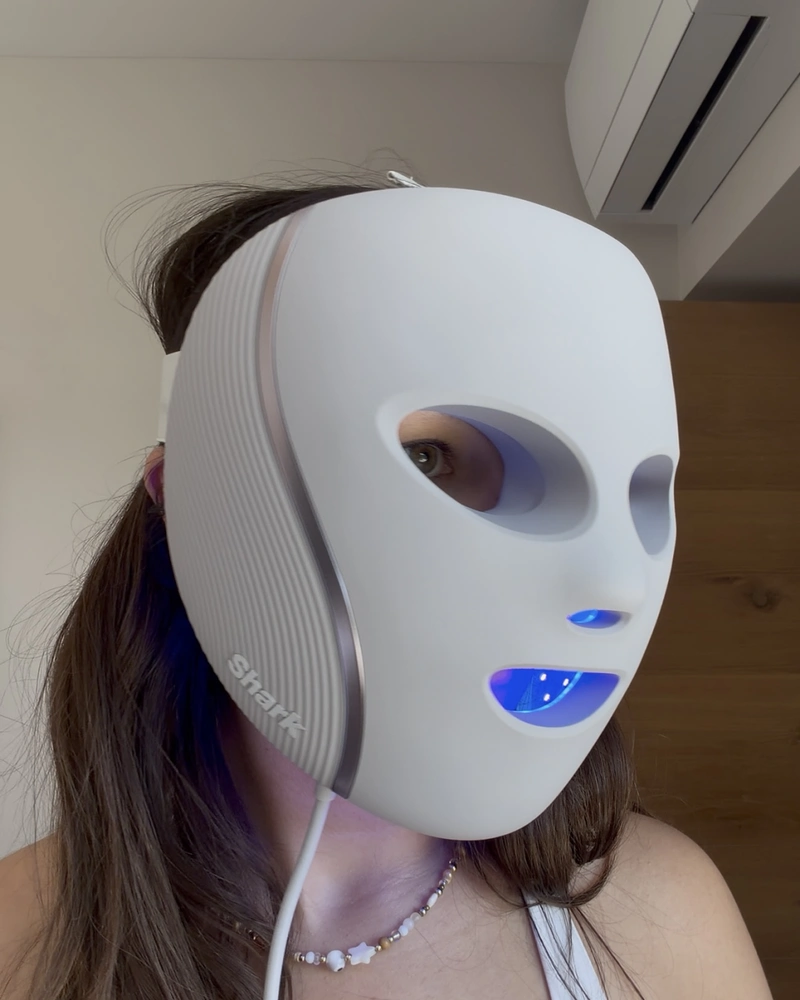
CurrentBody runs its own page comparing the two devices, and it says the Shark sits 1 to 2 cm from the skin and loses up to 90% of its power before it arrives. I fully agree on the principle that the greater the distance between the skin and the LED, the greater the power loss. My own test supports this, since the faceplate keeps my entire face away from the light and not just my eyes.
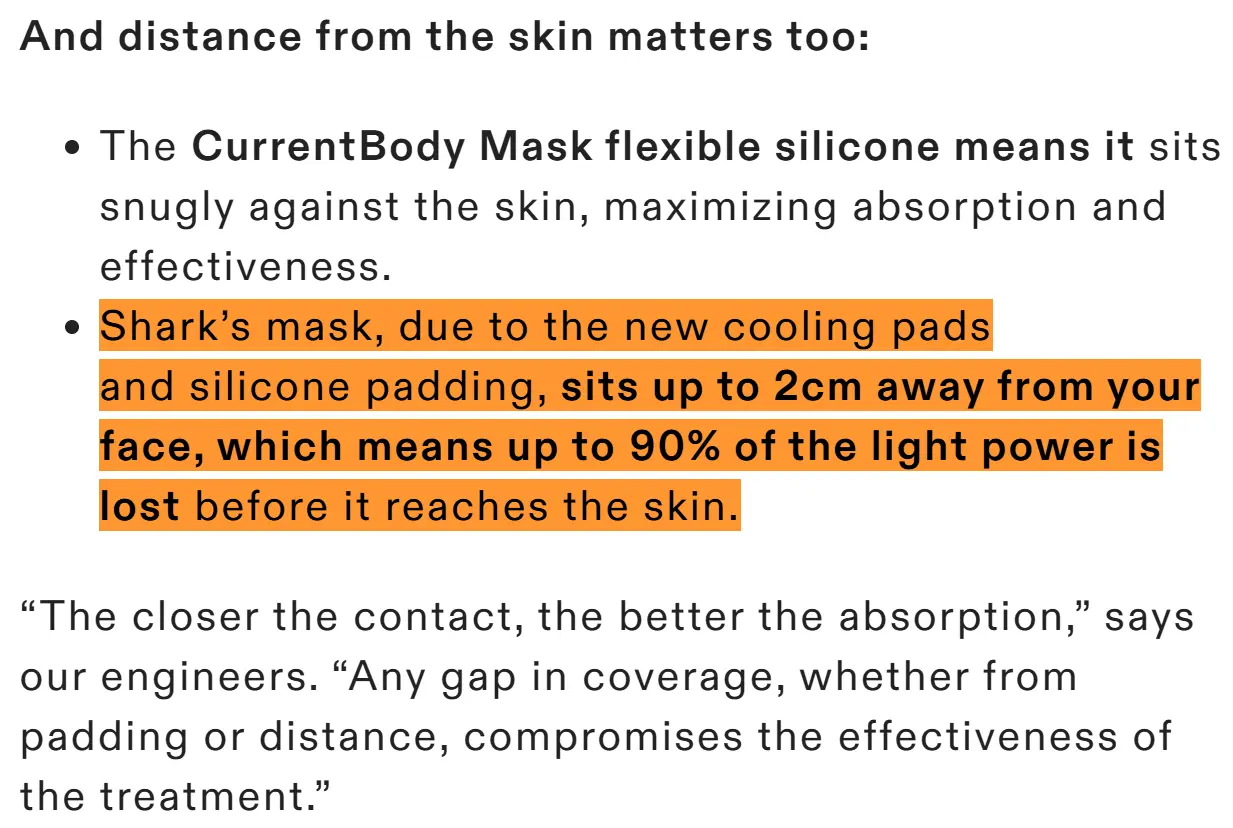
But on the number there’s nothing to check, because the page carries no distance test, no instrument and no method, and it comes from Currentbody itself, so I won’t take that specific figure as fact.
Coverage: Shark 2.5/5 · CurrentBody 3.5/5
How many points of light does the mask actually feature, how evenly are they distributed, and which areas remain uncovered? Note that I am counting “bulbs” and not LEDs, because the number of LEDs often includes two, three or more diodes per bulb, which inflates the apparent coverage area.
Read my coverage guideShark CryoGlow: 480 tri-LEDs, 160 light points
Shark mentions in its FDA file: “The device incorporates 480 LEDs (160 tri-wick packages).” So the number that matters is 160, each package carrying one red die, one blue and one infrared. The LED sheet under the plastic is a good one, and the spacing is regular. Then the shell takes a lot of that back.
The cooling pads cover the entire area under the eyes, nothing extends beyond the nose or upper lip, and the shell ends just before the underside of the chin.
CurrentBody Series 2: 236 LEDs, 110 light points
CurrentBody divides its 236 LEDs into 94 dual-core LEDs and 16 triple-core LEDs, for a total of 110 light points that illuminate my face. The 16 triple-core LEDs are concentrated on the forehead, so I don’t get the full benefit of this technology across my entire face…
The shape of the mask covers most of my face fairly well: my jawline, the skin under my chin, and the outer corners of each eye. But the bridge of my nose, my upper lip, and the skin right at the edges of my eyes don’t receive any light.

Currentbody or Shark for LED coverage ?
- Shark CryoGlow 160
- CurrentBody Series 2 110
Shark has 45% more emitters and more points mean beams whose edges overlap instead of leaving troughs between them, and I’ve said in every review that density is physics rather than marketing. But for Shark, those 160 light points are fixed to a rigid shell that stands off the skin so the light crosses whatever air is left… So I prefer the Currentbody one, as it covers more zones of my face.
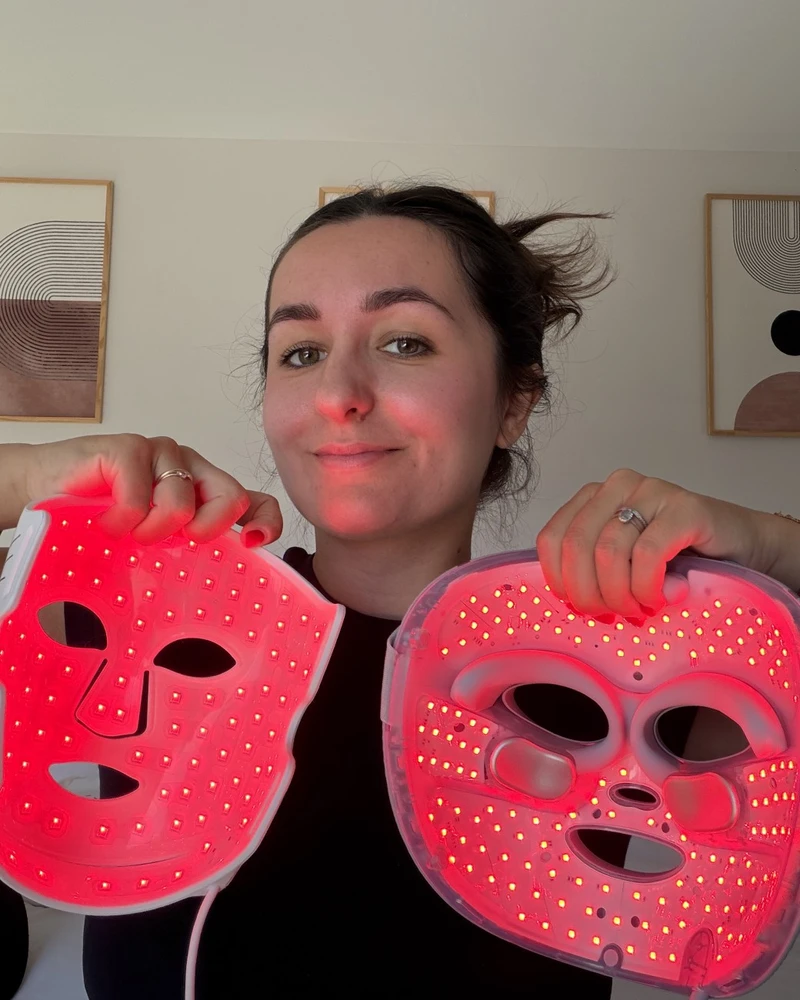
Still, the areas not covered by the CurrentBody are the nose and upper lip, which the Shark also neglects; so they’re even on that point. On the other hand, the Shark leaves out the area under the eyes and the underside of the chin, which are precisely the two places where the face begins to show the first signs of aging. I treat more in details those gaps in my Shark CryoGlow LED mask review.
Proof: Shark 4/5 · CurrentBody 4.5/5
What the brand clearly displays and what I check in the FDA file: wavelengths (in nm), emitted dose, FDA clearance number, product study, safety tests, warranty.
Read my proof guide| Audit point | Shark CryoGlow | CurrentBody Series 2 |
|---|---|---|
| Wavelengths given in nm | ✓ 415, 630, 830 | ✓ 633, 830, 1072 |
| Dose per session calculable | ✓ full power table per mode | ✓ 30 mW/cm² over 10 minutes |
| Clearance number cited and verifiable | ✓ K242796 | ✓ K250966 |
| Clinical study on this exact model | ✓ | ✓ |
| Study documented: size, duration, laboratory | ✗ no laboratory named | ✓ 35 subjects, 56 days, SGS |
| Photobiological safety declared | ✓ IEC 62471:2006 | ✓ IEC 62471:2006, in the FDA summary |
| Warranty and support documented | ✓ 2 years | ✓ 2 years |
| Points answered | 6 of 7, scored 4/5 | 7 of 7, scored 4.5/5 |
Shark CryoGlow FDA and study
K242796 was submitted by SharkNinja Operating LLC and cleared Substantially Equivalent in November 2024. It includes a power table broken down by mode and by wavelength with its tolerances, and IEC 62471:2006 named with its edition alongside 60601-1 and the biocompatibility standards.
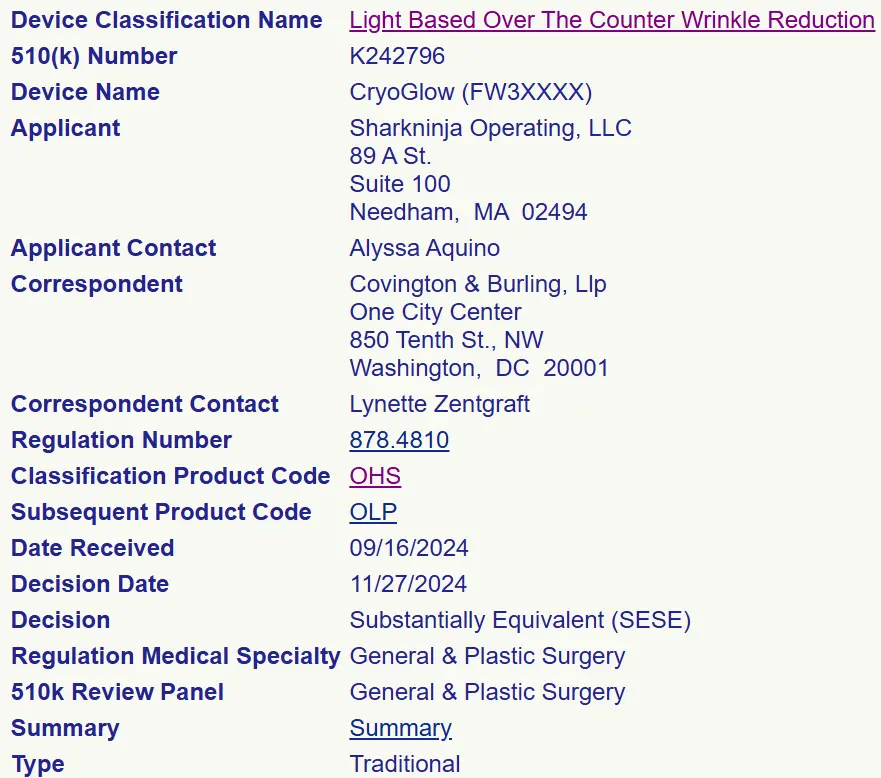
For the trial, Shark names the dermatologist and describes validated scales, controlled photography and instrumental testing, but publishes a marketing summary instead of the report. Cleared is not approved either, and clearance means the device resembles one already on the market, never that it works.
CurrentBody Series 2 FDA and study
K250966 is real but the applicant is Shenzhen Kaiyan Medical Equipment Co., Ltd. rather than CurrentBody or the group that owns it. What it means is that the company answering to the FDA for this LED mask is a factory in Shenzhen. The whole file is in my CurrentBody Series 2 review.
CurrentBody highlights a 57% increase in firmness, and the SGS summary attributes 57.1% to R7, biological elasticity, which corresponds to the reading recorded by a cutometer when measuring skin bounce. The FDA summary of K250966 also lists IEC 62471:2006, the photobiological safety standard.
So Shark, the cheaper LED mask, holds the better FDA file, filed under its own name, while CurrentBody documents its study better and answers all 7 points.
Comfort: Shark 3/5 · CurrentBody 4/5
Fit, weight, heat, eye comfort and minor inconveniences: straps, timer, battery. A mask that becomes a chore to wear several evenings a week scores poorly in these areas, as using it should be a pleasant experience!
Read my comfort guide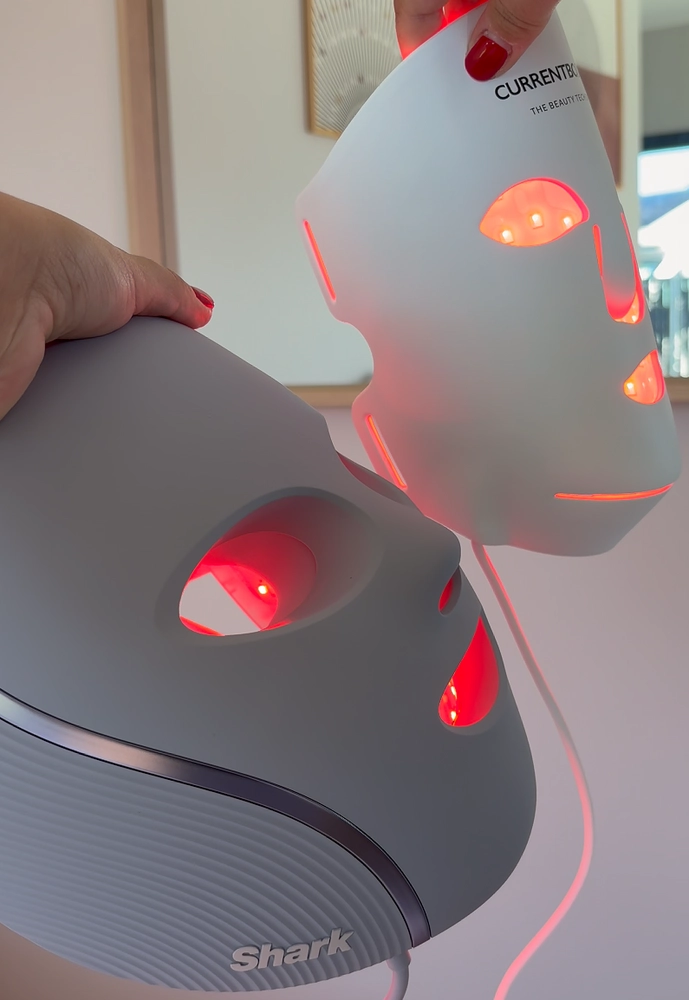
Shark CryoGlow: heavy and uncomfortable
The strap holds and the LED mask never slid on me, which is more than several rigid models have managed. But 1.1 lb sits on your head and you feel it, and the depth of the shell made me dizzy when walking around. So I stopped moving around during the sessions, which is a drawback for me, since I really appreciate being able to go about my business at home while the LED mask is running.
An 8-minute session for my program is the shortest I’ve ever had to do, since I usually do 10-minute sessions. The remote control is the best I’ve ever used on an LED mask, and the cooling feature is very pleasant in the morning. But since I mainly use it in the evening, I found it simply too cold and turned it off; plus, the fan in the ear pads is noisy, so I prefer not to use it.
CurrentBody Series 2: Classic Comfort
It is a soft silicone that stays cool, a molded shape that follows my cheeks and my jaw, with 10 minutes sessions and it switches itself off. I read my phone through a session with the eye inserts in, and I moved around without thinking about it.
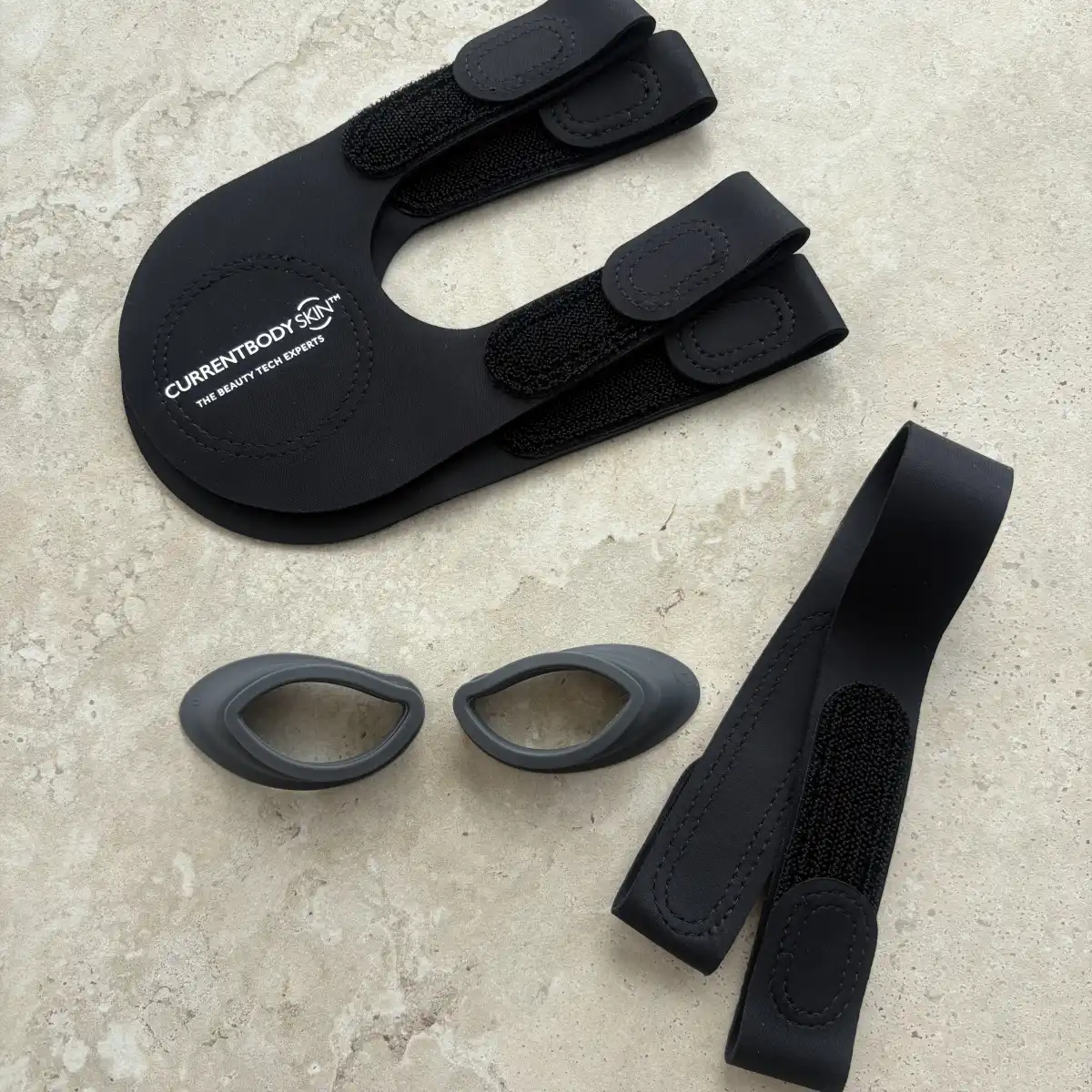
On the other hand, a ridge runs across the bridge of the nose, and I could feel it every time I put on the LED mask, and the exterior silicone finish isn’t as polished as you’d expect for a $469.99 product. Neither of these two issues is reason enough to stop using it, and both are far less bothersome than those of Shark.
Value: Shark 3.5/5 · CurrentBody 3.5/5
The price I paid, when viewed in the context of the results achieved and compared to other masks I have tested, both within this price range and at different price points.
Read my value guideShark CryoGlow: $349.99
For $120 less than the Currentbody, you get two cooling pads, a color remote control, a sturdy case, a good LED strip, and the same 2-year warranty. The catch is that these pads block the light, since they’re positioned exactly where the LED under your eyes should be, and, more importantly, they push the entire LED mask away from your face.
CurrentBody Series 2: $469.99
The extra $120 gets you a better mold. Still, you get fewer emitters and no cooling, but in exchange the LED touch your skin. That trade is worth making, which is the whole verdict of this comparison, though $470 is a lot to pay for this density of LED.
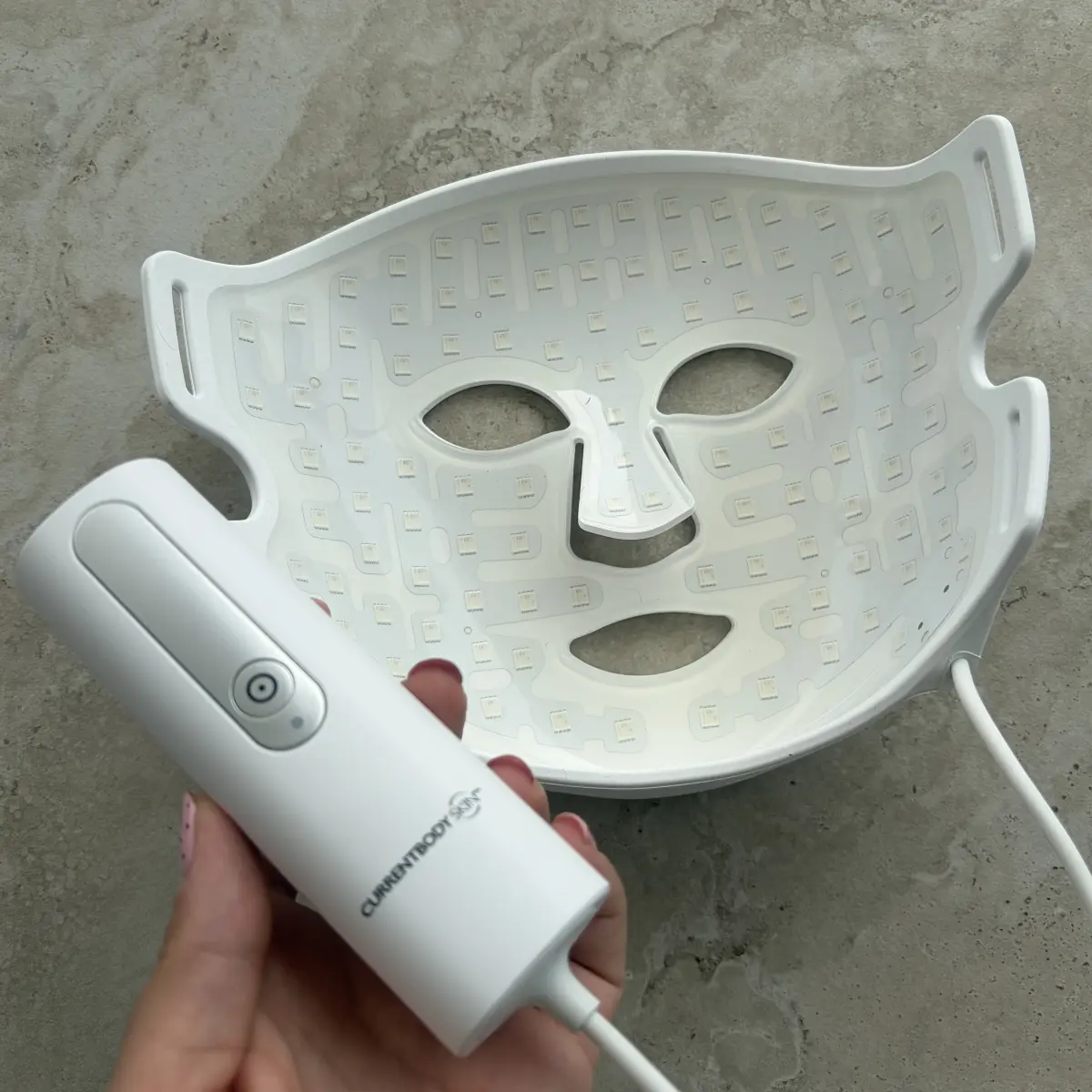
The Shark LED mask offers more features for less money, but I don’t think the cooling pads play a role during a light therapy session.
CurrentBody charges a higher price for its design but offers inferior technical specifications.
Should you go for the CurrentBody anyway, my code EMILIE15 knocks 10% off on its US shop (details on my CurrentBody discount code page). Paid link: a commission comes to me when the code is used. Both sit in the top five of my ranking of the best LED masks, a few places apart.
Safety & support: Shark 4/5 · CurrentBody 4/5
Eye protection, build quality, warranty, returns, responsiveness of customer support, and the mask’s ability to remain functional over time.
Read my safety & support guideShark CryoGlow
The clearance file lists what the device was tested against: IEC 62471 on photobiological safety, IEC 60601-1 on electrical safety, and the biocompatibility standards. The mask itself has eye shields, and the LED mask drops its output the moment you lift it off your face and stops each routine by itself.
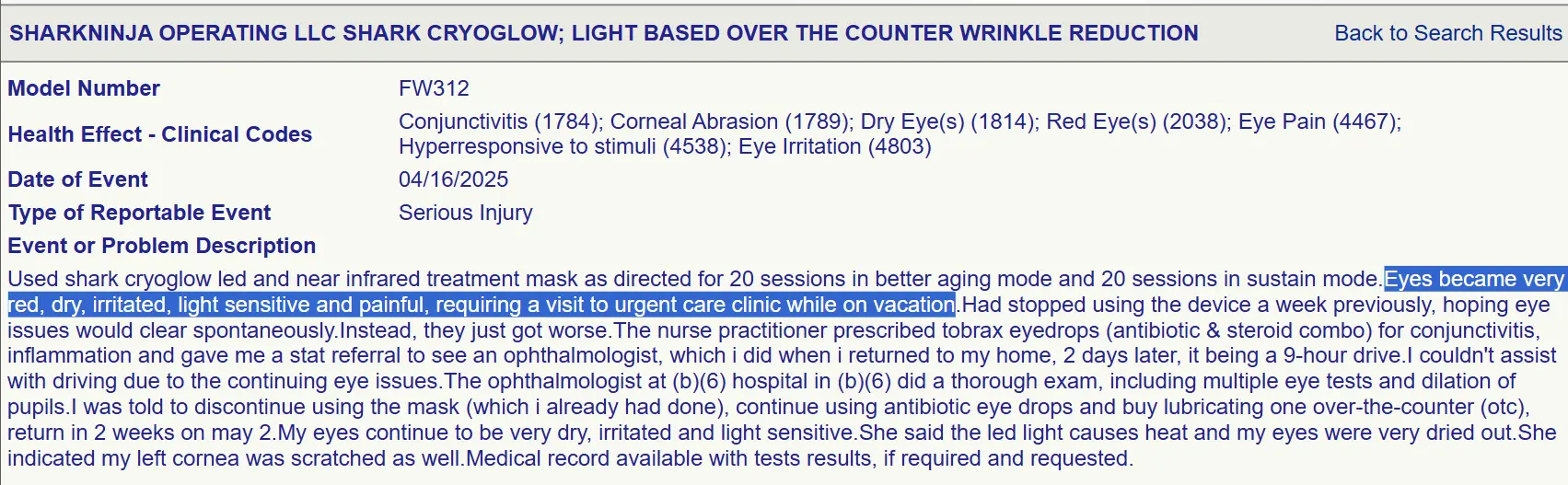
There’s a 2-year limited warranty, replacement accessories can be ordered, and no app or account stands between you and a session. Set against all of that, buyers have filed reports of burning, redness and irritation on this line in the FDA’s public adverse event database.
CurrentBody Series 2
Every contraindication is listed in Currentbody’s manual, you are told to patch test the inside of your arm for a full day before the LED mask goes anywhere near your face, and you get 14 days to return it if your skin reacts.
But neither brand publishes a risk group, even though it is precisely this classification that would tell you how long it is safe to look at a light source of this type. That’s why I always wear eye protection with my LED mask (whether at home or at a beauty salon).
Who shouldn’t buy the Shark CryoGlow or the CurrentBody Series 2
Skip both of these if you recognize yourself
- The under-eye area is your first concern. Shark puts cooling pads over that strip and CurrentBody stops its LED short of it.
- You want light on your nose bridge or your upper lip. Neither shell carries a LED over that smoker’s lines above the lip.
- You want high LED density AND 3D molded shell Premium brands offer LED masks with 600+ LED and 3D molded shell.
- You are on medication or special condition. Consult with your doctor first before using any LED mask
Am I still using the Shark CryoGlow or the CurrentBody Series 2?
Updated November 2026. None of them, since the Nooance Elite X600 is what I wear between tests, but the CurrentBody Series 2 is still one of few LED masks I recommend for beginners.
Shark CryoGlow vs CurrentBody Series 2: your questions
Shark CryoGlow or CurrentBody Series 2: which one should I buy?
The CurrentBody Series 2, and I scored it 72/100 against 63/100. It has fewer emitters and a smaller published irradiance, but its silicone sits on your skin instead of standing 1 to 2 cm off it, and nothing you buy on a spec sheet survives that gap. Buy the Shark instead if under-eye puffiness is what gets you out of bed unhappy.
Is the Shark CryoGlow really 4 times more powerful than the CurrentBody Series 2?
No, and you can’t divide one by the other. Shark’s 128 mW/cm² is every wavelength added together and read at the LED, which Shark states itself, and its red channel alone is 64 in Better Aging and 17 in Skin Sustain. CurrentBody’s 30 mW/cm² comes with no measurement condition at all, so neither number tells you what reaches a face.
Which LED mask has more LEDs, the Shark CryoGlow or the CurrentBody Series 2?
The Shark, on both counts. It advertises 480 LEDs and its FDA file explains that these are 160 tri-wick packages, so 160 lit positions land on your face. CurrentBody advertises 236, which are 110 red and 110 near-infrared sharing the same seats plus 16 deep near-infrared, so about 110 lit positions land on yours.
Is the CurrentBody Series 2 worth $120 more than the Shark CryoGlow?
For light therapy, yes, and I’d pay it again. The $120 buys a shell that molds to your face rather than bridging over it, and I’d rather have 110 diodes touching my skin than 160 shining across air. As an object you get more for your money from the Shark, which is why both scored the same 3.5/5 on value.
Did either LED mask change my skin?
Test log
- Exact models
- Shark CryoGlow LED Face Mask, FW312, Blue Frost, US version. CurrentBody Skin LED Light Therapy Face Mask: Series 2, red light version, MK-90H
- How I got them
- Both bought with my own money on each brand’s US site, $350 and $470.
- Test windows
- 8 weeks on the Shark, 12 weeks on the CurrentBody
- Sources checked
- Both US product pages and spec sheets, the FW312 user guide and the Series 2 manual, Shark’s science page, CurrentBody’s own comparison page, the FDA 510(k) records K242796 and K250966, and the FDA adverse event database

About Emilie
I have tested LED masks since 2023. I buy the devices, use them for weeks, and read the spec sheets nobody reads, because this market runs on numbers most brands never publish. Not a dermatologist, and I say so whenever a question needs one.