
I buy the devices I test unless the article says otherwise. Some links and discount codes on this site are paid links: if you buy through one, I earn a commission. It never changes a score or a verdict.
When I test LED masks, I include the criteria “Proof” to to verify the brands’ claims and their validity by consulting their sources. Almost all product descriptions indicate FDA-approved and clinically proven, but for most of the LED masks I’ve tested, these claims are often false…
Here’s what you need to know about FDA-cleared and FDA-approved LED masks, how I check folders and read a study, and the 7 points I check on each LED mask with 4 tested LED masks as an example.
Proof: One of the 7 criteria on my grid
Proof is one of the 7 criteria behind every score on Tested By Emilie, and usually someone ask me whether “FDA-cleared” on a box means anything. It deserved more than the paragraph I kept rewriting in each review, so each criterion now has a page of its own. Here are the 7, in the order of my grid from my How I test page:
- Results, 24% of the score
- Irradiance, 16% of the score
- Coverage, 14% of the score
- Proof, 14% of the score, this page
- Comfort, 12% of the score
- Value, 12% of the score
- Safety & support, 8% of the score
FDA-cleared, FDA-approved, FDA-registered: 3 different things
- FDA-cleared means the device went through a 510(k) notification: the company showed the FDA that its LED mask is substantially equivalent to a device already on sale, for the same intended use. The FDA issues a letter with a K number, and the device appears in the public 510(k) database. It says the mask resembles one already sold, not that it works.
- FDA-approved is a much heavier process, with clinical data reviewed for safety and effectiveness, and no consumer LED mask has gone through it. When a product page writes “FDA-approved”, it’s wrong, and it tells me how carefully the rest of the page was written…
- FDA-registered means the company registered its establishment but has not yet passed the review, which says nothing about the device being reviewed.
How I check an FDA clearance for a LED mask
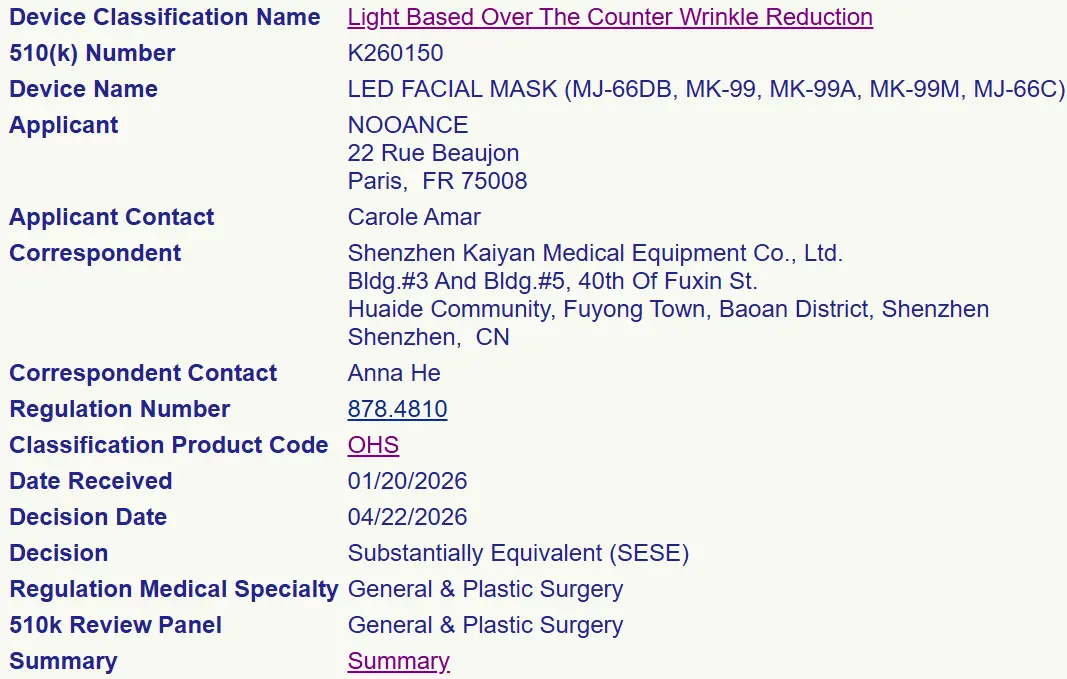
I open the FDA’s 510(k) database and search the K number if the brand prints one, otherwise the brand, then the model number on the box or in the manual. Then I read 3 lines: the applicant, the device name with the model codes it covers, and the summary PDF (which often holds the irradiance per mode and the LED count the website never gives).
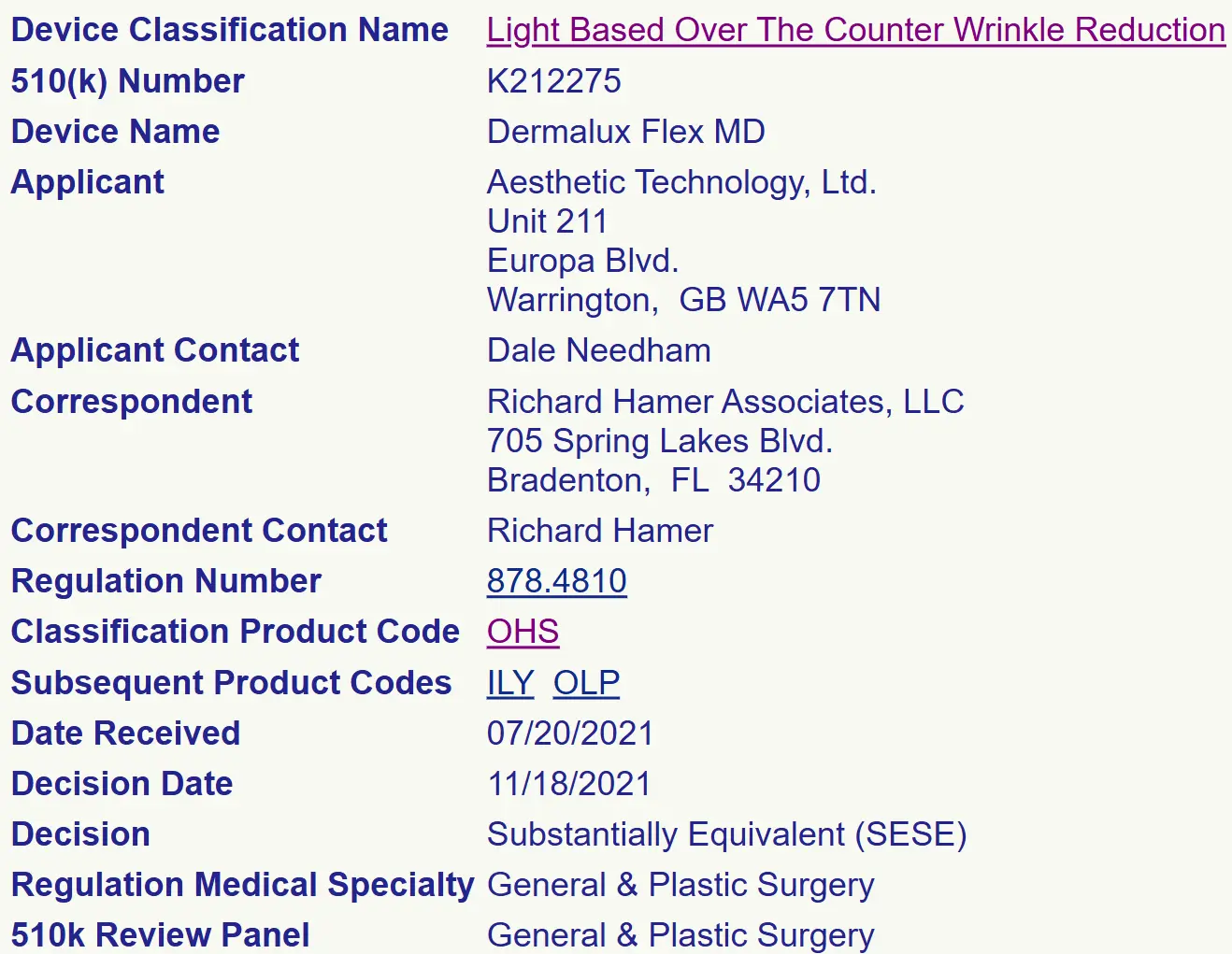
The applicant varies by brand, for example, Nooance, Shark, and FOREO have registered their own masks, but Currentbody’s K250966 masks are registered under the manufacturer’s name.
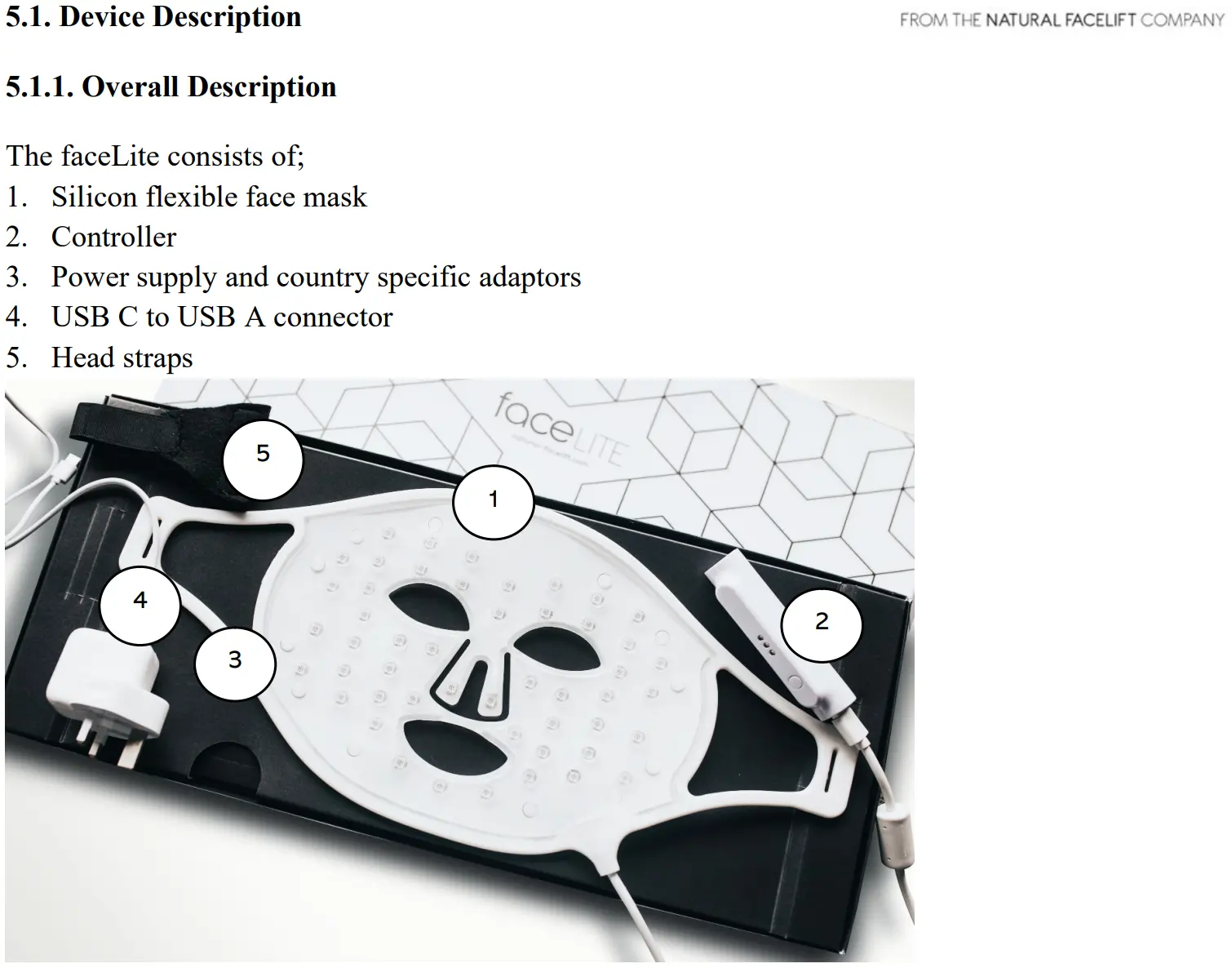
However, I sometimes come across exceptional cases, such as Omnilux’s K191629 authorization, which was registered by a British marketing company for a device called faceLITE, and more than 20 brands market the same LED mask under this reference!
The second thing I check is that the file actually pertains to the LED mask itself, because several brands keep the same file for multiple LED masks. But certification isn’t transferable just like that; for example, the iRestore Illumina mask refers to a file held by a Chinese manufacturer for 13 references, none of which correspond to the Illumina…
How I read a clinical study on an LED mask
Apart from the FDA application, I also look at clinical studies on the LED mask, when a study has been carried out on it.
- Was it run on this model, or on a clinic machine with the same wavelengths?
- How many people enrolled, how many finished, over how many weeks?
- Is the laboratory named?
- Were the results measured with instruments (a cutometer, a VISIA camera, an ultrasound probe) or with a self-questionnaire?
- Was there a control group, a statistical method, dated photos?
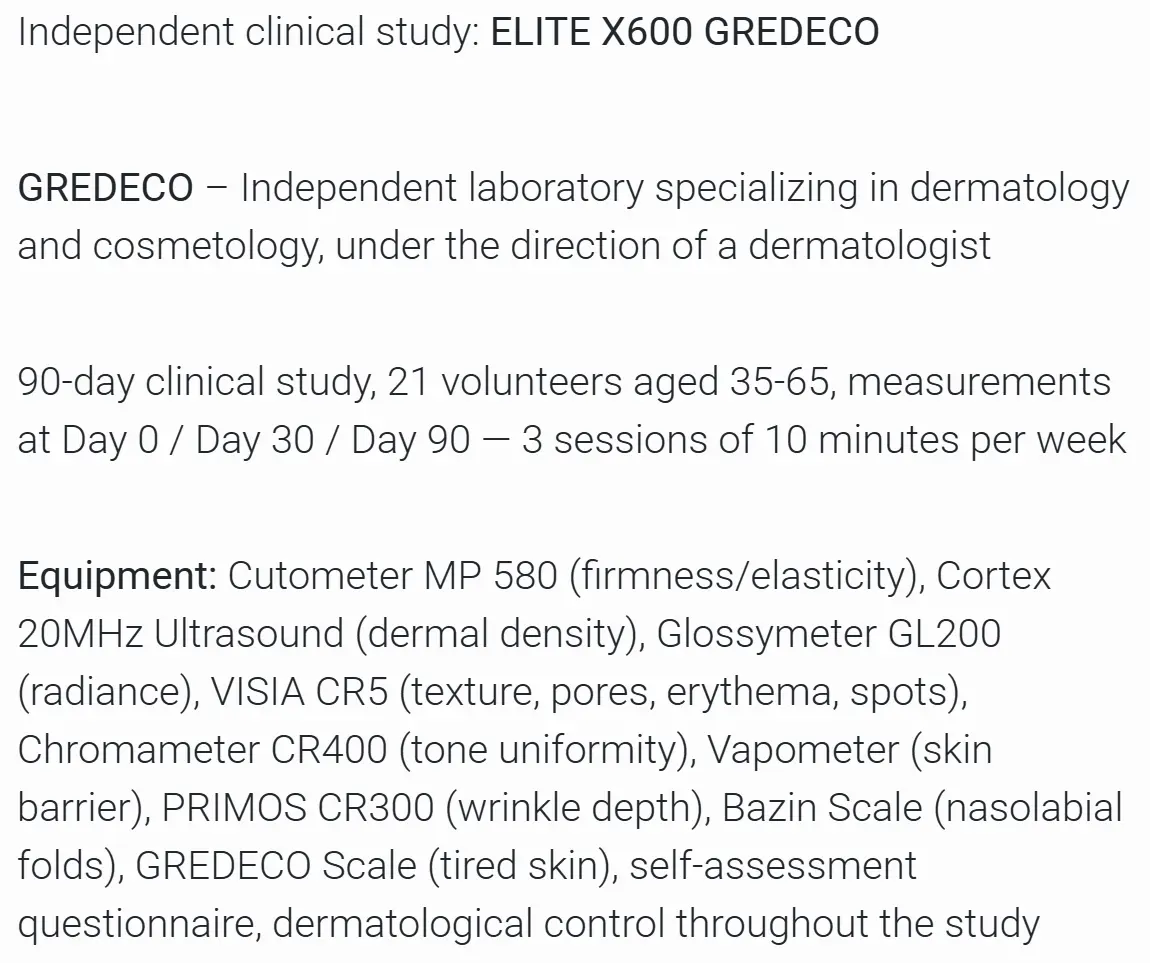
An instrumental study focusing on the exact model is far more valuable in my view than a satisfaction questionnaire, since the figures are concrete whereas satisfaction is relative. I elaborate further on the interpretation of the measurements in the “Results” criterion.
I also evaluate the study method, because many brands conduct studies themselves and make mistakes… For example, the Omnilux study on Contour Face mentions its instruments, but each participant wore a hydrogel mask under the LED mask at each session, with an increased elasticity of 21.4% ten minutes after the start of the first session… Nobody produces collagen in 10 minutes!

The 7 proof points I check on every LED mask
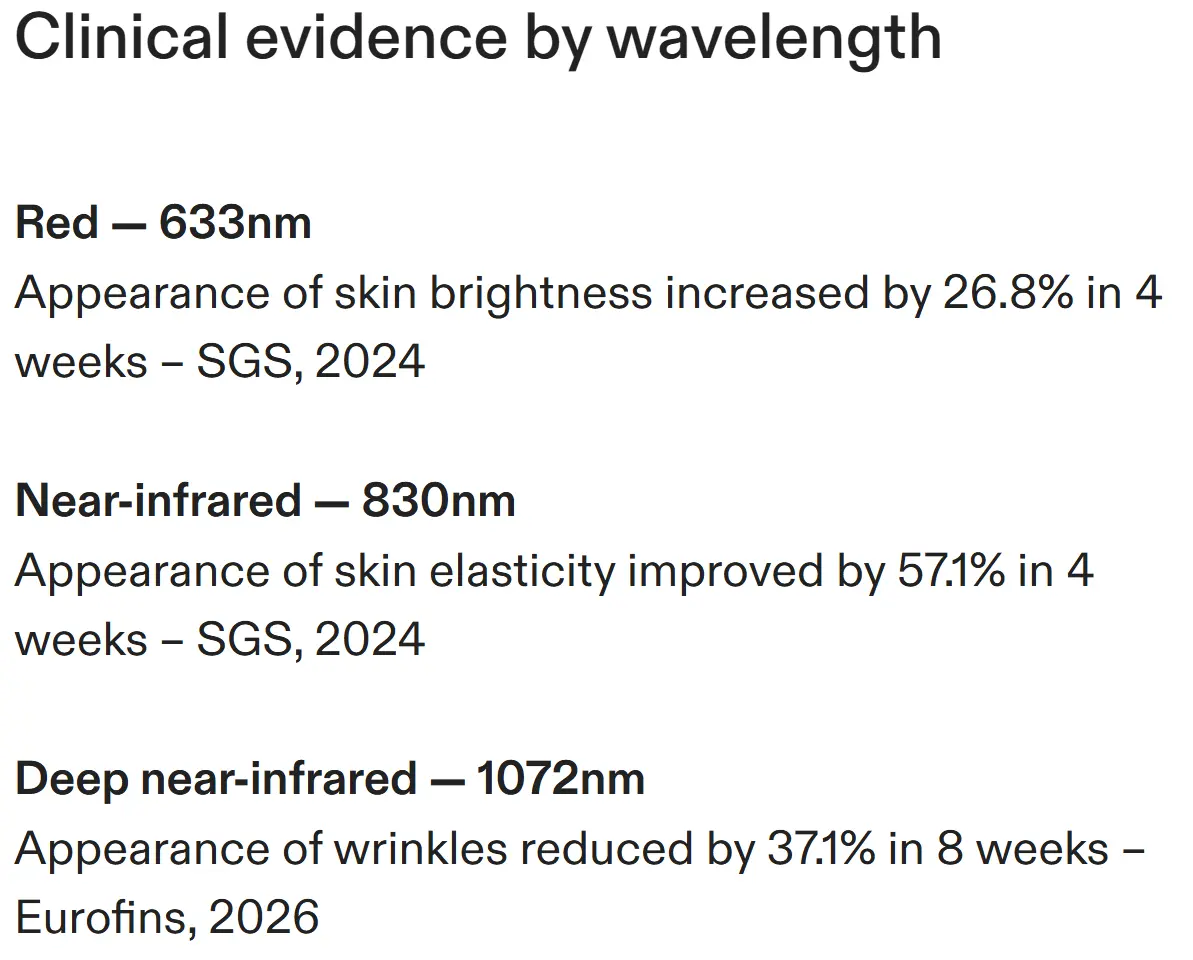
- Wavelengths in nm, not “red light”. 633 and 830 nm are a specification, a color isn’t. And a nm doesn’t make a trendy color useful: in CurrentBody’s own FDA file, green “is provided solely for the user’s comfort and relaxation” (the screenshot is in my CurrentBody Series 3 review).
- A dose I can calculate, in J/cm², from a published irradiance and the session length. No irradiance, no dose, no point.
- An FDA clearance number I can find in the database, covering this model. A badge without a number sends me looking, and I don’t always find it.
- A clinical study on this exact model, rather than on a predecessor, a clinic device or a wavelength.
- A study documented past the headline: sample size, duration, named laboratory.
- Photobiological safety declared, under any wording: IEC 62471 tested, photobiological safety tested… The risk group itself is a bonus almost nobody prints.
- Warranty and support documented: the term, the return window, a way to reach someone.
4 LED masks I assessed on proof
- Nooance Elite X600 7
- CurrentBody Series 2 7
- Omnilux Contour Face 6
- Shark CryoGlow 5
- CurrentBody Series 3 2
Best: Nooance Elite X600
The FDA-clearance (K260150) is in Nooance’s own name, it lists the model, and the number is clearly displayed on the website. The study was conducted by GREDECO, an independent dermatology laboratory, on this exact model. All instruments used are listed, statistics are displayed below the results, and photos were taken on days 0, 30, and 90. The manual indicates the photobiological risk group, and the warranty is 2 years.
7 points out of 7 and 5/5, and I go through the study page by page in my review of the Nooance Elite X600.
Okay: CurrentBody Series 2
CurrentBody states “FDA approved” and leaves it at that. I found the file myself (K250966), which includes the manufacturer’s name, and the number is still not displayed on the website. The study is real and conducted in a reputable laboratory, even if some figures have been slightly manipulated. Overall, the 7 points are well-deserved, but the presentation is less polished than Nooance’s: 4.5/5. Details in my CurrentBody Series 2 review.
Mid: Omnilux Contour Face
Omnilux has a fair amount of documentation but communicates (intentionally or not) with many mistakes. The FDA-clearance is the faceLITE dossier, filed by another company and shared by about twenty brands. I find this unprofessional.
The 3 effectiveness percentages on the product page come from an acne study conducted with another Omnilux device, while the actual Contour Face study also used a hydrogel mask. Frankly, it’s misleading, and I gave it a 3/5 rating. My Omnilux Contour Face review shows both documents.
Worst: CurrentBody Series 3
The Series 3 page says FDA-cleared with no number, and I found nothing under its model code. No irradiance is published, and the 5 studies on the page were run on the Series 2 or on single wavelengths, none of them on the Series 3: CurrentBody redesigned the LED mask and kept the Series 2’s paperwork. Wavelengths and warranty are the only 2 points it holds, so 1.5/5. My CurrentBody Series 3 review lists what I’d need to see to change that.
Every proof score I have given is in my LED mask picker, and the masks that combine a clearance, a study and good light sit at the head of my ranking of the best LED masks.
The mistakes I see LED masks buyers make with proof
Reading FDA-cleared as “it works”. It means the device resembles one already on the market for the same use. Effectiveness is the study’s job, not the clearance’s.
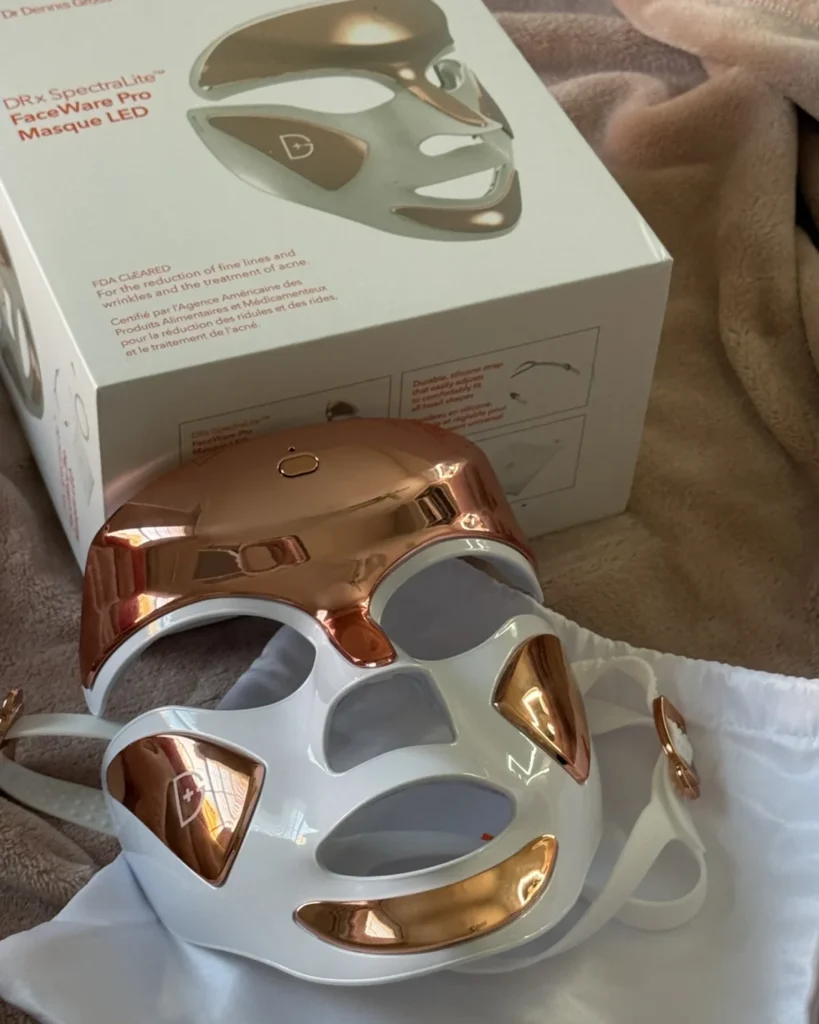
Trusting a badge with no number. Dr. Dennis Gross prints FDA-cleared on the box and no K number anywhere, so I had to find the file myself, and it holds no clinical data on the mask.
Taking a percentage for a result. “87% saw smoother skin” with no sample size, no duration and no lab is a sentence, not a measurement.
Accepting a study on another device. Qure quotes figures from studies where the users were wearing something else, and Shark’s and CurrentBody’s newer masks lean on studies of their predecessors…
FDA clearance and LED mask studies: your questions
Is any LED mask FDA approved?
No. Consumer LED masks go through 510(k) clearance, which establishes equivalence to a device already on the market, not through approval, which reviews clinical data for safety and effectiveness. A page that says “FDA-approved” is wrong on that word, and I read the rest of it with that in mind.
How do I check if an LED mask is really FDA cleared?
Search the FDA’s 510(k) database for the K number if the brand prints one, otherwise for the brand name and the model code in the manual. Then check two things: that the model in the file is the one in the box, and who the applicant is. A file held by a factory for a dozen model codes can cover your mask, or not.
Does FDA clearance mean the LED mask works?
No. It means the FDA agreed the device resembles one already sold for the same intended use. Many 510(k) summaries for LED masks state that no clinical data was submitted. Whether the mask does anything on skin is the study’s job, and that’s a separate point on my grid.
What makes a clinical study on an LED mask credible?
It was run on this exact model, it names the lab, it gives the sample size, the completers and the duration, it measured with instruments rather than a questionnaire, it describes its statistics, and it shows dated photos.
Sources
- FDA files
- 510(k) database entries K260150 (Nooance), K250966 (CurrentBody Series 2, applicant Shenzhen Kaiyan), K191629 (faceLITE, 2019, applicant Ismart Marketing Services, used by Omnilux), K260715 (CurrentBody Multi-Light MK-110D, the closest file to the Series 3 MK-110I), K250830 (the file iRestore’s badge points to), K183247 (Dr. Dennis Gross), K242796 (Shark), product code OHS throughout
- Studies
- GREDECO reports published on Nooance’s product pages, the Omnilux Contour Face study PDF (28 enrolled, 25 completers), ClinicalTrials.gov NCT07025837, the study summaries on CurrentBody’s and Shark’s pages
- Checked
- November 2026

About Emilie
I have tested LED masks since 2023. I buy the devices, use them for weeks, and read the spec sheets nobody reads, because this market runs on numbers most brands never publish. Not a dermatologist, and I say so whenever a question needs one.