
I buy the devices I test unless the article says otherwise. Some links and discount codes on this site are paid links: if you buy through one, I earn a commission. It never changes a score or a verdict.
Coverage is the number of light points an LED mask puts on your face, how evenly they’re spread, and which zones get nothing. It’s the only criterion you can check by eye before buying, and it’s also the one where the number on the box misleads the most: 600 LEDs can be 300 light points, or only 100 light points!
Here’s how I count, why density matters, the zones most LED masks leave in the dark, and 4 LED masks I’ve tested as examples.
Coverage: One of the 7 criteria on my grid
Coverage is the third of the 7 criteria I score every LED mask on, and the one you ask me about most, because the LED count is the first number on every box. After enough of those questions, I decided to give each criterion its own page rather than a paragraph in every review. Here are the 7, in the order of my grid from my How I test page:
- Results, 24% of the score
- Irradiance, 16% of the score
- Coverage, 14% of the score, this page
- Proof, 14% of the score
- Comfort, 12% of the score
- Value, 12% of the score
- Safety & support, 8% of the score
LEDs or light points?
Every LED mask brand counts chips. A bulb that holds a red die and a near-infrared die is sold as 2 LEDs (dual-core LED), a tri-chip bulb as 3, a quad-chip as 4. It’s the convention of the whole market, so I don’t hold it against any one brand. But more LEDs do not necessarily lead to better facial coverage.
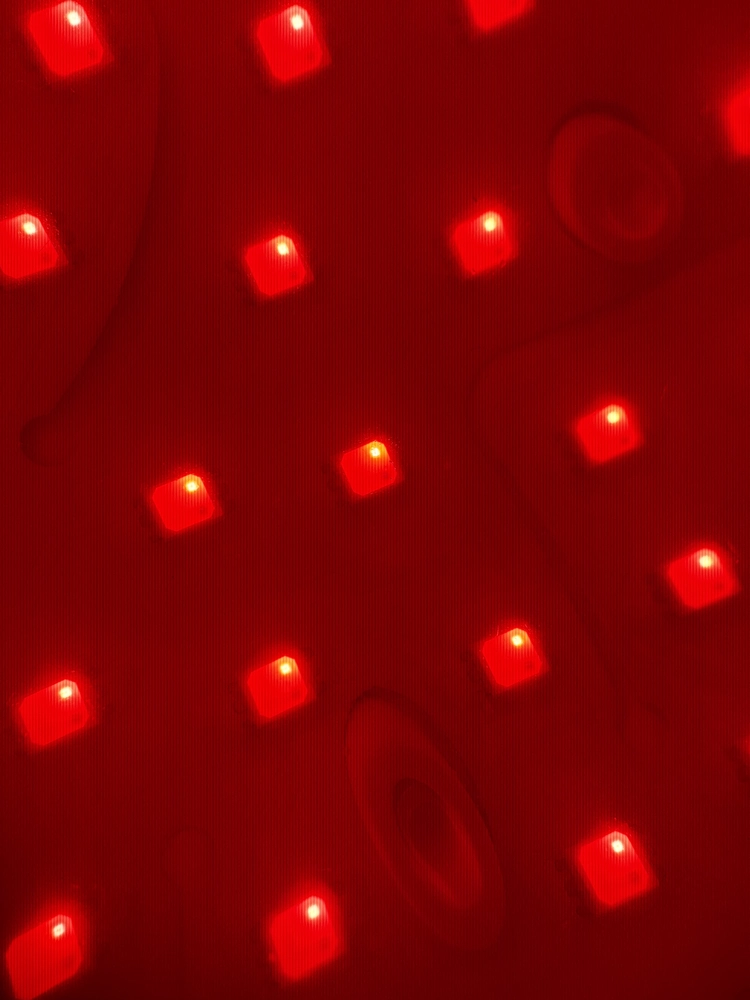
So I do the same recount on every LED mask: I count the chips myself rather than the LEDs. And sometimes there’s a big difference, for example:
- The Nooance Elite X600 advertises 600 LEDs and lights 300 points (dual-core LEDs)
- The CurrentBody Series 3 advertises 750 LEDs and lights only 125 points (hexa-core LEDs).
- The Omnilux Contour Face advertises 132 and lights 66.
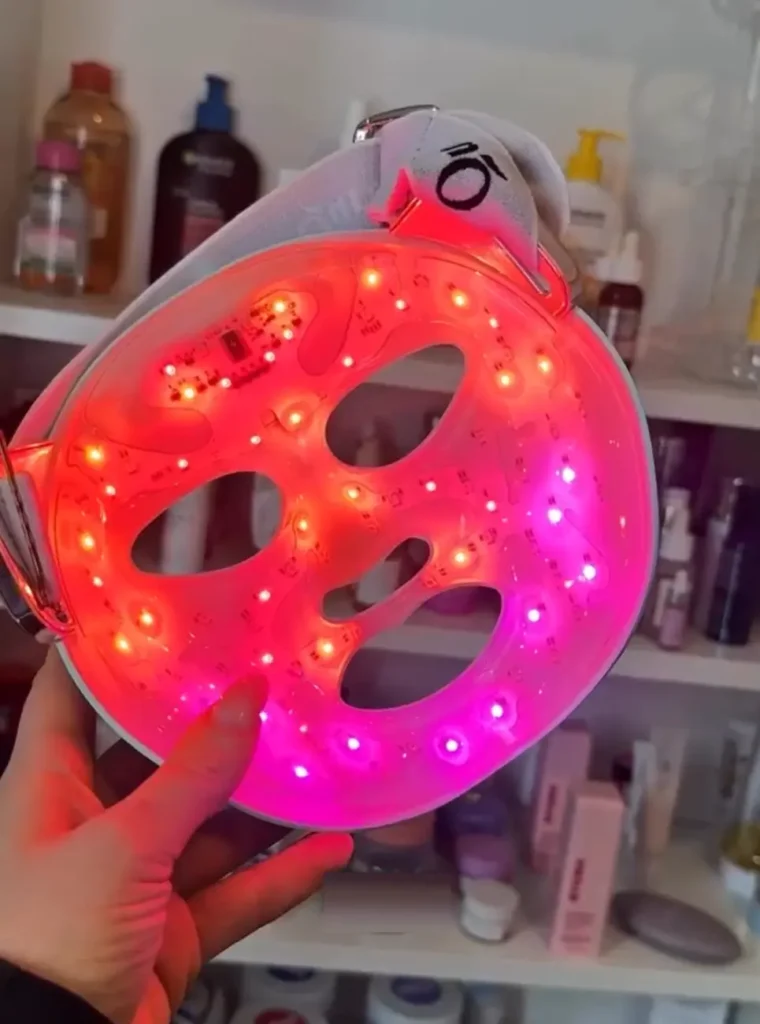
- FOREO’s FAQ Swiss 202 advertises “600 light points” that are actually holes in the silicone, with 50 LEDs in the headband around them…
A brand that prints both numbers, like Dermalux with its 144 chips and 318 LEDs, makes this easy, and I appreciate it. But why so many LEDs in each bulb? Mostly because of the trendy colors: yellow, green, blue, sometimes purple… Every new color adds one chip to every bulb, so the LED count on the box goes up. That’s how the CurrentBody Series 3 gets to 750 LEDs: each of its 125 bulbs holds 6 wavelengths, and 3 of them are blue, green and yellow.
To be honest, there’s no solid evidence that yellow or green do anything on skin, unlike the red and near-infrared used in clinics (blue is a separate case with some first results, for acne). I’ve tried these colors myself and saw no effect, so personally, I’d rather feed my skin with the wavelengths that have actually proven their effects! I explain why they shouldn’t cost you more either in my value guide.
Why LED density matters
Each LED throws a cone of light that’s brightest in the center and fades toward the edge. To get an even dose across the face, the bulbs need to be close enough for neighboring beams to overlap. Spread them out, and the skin under a bulb and the skin between two bulbs get two different doses during the same 10 minutes.
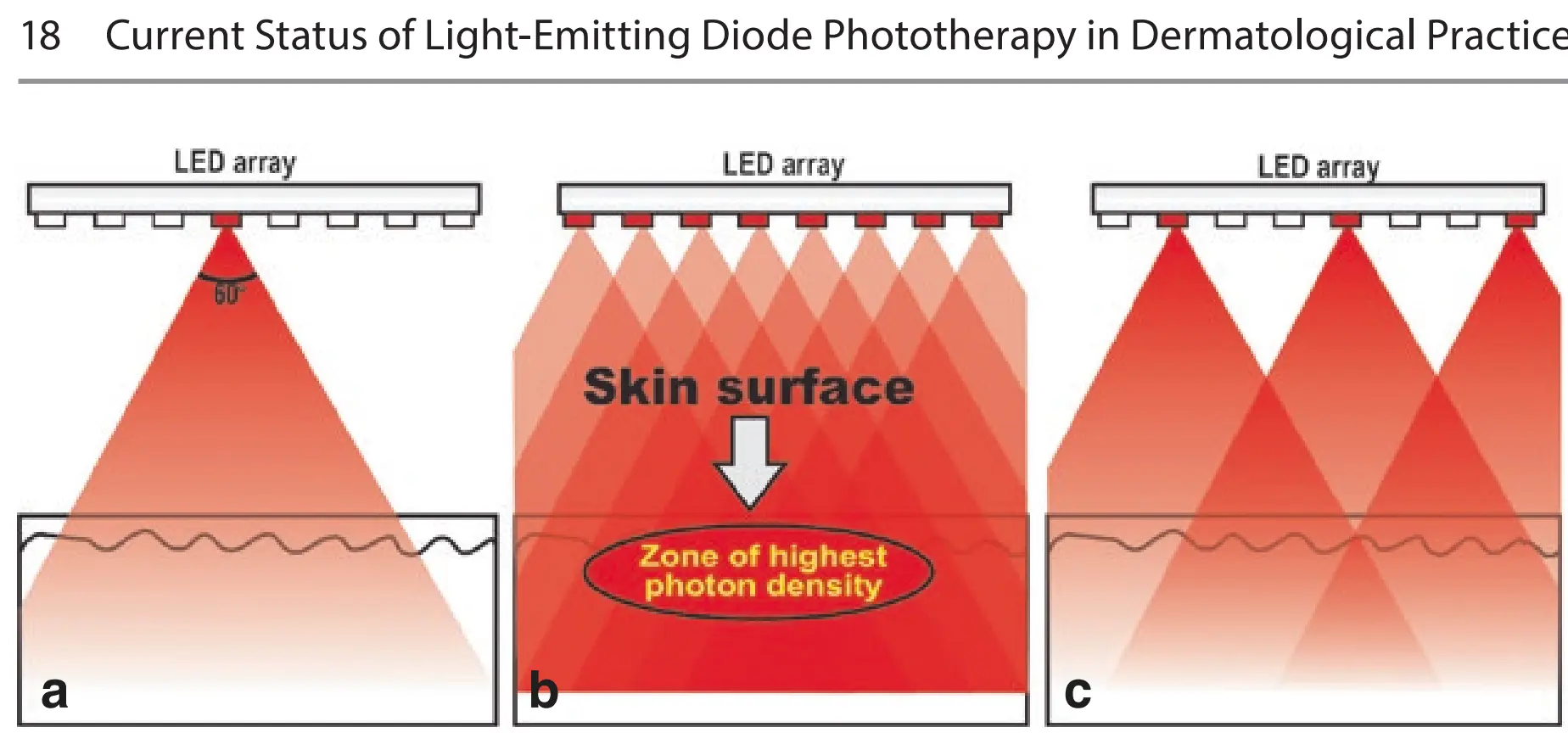
So more light points can increase the light density itself, and also give you fewer gaps. That’s why irradiance and coverage weigh 30% of my score together: they describe the same dose from two ends. In practice, I consider about 120 light points as the minimum for a full face. Below that, you can see the gaps with the naked eye, and I’ve tested a few LED masks under 100 that did nothing on my skin in 8 weeks.

The zones an LED mask leaves in the dark
In addition to the number of LEDs, I also look at the areas exposed. So, I put on the LED mask and observe the areas it doesn’t cover, the most common being the hot spots: the nose (bridge and sides), the upper lip, the eye contour and crow’s feet, the jawline, the chin, and the top of the forehead.
These are the areas for which most people buy an LED mask because they are the ones that show signs of aging the fastest, and yet many masks don’t cover them properly. If your priority is reducing crow’s feet wrinkles, focus first on the eye contour!
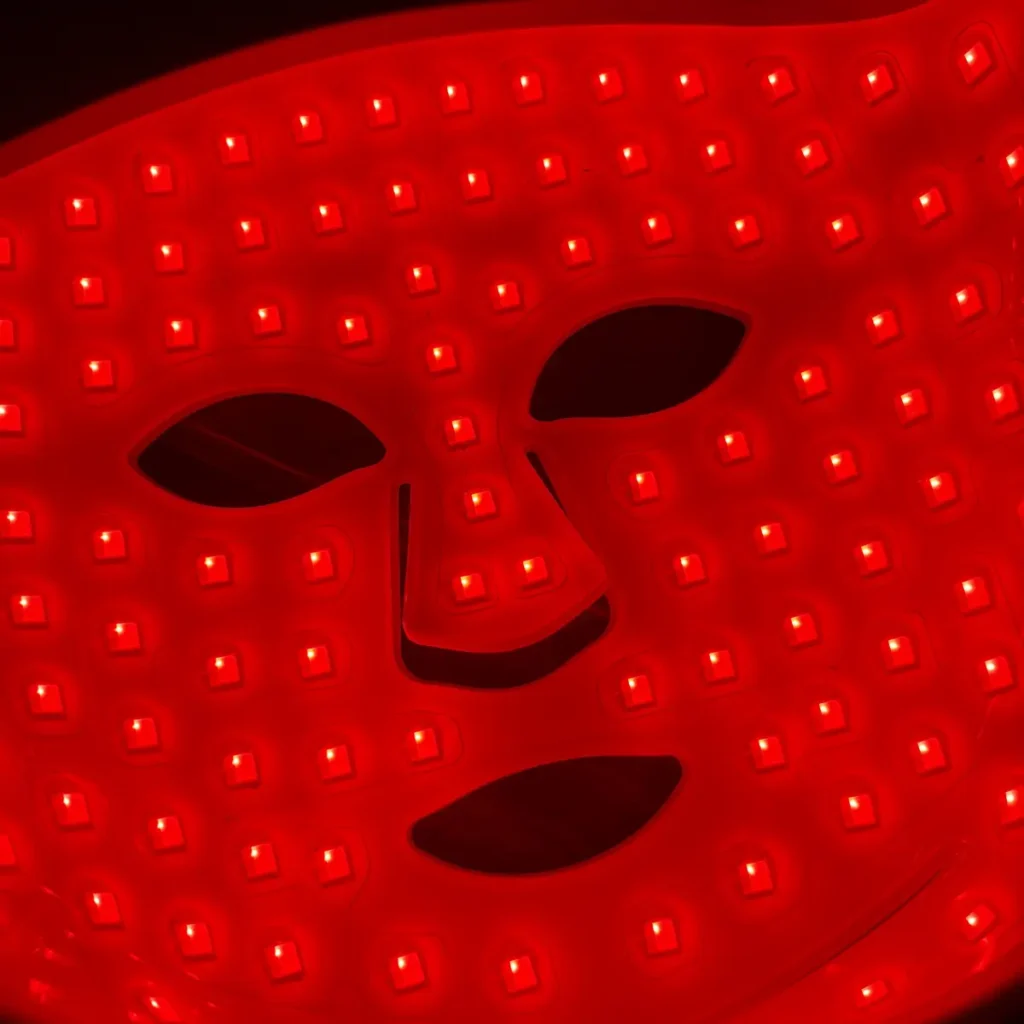
The positioning of these LEDs is also important, as some models don’t have LEDs covering the entire LED array. For example, the Therabody TheraFace mask has 216 light points but a large empty area from the forehead to the chin, precisely where the nose, upper lip, and chin are located.
Its less expensive alternative, the TheraFace Mask Glo, has 168 LEDs but adequately covers this area. Personally, I’d take the 168 (my comparison of the two).
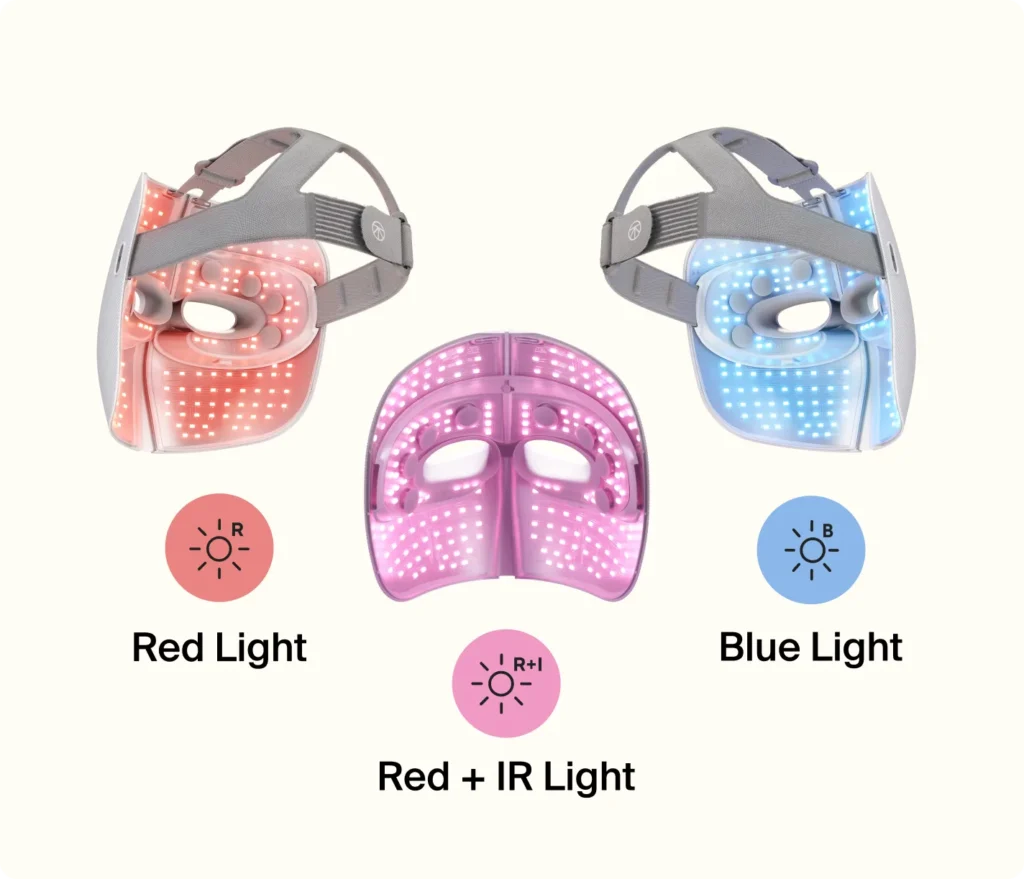
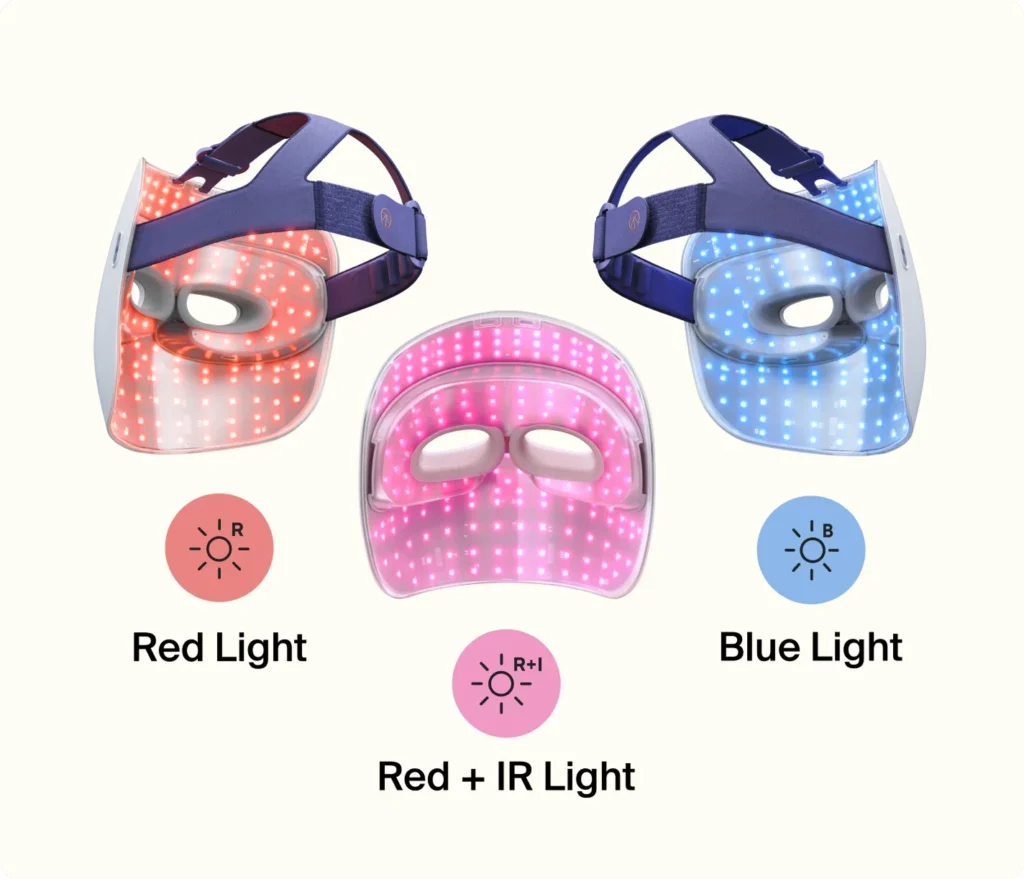
Molded, flat or rigid: does the light reach the skin?
Besides the number of light points, I also consider the shape of the mask in my tests because it directly influences the amount of light reaching the skin:
- A molded silicone shell follows the face: it touches the jaw, the sides of the nose and under the chin, so every light point is as close as possible to the skin (Nooance, CurrentBody, JOVS).
- A flat panel bridges from cheekbone to cheekbone and leaves the skin exposed for several millimeters, and even more on the nose, jaw and chin (Omnilux, Nanoleaf).
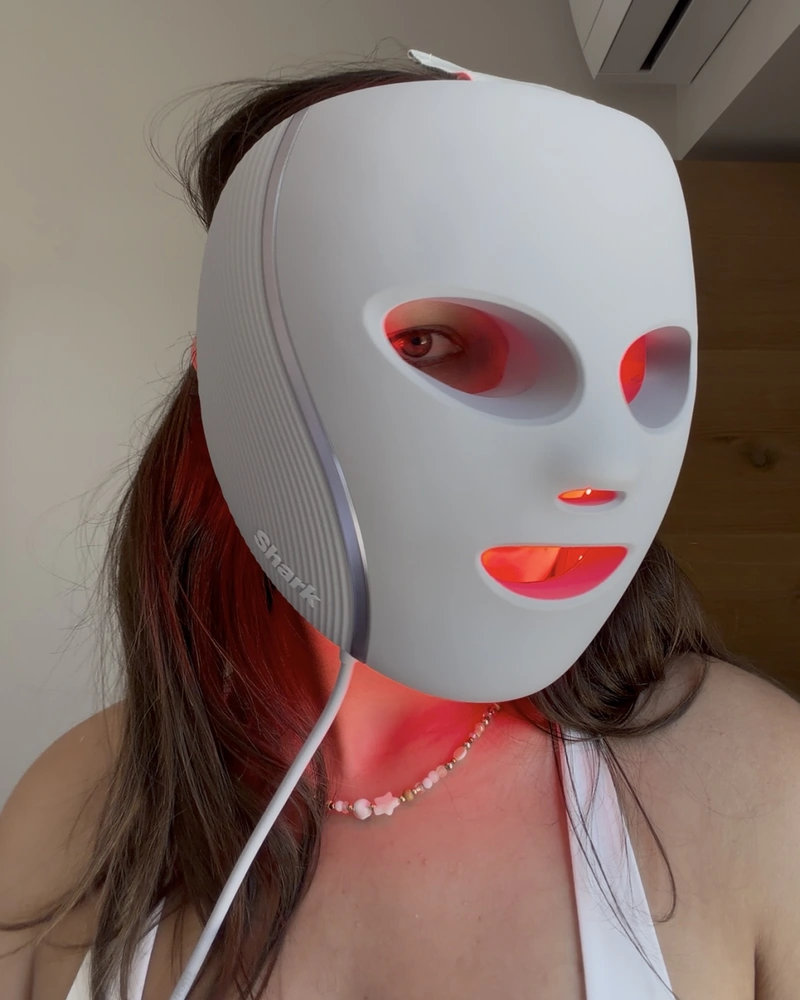
- A rigid shell cannot adapt to the face, and some models cause the LED array to be really far from the skin (Shark, Therabody, iRestore).
4 LED masks I assessed on coverage
- Nooance Elite X600 300
- Shark CryoGlow 160
- CurrentBody Series 2 110
- Omnilux Contour Face 66
- FOREO FAQ Swiss 202 50
The Shark isn’t among the 4 below, but you can see on this chart that 160 points isn’t the whole story: on a rigid shell with cooling pads under the eyes, it only scored 2.5/5 here.
Best: Nooance Elite X600
600 LEDs and 300 light points are both true: each bulb is dual-core, a red die next to a near-infrared one. The molded silicone follows the face, so the light reaches the nose on both sides, the upper lip, the jaw, under the chin and all the way around the eyes.
From underneath, it’s a continuous sheet of light rather than a grid of dots, and it’s the best coverage I’ve had at home: 5/5. My review of the Nooance Elite X600 has the photos.
Okay: CurrentBody Series 2 and Series 3
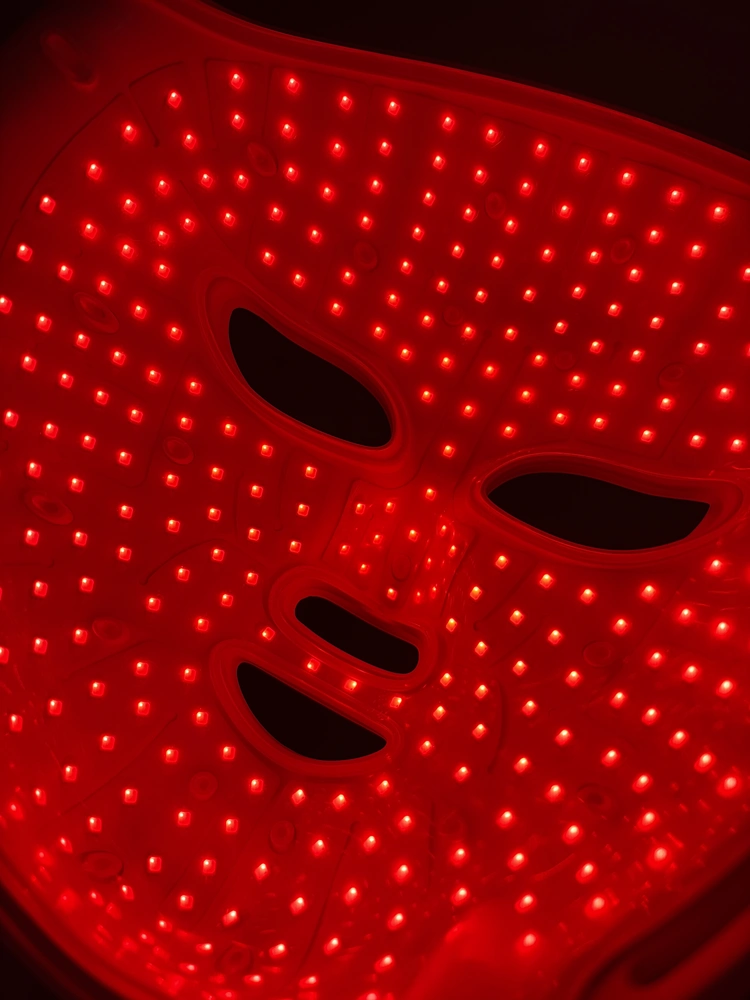
The box says 236 LEDs, but on my face the Series 2 lights about 110 points. And for the Series 3, it says 750 LEDs but only 125 points… The shell is molded and flexible, so my jaw, under my chin and the outer corners of my eyes all get light, which is more than most LED masks I tested.
But the cutouts are not good as there is no LED over the bridge of my nose, over my upper lip, or on the skin closest to my eyes. 3.5/5, and my CurrentBody Series 2 review maps it zone by zone.
Mid: Omnilux Contour Face
132 LEDs in 66 dual-chip bulbs, on a flat flexible panel. 66 bulbs spread over a whole face can’t overlap, and there’s no LED above the upper lip at all, so the zone most of its buyers care about is the one it skips… It’s well made and sits closer to the skin than a rigid shell, but that’s still 2/5 for coverage. My Omnilux Contour Face review shows the dead zones one by one.
Worst: FOREO FAQ Swiss 202
FOREO advertises “600 light points,” but it’s not an LED array, it’s just holes: you can stick a toothpick in one and come out the other! In reality, there are only 50 LEDs in the eye strip that illuminate the silicone sideways, and none of them are in direct contact with the skin.
The sheet doesn’t cover the nose, mouth, chin, or jaw. I give it 1/5 and I don’t recommend it. My FOREO FAQ Swiss 202 review explains why I stopped the test after 4 weeks.
The light points of every mask I have counted are in my LED mask picker, and it is no coincidence that the densest ones come first in my ranking of the best LED face masks.
The mistakes I see buyers make with LED count
Comparing box numbers. 480 against 236 tells you nothing until you know how many chips each brand packs per bulb. Divide first by the number of wavelengths, then compare. You can also count the chips on pictures.
Counting colors as coverage. A bulb with a red, a near-infrared and a yellow chip is 3 LEDs on the box, but it’s still 1 light point on your face.
Believing more LEDs means more power. At equal irradiance, more points don’t give a stronger beam, they give fewer gaps. Density is coverage, irradiance is intensity, and you need both.
Taking flexible for fitted. A flat silicone sheet bends, it doesn’t follow a nose or wrap under a chin. Only a molded flexible shell does, and it’s a different object at a different price.
LED count and coverage: your questions
How many LEDs should an LED mask have?
Count light points, not LEDs. I consider about 120 light points as the minimum for a full face, and the best LED mask I’ve worn has 300. In LEDs as brands count them, that minimum is 240 for a dual-core mask and 360 for a tri-chip one.
What’s the difference between LEDs and light points?
A light point is one bulb on the mask. Brands count the chips inside each bulb, usually 2 or 3 of different wavelengths, and only one of them is lit in a given mode. So 600 LEDs on a dual-core mask is 300 light points on your skin, and both numbers are true.
Do yellow and green LEDs make an LED mask better?
Not in my opinion. They raise the LED count on the box, but there’s no solid evidence they do anything on skin, and I saw no effect when I tried them. Red and near-infrared are the wavelengths with proven effects, so those are the ones I look for.
Do more LEDs mean more power?
No. Power per square centimeter is the irradiance, and it’s a separate figure. More light points mean the beams overlap instead of leaving gaps, so the dose is even across the face. You need both: enough irradiance, and enough points to spread it.
Sources
- Counts
- Light points counted by me on each lit mask, set against the LED breakdowns in the brands’ FAQs, manuals and FDA 510(k) summaries, as detailed in each review linked above
- Diagram
- Beam-overlap figure reproduced from a dermatology paper on LED phototherapy, as used in my reviews
- Checked
- November 2026

About Emilie
I have tested LED masks since 2023. I buy the devices, use them for weeks, and read the spec sheets nobody reads, because this market runs on numbers most brands never publish. Not a dermatologist, and I say so whenever a question needs one.