I buy the devices I test unless the article says otherwise. Some links and discount codes on this site are paid links: if you buy through one, I earn a commission. It never changes a score or a verdict.
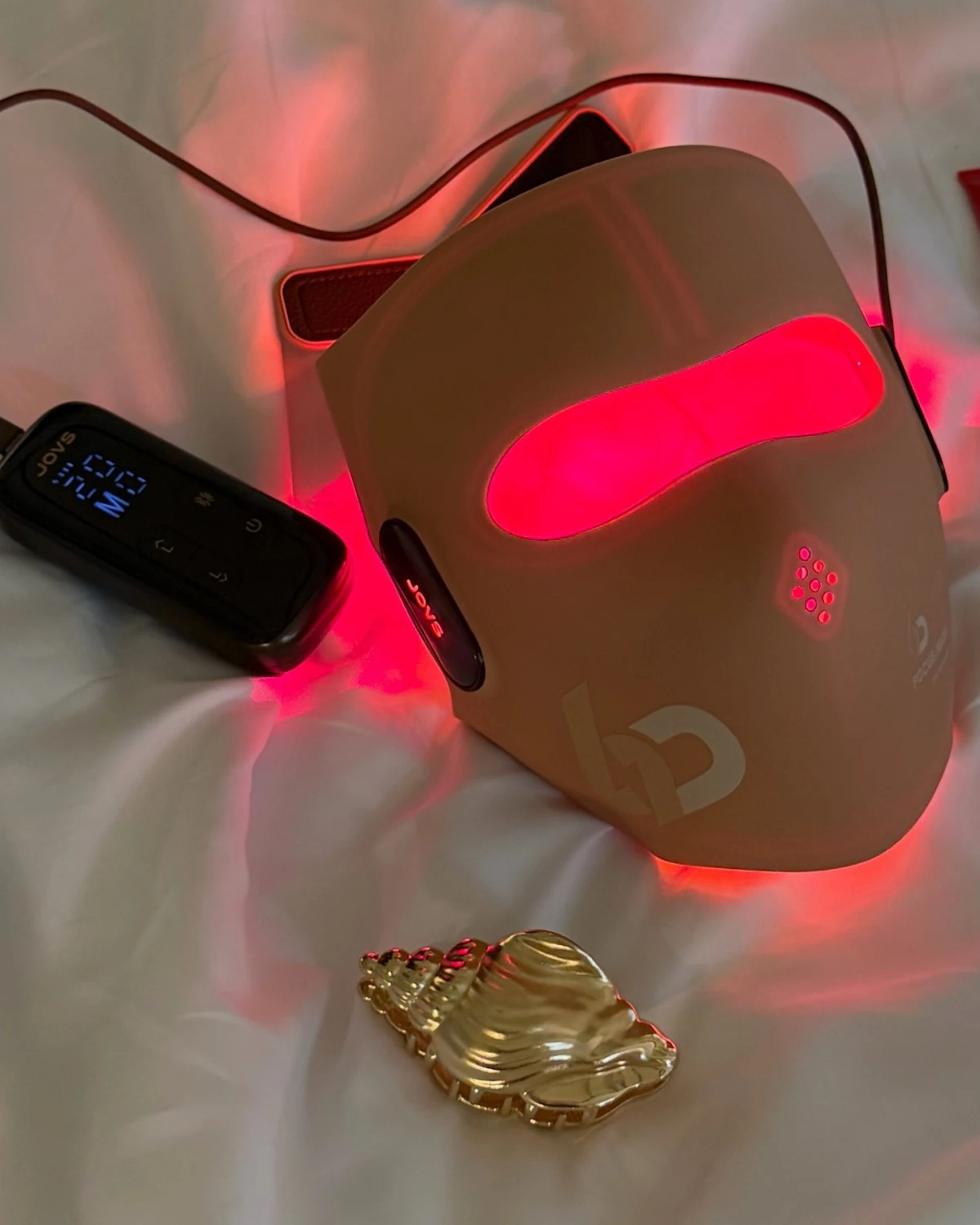
The JOVS 4D Laser Light Therapy Mask is the one Kim Kardashian held up on Instagram, and the first face mask I’ve tested that runs on lasers only, with no LED at all.
I used it for 8 weeks, 3 sessions per week, each lasting 10 minutes, in Mode 1. So here are my results, along with my full review of the JOVS 4D and the real benefits of lasers.
51/100
Shelved since October 2026My skin got slightly worse in a few areas. The soft molded shell is the best fit I’ve had since the Nooance, but lasers throw narrow beams, so 70 light points leave most of the face dark. 143 mW/cm² on a few spots is not a better deal than 50 mW/cm² everywhere, and that’s the whole story.
Buy it if
- You want a soft, foldable mask you can see through and carry in a bag.
- The laser argument convinces you more than the coverage one does.
Skip it if
- You expect light on the whole face, eye contour included.
- You already own a dense LED mask with +100 light points.
- You are buying it because it is the first of something.
What I tested: the JOVS 4D Laser Light Therapy Mask
I bought the JOVS 4D Laser Light Therapy Mask directly on the brand’s website at $729 instead of the $849 list price, with the newer remote that has a small screen for the mode and the timer. No code, no link, no contact with JOVS.
I tested it for 8 weeks, always in Mode 1. The 3 modes only change the intensity, and the light remains red regardless of the mode selected, so I opted for the shortest duration (10 minutes in Mode 1).
With an irradiance of 143 mW/cm² (light output) as specified by JOVS, 10 minutes are already enough to deliver approximately 86 J/cm² per session, nearly 3 times the 30 J/cm² often used in clinical studies. And that’s already a first sign that “something doesn’t add up.”
Results: 1.5/5
What changed on my face following my test, including my before-and-after photos. I also evaluate the “before-and-after” examples provided by the brand being tested, as well as the results of any studies that may have been conducted on the mask.
Read my results guideMy results with JOVS Laser mask: Before & After
After 24 sessions my skin was slightly worse than when I started, in patches rather than all over. Not a disaster, but the wrong direction for a $729 facial mask. I’m using LED masks for years, so when I stop my usual red light therapy routine for another device, I can quickly see if the alternative is not as good.
And in that case, for my skin at least, that settles the laser question: it didn’t help, since I can see that some areas aren’t being covered.
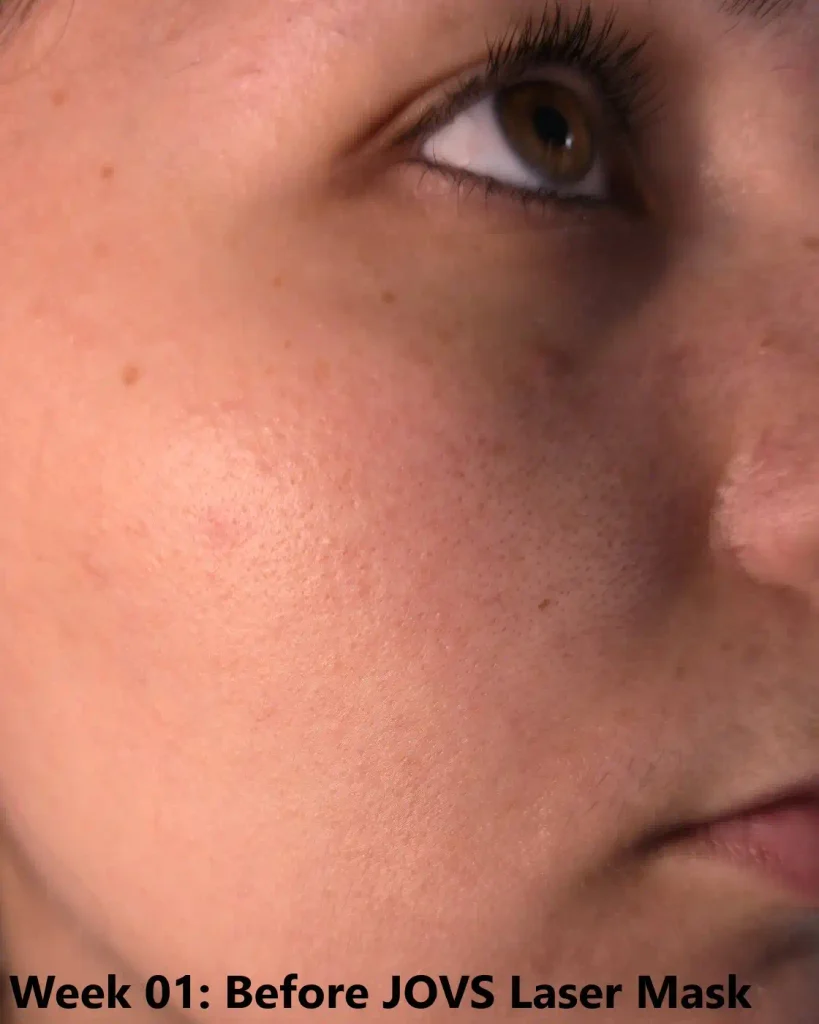
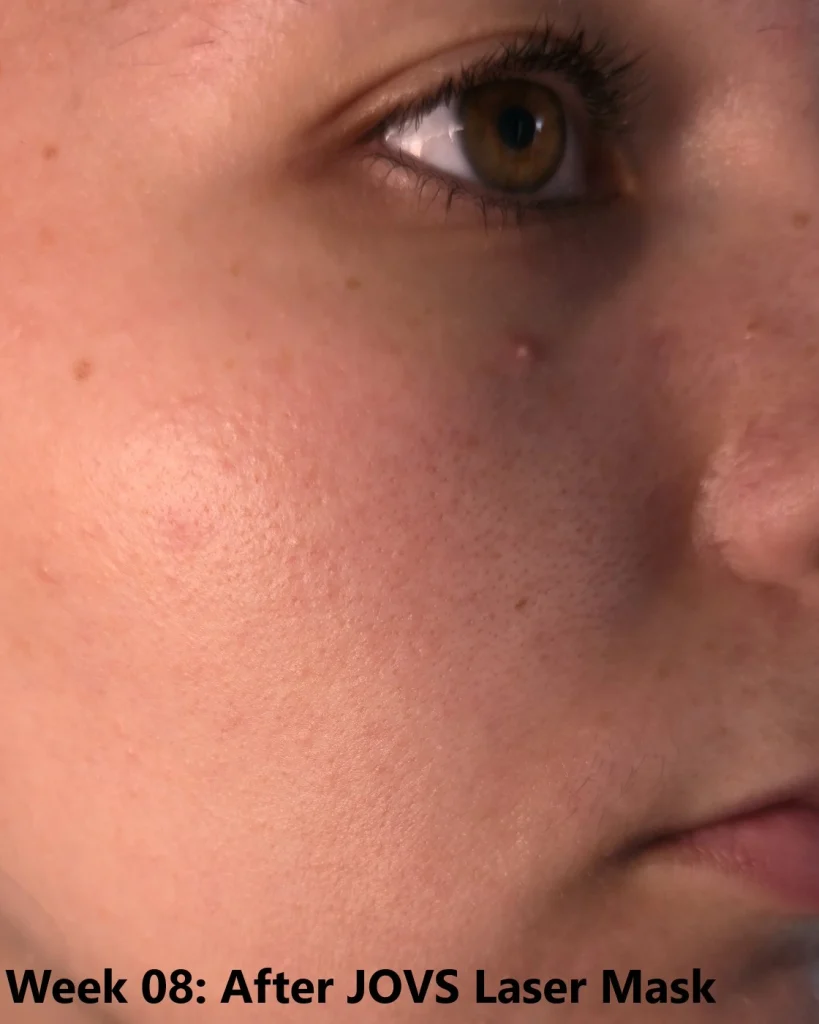
Usually, this is due to LED masks that aren’t powerful enough, but in this case it’s directly related to the lasers and the small number of light points. I’ll come back to this topic in the irradiance and coverage tab.
JOVS Laser mask results according to the brand
JOVS talks about 65% of users noticed firmer skin as early as the first week, 80% observed a lifting effect as early as the second week, and 90% reported firmer skin as early as the fourth week.
But I can not see any study names, participant numbers, or laboratories to back up these figures. Moreover, red light therapy can show results after several months, so people seeing results in the first week are simply expressing biased opinions…
Irradiance: 3/5
How much light reaches the skin, in mW/cm²? I evaluate this value, as well as how the information is presented, the conditions under which it was measured, and the total dose received in a single session. If the brand does not communicate it, I give it a severe rating.
Read my irradiance guideJOVS publishes 143 mW/cm², but I can not see any distance and no mode next to the figure. The same 143 sits in its comparison table against 30 for “LED masks“, which is where the “6× more powerful than LED” line comes from.
But against the 50 mW/cm² of my Nooance it’s less than 3 times, and it isn’t a target at all considering the 30 to 50 mW/cm² band where the research sits. Past that band, more light on the same spot doesn’t buy you more on a 10 minutes session.
JOVS 4D: 143 mW/cm² on the page, 100 in the FDA file
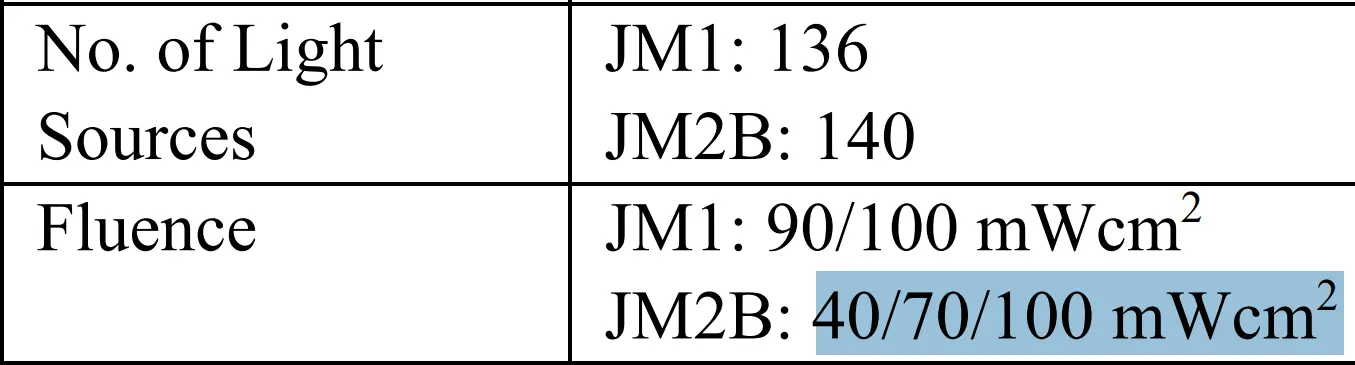
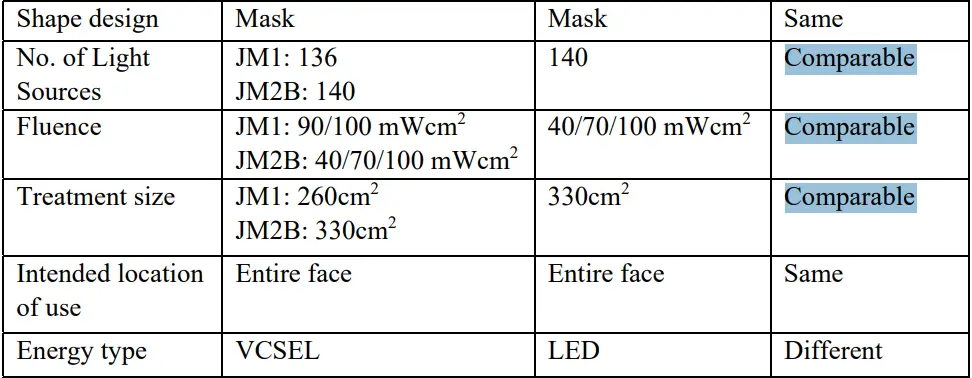
The number I trust more is in the FDA file. The 510(k) summary for the JM2B (code name of JOVS 4D) lists 40, 70 and 100 mW/cm² for its 3 levels. That’s the brand’s own document, submitted to a regulator, and it stops at 100. I would consider then the 100 mW/cm² as the right level of irradiance for JOVS. However, no indications about where it was measured: at the laser array of at the skin level …?
- JOVS 4D (product page) 143
- JOVS 4D (FDA file, top level) 100
- Nooance Elite X600 50
- CurrentBody Series 2 30
- Omnilux Contour Face 30
Coverage: 2.5/5
How many points of light does the mask actually feature, how evenly are they distributed, and which areas remain uncovered? Note that I am counting “bulbs” and not LEDs, because the number of LEDs often includes two, three or more diodes per bulb, which inflates the apparent coverage area.
Read my coverage guideJOVS 4D: 140 lasers or 70 light points?
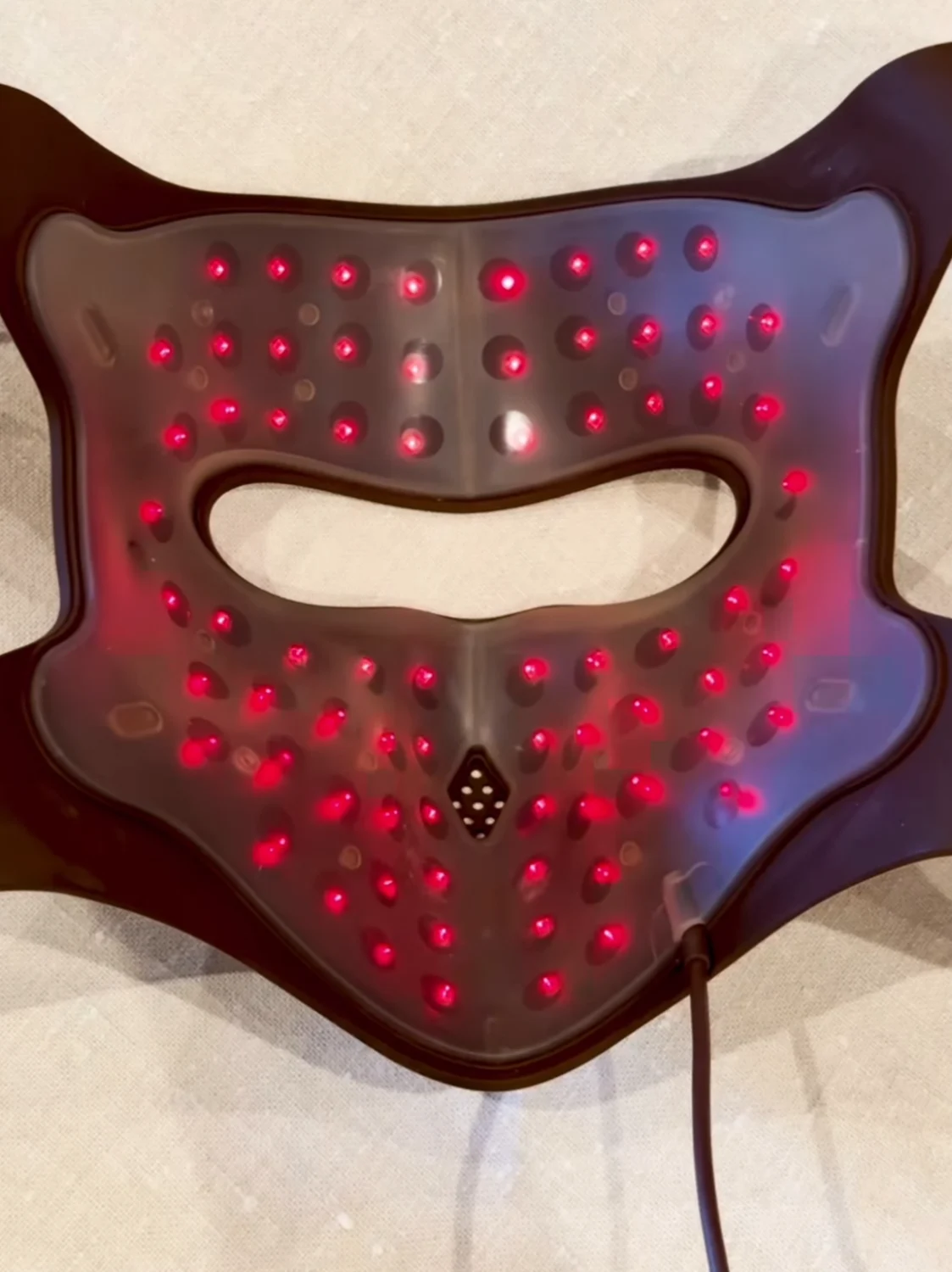
JOVS writes “140 precision laser beams” and it is indeed 70 light points that the mask is covering. Each point holds 2 lasers, which is where the 140 comes from, but the number that matters for your skin is the 70 because it indicates the light density.
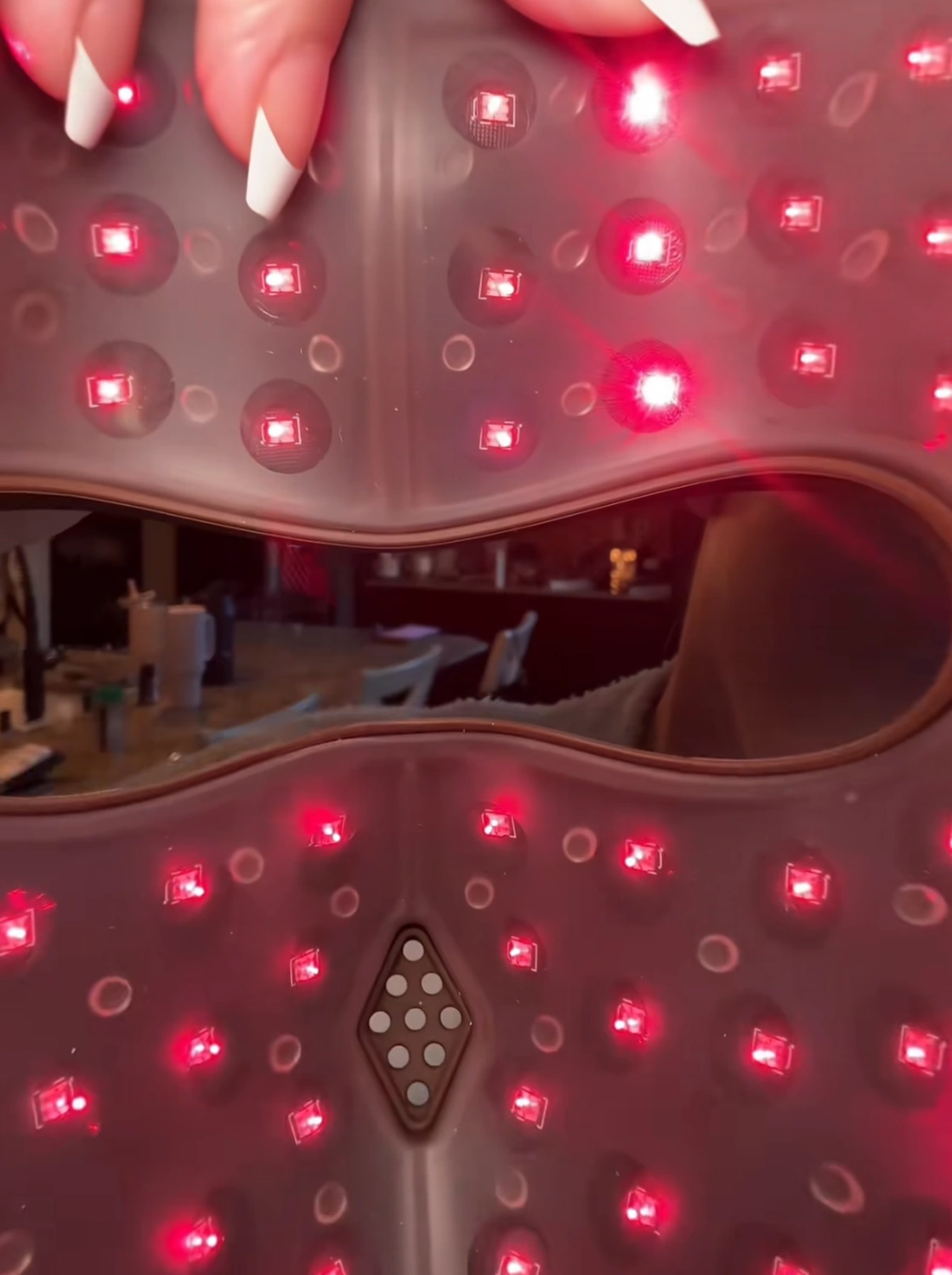
Why a laser mask can’t spread its light
An LED emits light at an angle of approximately 130°, a figure that JOVS itself lists in its comparison chart. As a result, adjacent LEDs overlap on the skin, providing uniform light coverage across the face. This is the principle behind light therapy.
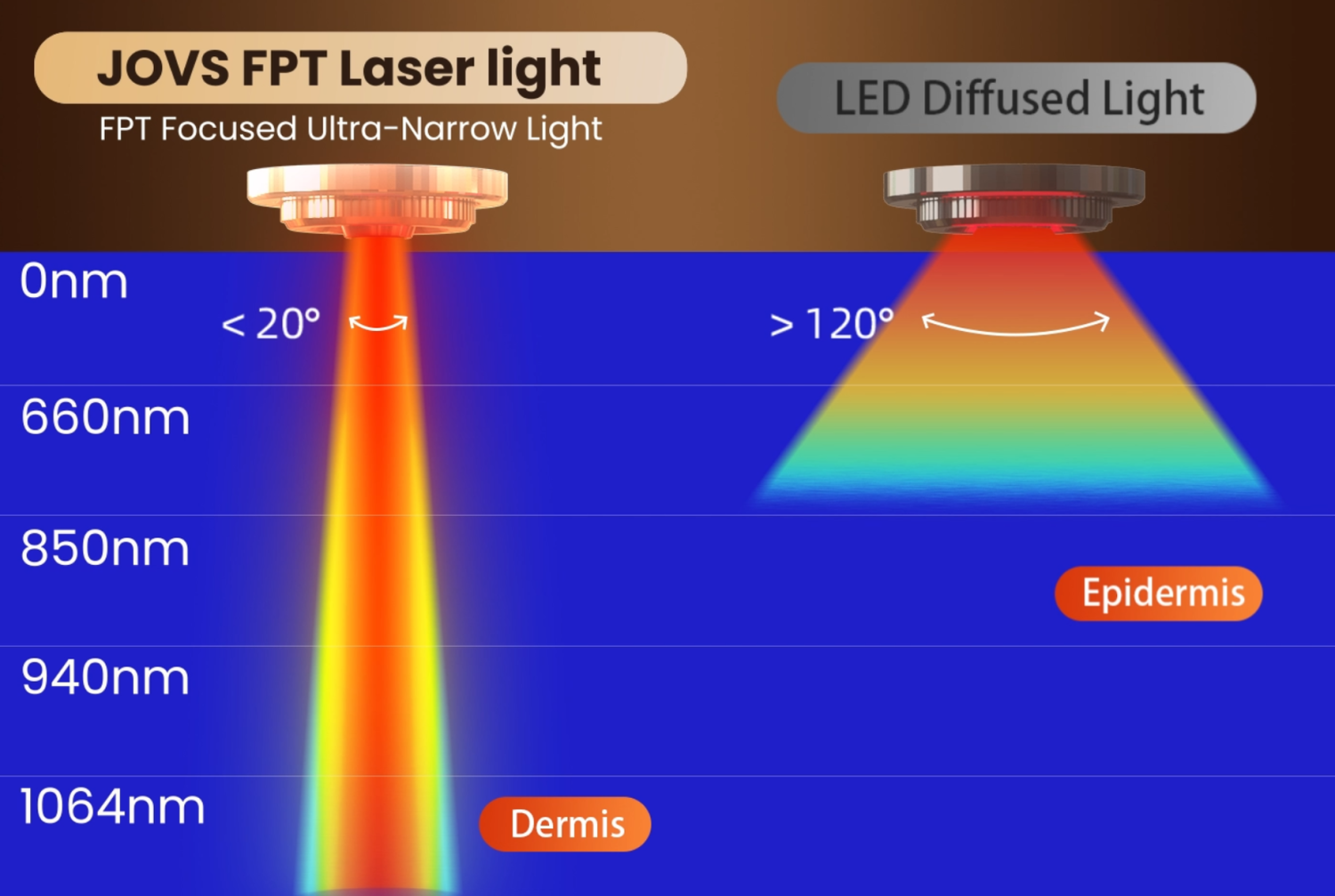
The lasers highlighted by JOVS emit light at an angle of 18 to 20°. Although JOVS primarily emphasizes the depth reached by the wavelength, the real difference with lasers lies in their narrow beam, which concentrates more energy at a single point.
But this also means that each of the 70 points illuminates only a small circle, and the skin between two circles receives virtually nothing…
In other words, Jovs maximizes power beyond the target thresholds, at the expense of light coverage on the skin… We need to do the exact opposite! Maximize coverage while ensuring sufficient and uniform power. You can see the problem in my video of the mask turned on.
And that’s a shame because Jovs 4D is one of the few LED masks with molded silicone that sits properly on the skin! It is the right design for an LED mask because the light arrives at the distance it was calibrated for. But here, on a laser mask, it just pins 70 dots in 70 fixed places.
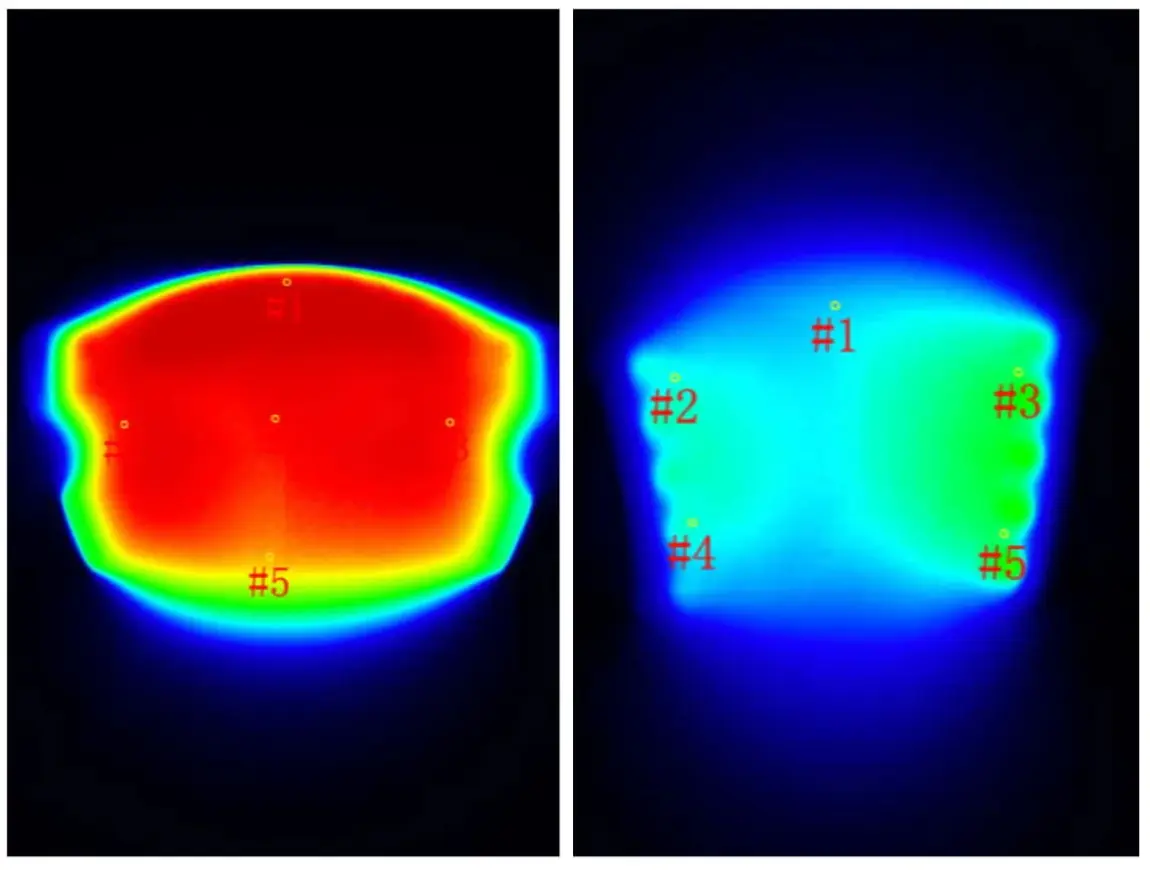
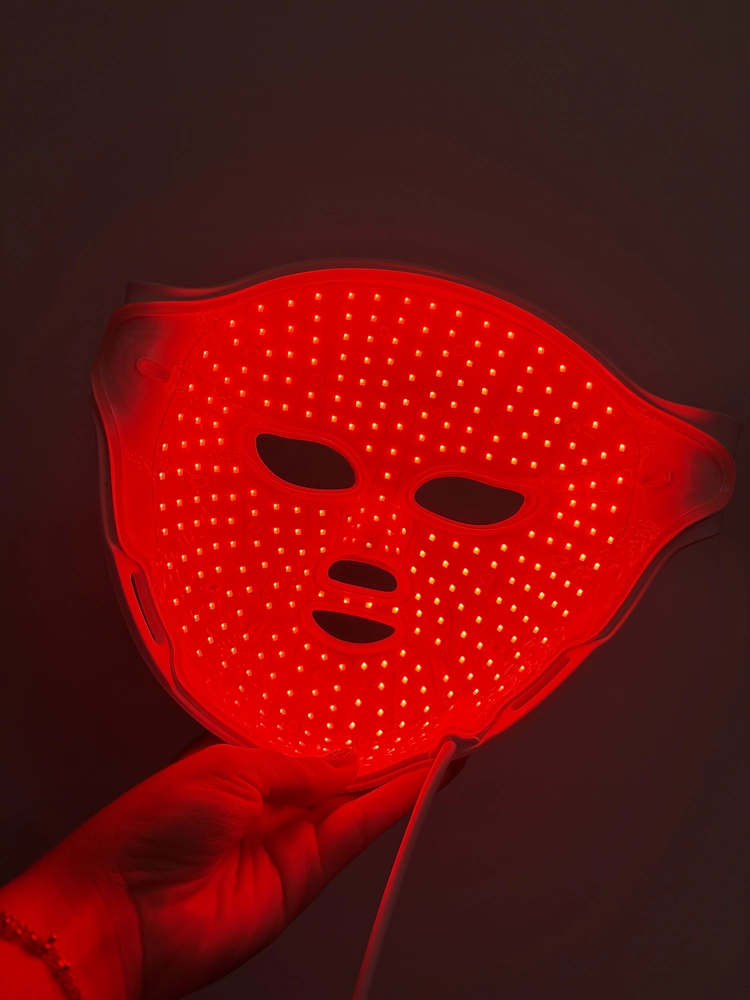
The eyes get a wide open visor, so the eye contour receives nothing. Dense LED masks win this comparison in one picture: the Omnilux Contour Face has 66 light points, fewer than the JOVS, and still lights the whole face because its beams spread, and the X600 has 300 light points.
- JOVS 4D 70
- Omnilux Contour Face 66
- CurrentBody Series 2 110
- Nooance Elite X600 300
Proof: 3/5
What the brand clearly displays and what I check in the FDA file: wavelengths (in nm), emitted dose, FDA clearance number, product study, safety tests, warranty.
Read my proof guideWhat the brand publishes
- Published: Wavelengths in nm: 660, 850, 940 and 1064 on the product page
- Published: Dose per session calculable: 143 mW/cm² for 10 minutes, about 86 J/cm²
- Published: FDA clearance verifiable in the database: K244020, for 660 and 850 nm only, number not printed by the brand
- Missing: Clinical study on this model: the FDA summary says no clinical data was submitted
- Missing: Study documented with participants, duration and lab: the 65%, 80% and 90% have none
- Published: Light safety tested: IEC 60825-1 in the FDA file, laser class not published
- Published: Warranty and support documented: 1 year, purchases on jovs.com only
Proof: 3/5
Is the JOVS 4D laser mask FDA-cleared?
Yes, K244020, cleared on 2025, is in the name of Shenzhen Qianyu Technology, the factory behind JOVS, for a “Wrinkle Treatment Device” in 2 versions, JM1 and JM2B. It is cleared for 2 wavelengths, 660 and 850 nm, but the 940 nm and the 1064 nm that JOVS prints on the box, are not in the file.
So “world’s first and only FDA-cleared laser mask” is accurate, and the product description that calls it “FDA-approved” is not: cleared and approved are different procedures, and no beauty device goes through the second one.
So… is a laser better than an LED for light therapy?
The JOVS post with Kim Kardashian says it in one line: “It’s LASER, not LED”, “same red-light benefits, but way more powerful“.
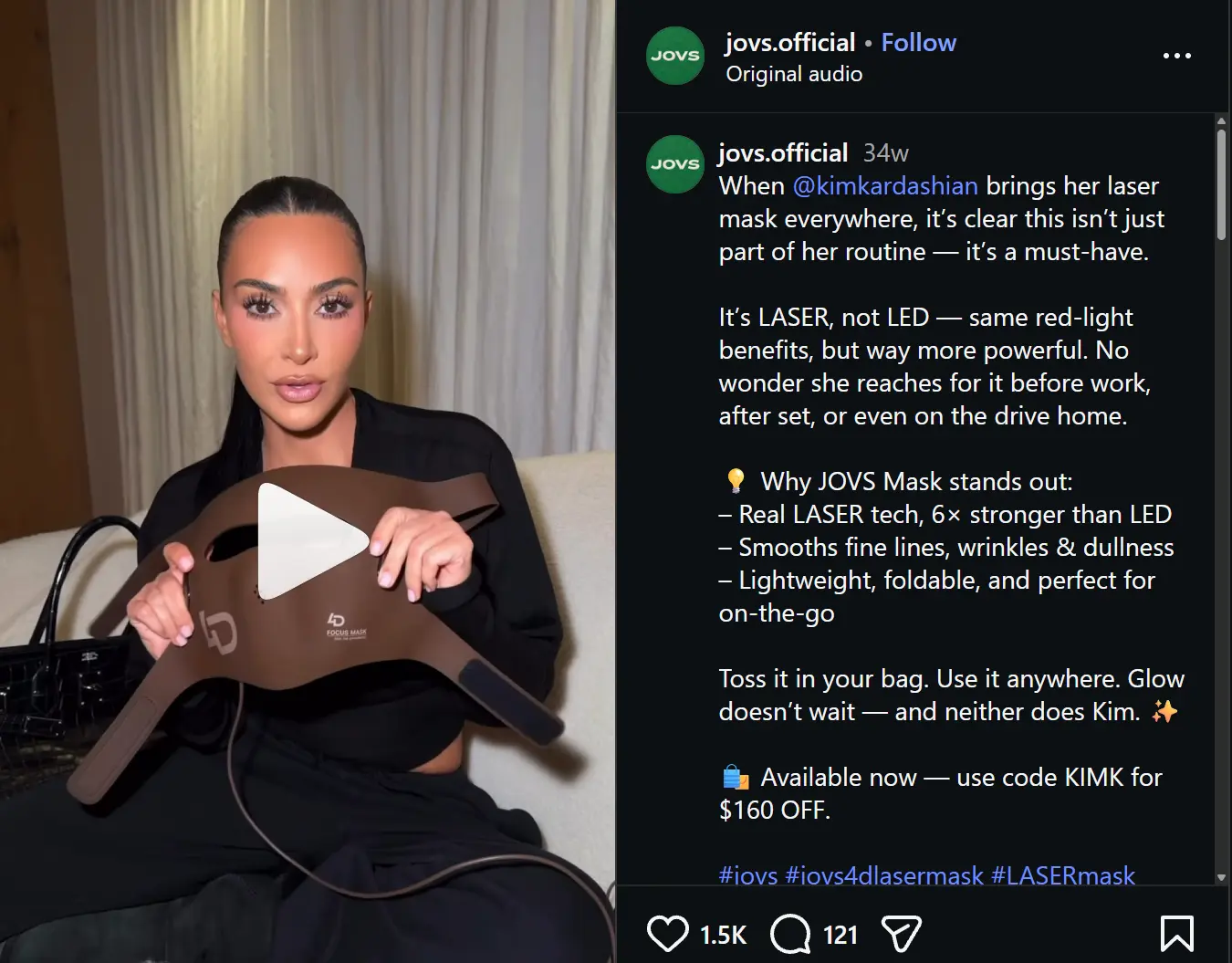
But the research says otherwise. The one property a laser adds to an LED of the same wavelength is coherence, and a 2018 review by Heiskanen and Hamblin (pubmed link) on exactly this question finds that coherence is lost in the first layers of skin and that no benefit of lasers over LEDs has been shown at equal dose. Depth is set by the wavelength, not by the source.
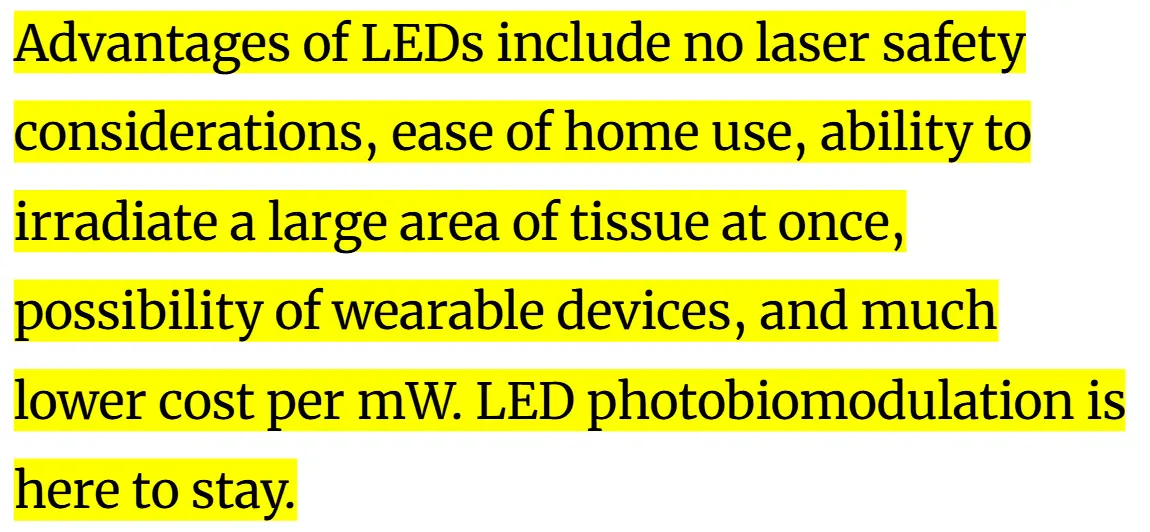
That’s why nearly every LED mask on the market uses LEDs: they cover more skin for less money with fewer safety constraints, and they didn’t lose anything in the trade. Being the first to put lasers in a face mask is a marketing first, not a technical one, and Jovs own FDA file claims equivalence to its LED mask.
Comfort: 4/5
Fit, weight, heat, eye comfort and minor inconveniences: straps, timer, battery. A mask that becomes a chore to wear several evenings a week scores poorly in these areas, as using it should be a pleasant experience!
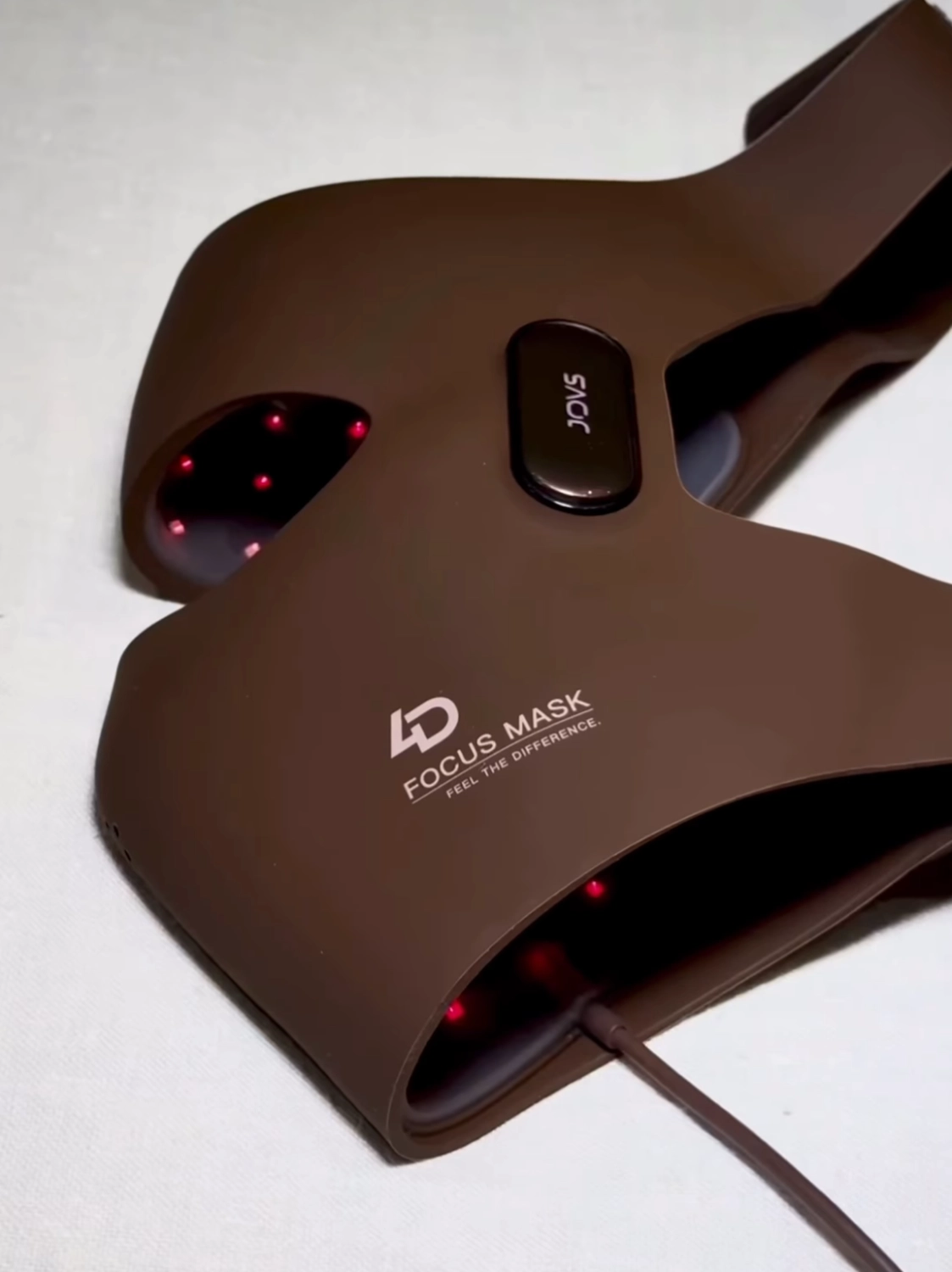
Read my comfort guideComfort is where JOVS 4D mask is good. The shell is soft silicone, molded in 3D. It’s the closest thing to the Nooance fit I’ve had, with none of the rigid-shell hovering of a CurrentBody Series 2 (my review of this LED mask).
The open visor means I can see, check my phone and walk around during a session, and 10 minutes is short enough that I never had to plan around it. The straps hold without pinching, and the remote, the newer one with a small screen, shows the mode and the minutes left, which I really appreciate at the end of a session.
Still a few points on my cheeks got noticeably warmer than the rest of the face, not painful, but there every session, and the FDA file lists a “thermal accumulation” test, so JOVS knows.
Value: 2/5
The price I paid, when viewed in the context of the results achieved and compared to other masks I have tested, both within this price range and at different price points.
Read my value guideJOVS 4D Laser Mask is sold $849 on paper, $729 on sale when I bought it and still today, and a $160 code in Kim Kardashian’s name on the brand’s own Instagram. What you get for it: only 70 light points and a laser argument the research doesn’t support.
To compare with, the Nooance Elite X600 costs about the same and puts 50 mW/cm² on 300 points over the whole face. I ran that mask against the Series 2 in my CurrentBody vs Nooance comparison, and either of them delivers more light to more skin than the JOVS for the same money. On price alone the JOVS 4D keeps company with the best, on score it does not, and my ranking of the best LED masks shows the gap.
Safety & support: 2.5/5
Eye protection, build quality, warranty, returns, responsiveness of customer support, and the mask’s ability to remain functional over time.
Read my safety & support guideIs the JOVS 4D laser mask safe for the eyes?
JOVS doesn’t publish the laser class unfortunately. In the FDA file, IEC 60825-1, the laser safety standard, is listed as a test passed, without the class that test assigns.
For comparison, the iRestore Laser Face Mask Pro prints class 3R in its manual, the class where looking into the beam can hurt. So I recommend to avoid looking at the JOVS lasers, considering they may hurt your eyes.
Warranty is 1 year, and only for purchases on jovs.com, with a video of the fault required before an exchange.
Who shouldn’t buy the JOVS 4D laser mask
Skip this one if you recognize yourself
- You want your eye contour treated. The visor is open, and the 70 points stop well above and below it.
- You want a full face coverage mask. JOVS does not cover properly the face with only 70 light points.
- You have active acne or a wound on your face. JOVS’s own FAQ says not to wear the mask in that case because of lasers.
- You are buying it for pigmentation. JOVS’s FAQ warns that “pigmentation may appear temporarily more visible at first”.
Am I still using the JOVS 4D laser mask?
Updated November 2026. The test ended and the JOVS 4D went back in its box the same day. I’m not convinced by the lasers argument.
Kim Kardashian wears this one, and I wrote up what that is worth on my page about Kim Kardashian’s LED mask. To see the 4D against masks that cover the whole face, my LED mask picker lines them up on one page.
What I still want to know about the JOVS laser masks
Where does this value of 143 mW/cm² come from, since the FDA file lists 100, and no independent laboratory has published any measurements on it.
I would also like to see a clinical study conducted on this model to actually measure the effects of the lasers, because given their low diffusion and my results, I am not convinced of their effectiveness.
JOVS 4D laser mask: your questions
Is the JOVS 4D laser mask FDA-cleared?
Yes. K244020, in the name of Shenzhen Qianyu Technology, covers the JM2B laser mask at 660 and 850 nm with 140 light sources. The 940 and 1064 nm and the 143 mW/cm² on the product page are not in the file, and the summary states that no clinical data was submitted.
How many lasers does the JOVS 4D mask have?
JOVS says 140 laser beams and the FDA file counts 140 sources. I count 70 light points on the mask, with 2 lasers behind each point.
Is a laser mask better than an LED mask?
Not in the research. Depth is set by the wavelength, not by the light source, and the 2018 review by Heiskanen and Hamblin finds no benefit of lasers over LEDs at equal dose. What a laser does change is the beam: 18 to 20° instead of about 130°, so the light lands in dots instead of covering the face.
How long is a JOVS 4D session?
The remote offers 10, 15 and 20 minutes and starts on 10. I used 10 minutes on mode 1 for all 24 sessions. At the 143 mW/cm² JOVS publishes, that is already about 86 J/cm², and the 20-minute timer is about 172.
Is the JOVS 4D the mask Kim Kardashian uses?
It is the one she showed. She posted it on her own account in October 2025, then appeared in a video on the JOVS account in February 2026 with a code in her name, KIMK, for $160 off. That second post is a brand campaign.
Test log
- Exact model
- JOVS 4D Laser Light Therapy Mask, remote with screen. Model JM2B in FDA file K244020
- How I got it
- Bought on jovs website, $729. No code, no link, no contact with the brand
- Test window
- 8 weeks, 3 sessions a week, mode 1
- Documents read
- 510(k) summary K244020, JOVS product page, FAQ, warranty and return pages
About Emilie
I have tested LED masks since 2023. I buy the devices, use them for weeks, and read the spec sheets nobody reads, because this market runs on numbers most brands never publish. Not a dermatologist, and I say so whenever a question needs one.
2 thoughts on “I tested JOVS 4D Laser light therapy mask 8 weeks: My honest review with results”