
I buy the devices I test unless the article says otherwise. Some links and discount codes on this site are paid links: if you buy through one, I earn a commission. It never changes a score or a verdict.
I wore the CurrentBody Skin LED Mask Series 2 for 50 sessions across 12 weeks, and the Omnilux Contour Face for 40 sessions across 8 weeks. Both publish the same light output, around 30 mW/cm². So what separates them is the shape of the LED mask and how many points of light actually land on your skin, and there is a huge difference between both.
So here are both scores, my own count of light points on each LED mask, and the one difference that decides this comparison.
CurrentBody Series 2 vs Omnilux Contour Face
| CurrentBody Series 2 | Omnilux Contour Face | |
|---|---|---|
| Price on the brand’s US site | $469.99 | $395 |
| Irradiance published by the brand | 30 mW/cm², on the spec sheet | ~30 mW/cm², inside a FAQ |
| Dose per session | 18 J/cm² over 10 minutes | 18 J/cm² over 10 minutes |
| LEDs advertised | 236 LED bulbs | 132 LEDs bulbs |
| Light points at your skin | 110 | 66 |
| Wavelengths | 633 nm, 830 nm,1072 nm | 633 nm, 830 nm |
| Shape | 3D molded shell, sits against the face | Flat flexible panel, bridges over the face |
| Eye protection in the box | 2 clip-in inserts | none |
| Session | 10 minutes, 3 to 5 times a week | 10 minutes, 3 to 5 times a week |
| FDA 510(k) file | K250966, applicant Shenzhen Kaiyan Medical Equipment | K191629, applicant Ismart Marketing Svcs, device named faceLITE |
| Clinical study on this model | 35 subjects, 56 days, laboratory named | 25 finishers, 4 weeks, no control group, hydrogel mask worn underneath |
| Warranty | 2 years | 2 years |
| Returns | 14 days if your skin reacts | 30 days, unopened only, $15 fee |
| What my test came to | 50 sessions, 12 weeks | 40 sessions, 8 weeks |
| Score | 72/100, Emilie Approved | 52/100, Shelved |
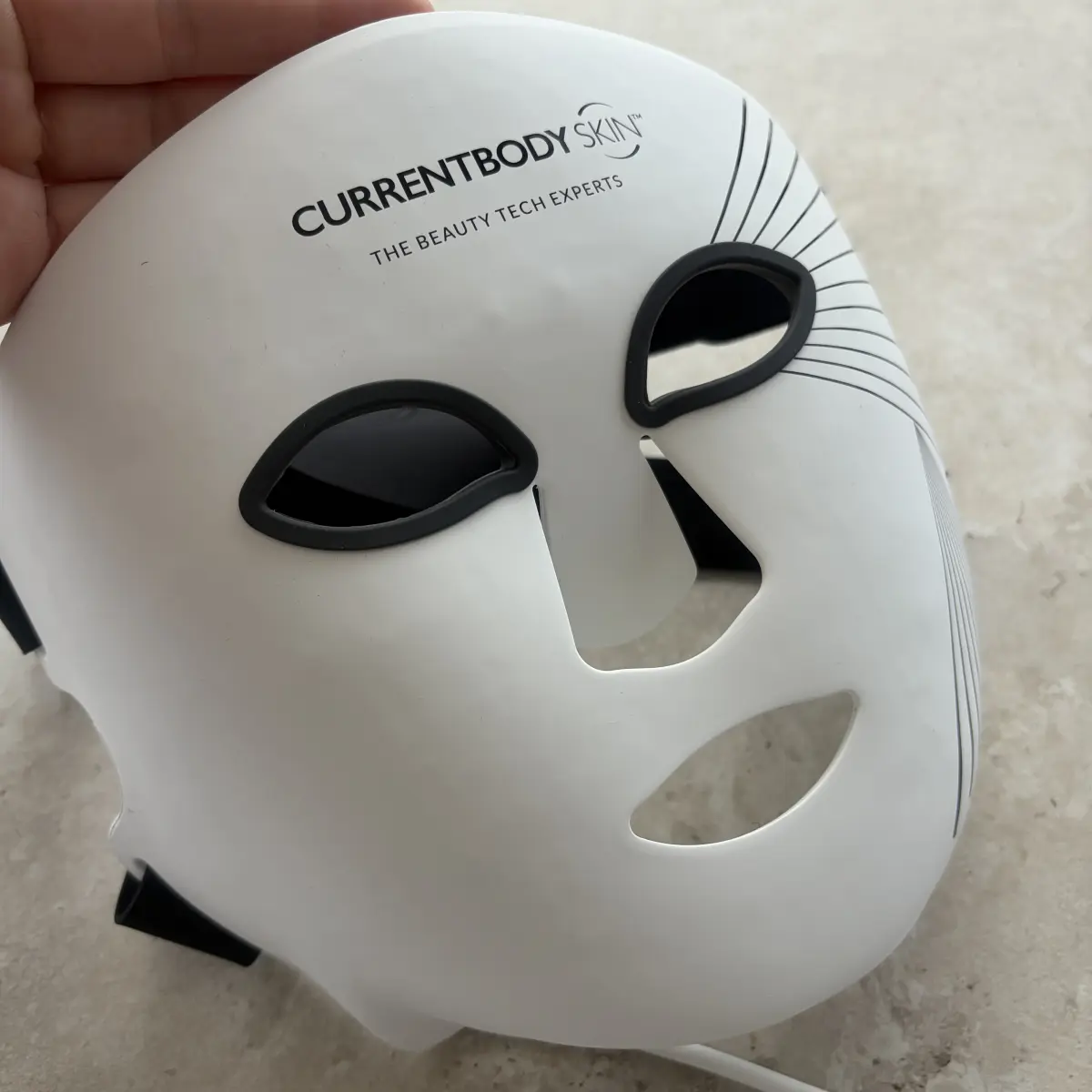
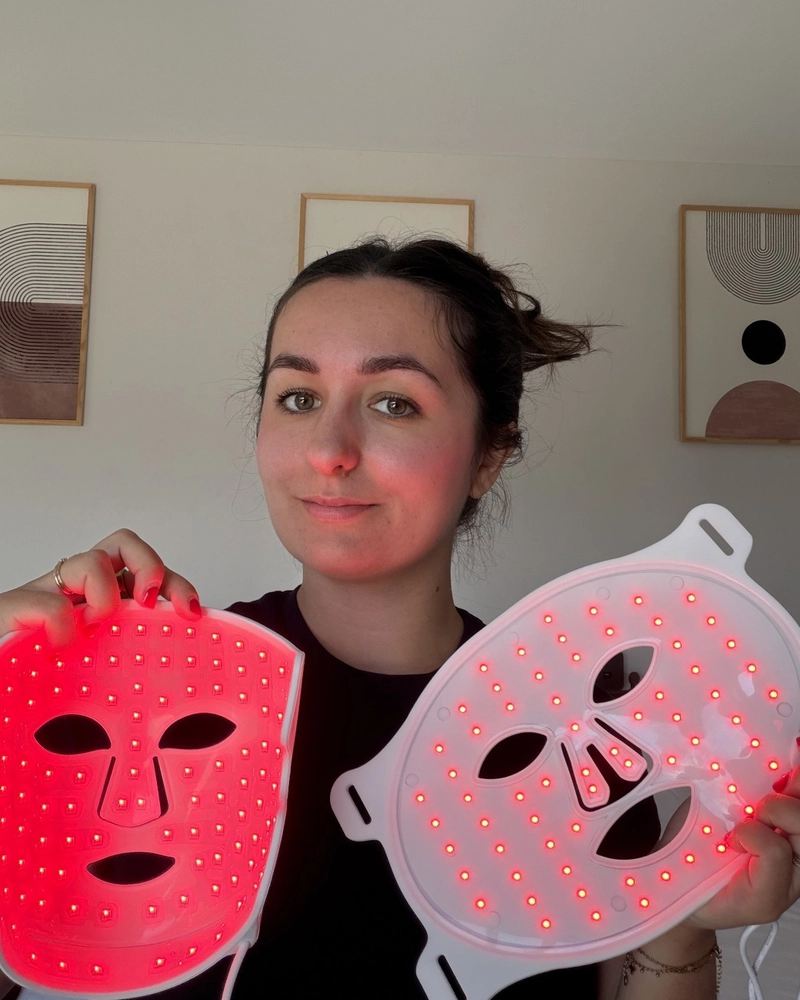
The CurrentBody wins all seven criteria on my grid. Nearly twice as many light points, so neighboring beams overlap instead of leaving cold spots between them. And a molded shell that stays on the jaw and the chin, where the flat Omnilux panel bridges across and loses output to the air.
Buy the CurrentBody Series 2 if you want the denser of the two and a shape that follows your face. 110 light points against 66 is the whole argument, and the 3D mold is what carries them down to the jawline.
Buy the Omnilux Contour Face if you want a cheaper LED mask as it costs $75 less, but with weaker characteristics.
Buy neither if what bothers you sits on your upper lip, on the bridge of your nose or right against your eyes because neither LED mask puts light there.
What I tested: the CurrentBody Series 2 and the Omnilux Contour Face
The CurrentBody Skin LED Light Therapy Face Mask: Series 2, red light version, went on every other evening for 12 weeks, which came to roughly 50 sessions of 10 minutes. The Omnilux Contour Face took 5 evenings a week for 8 weeks, 40 sessions of 10 minutes, on the one mode it has. 90 sessions in total.
I bought both with my own money, $470 for the CurrentBody on their US site and $395 on Omnilux website.
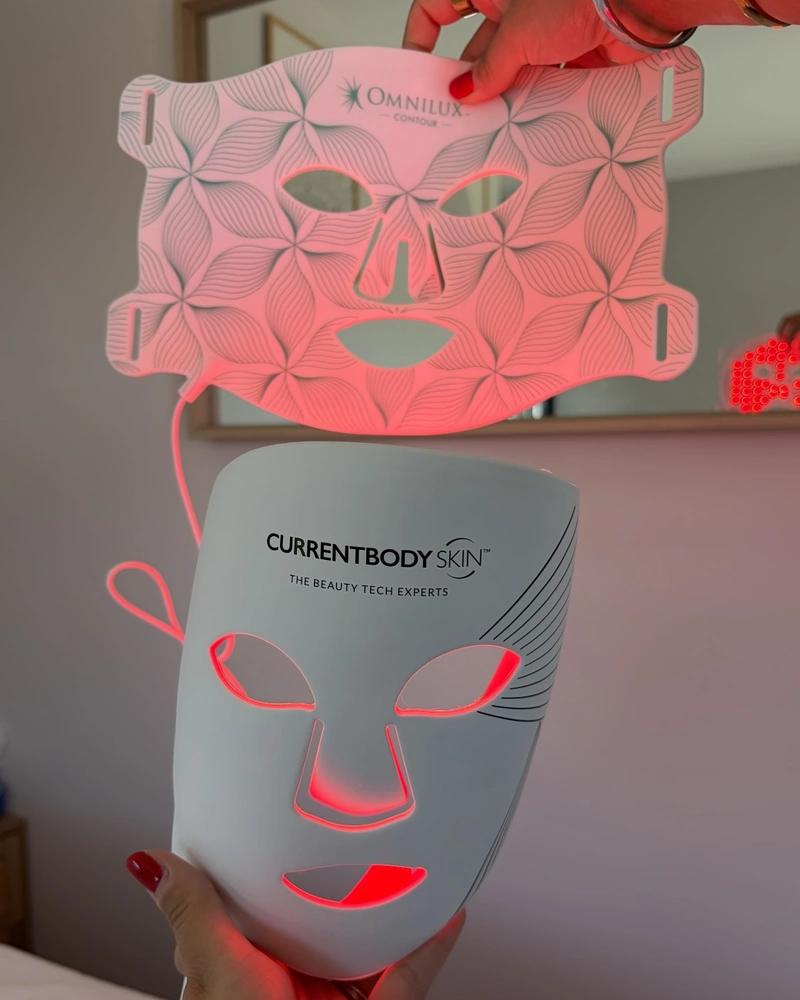
Outside my test windows I wear a much denser LED mask, and I put it away for both of these, so both started from the same handicap. The seven criteria the scores come from are on the page where I explain how I test LED masks.
Results: CurrentBody 3/5 · Omnilux 2.5/5
CurrentBody: my own before & after
After 12 weeks and 50 sessions, I didn’t notice any changes in my skin: no smoother texture, no reduced wrinkles. I also didn’t notice any deterioration, which is already a positive point, since most of the LED masks I test yield negative results because I stop using my higher-density LED mask during these testing periods.
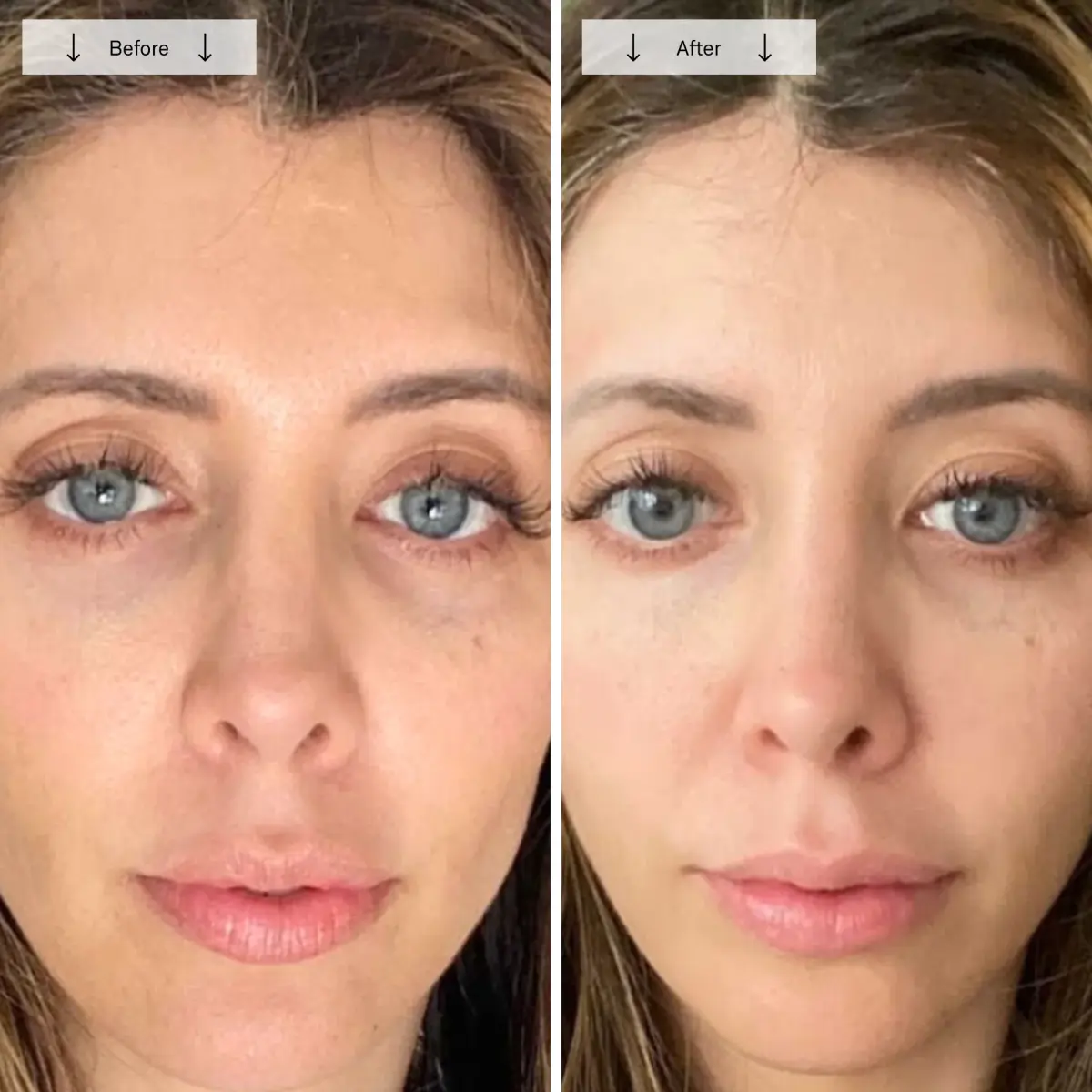
Currentbody Officials Before & After
The before & afters on their site were sent in by buyers rather than produced under lab conditions, so they carry little weight on my grid.
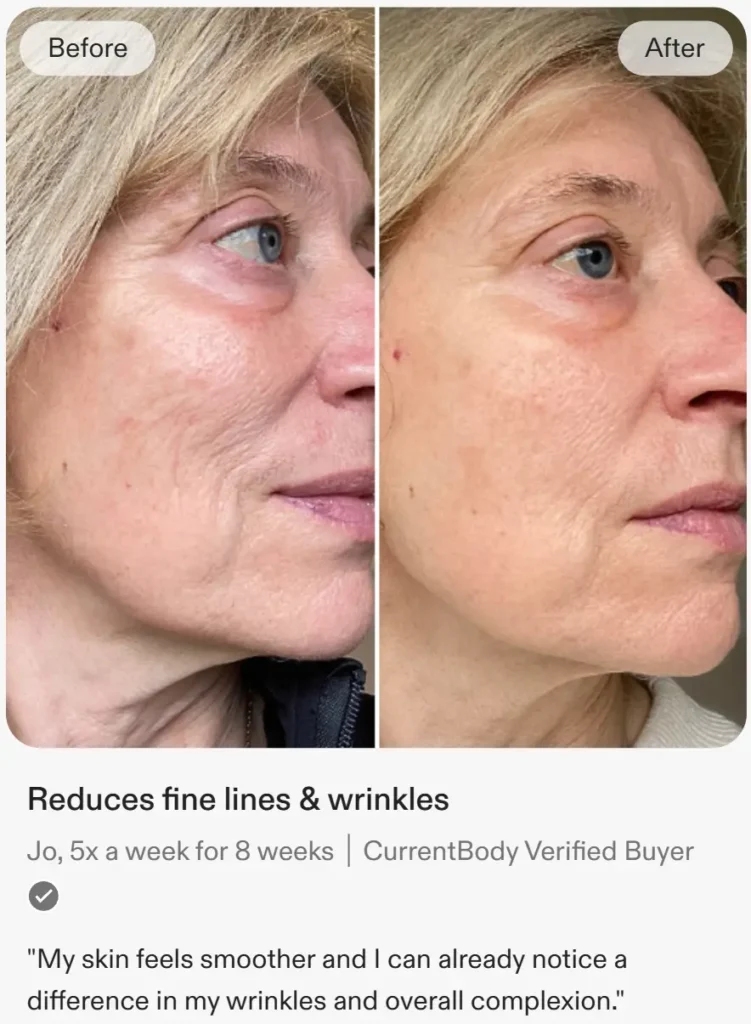
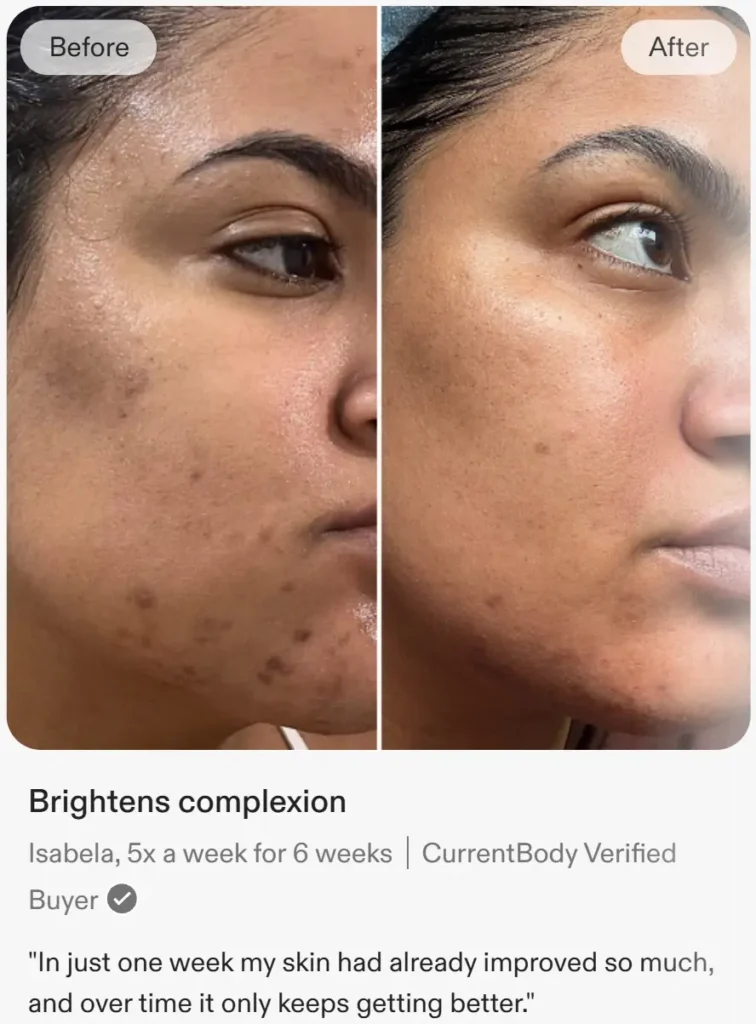
A company picks which customer photos land on its own page, and it picks the light they were shot in, so I treat them as marketing and not as data. The full 12 weeks are in my CurrentBody Series 2 review.
Omnilux: my own before & after
Here I do have two photographs, shot with the same camera, the same lamp and the same distance 8 weeks apart, and they don’t go the right way. By session 40 my tone was duller than in week 1 and my pores read larger atfer using the Omnilux LED mask.
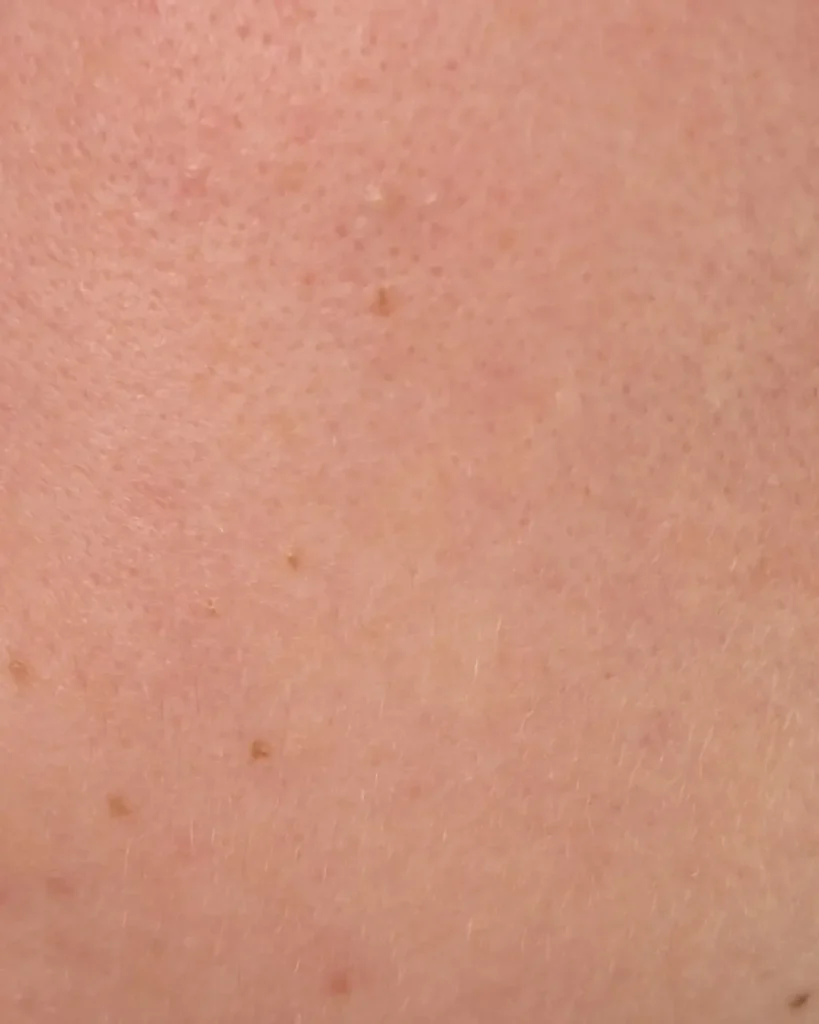
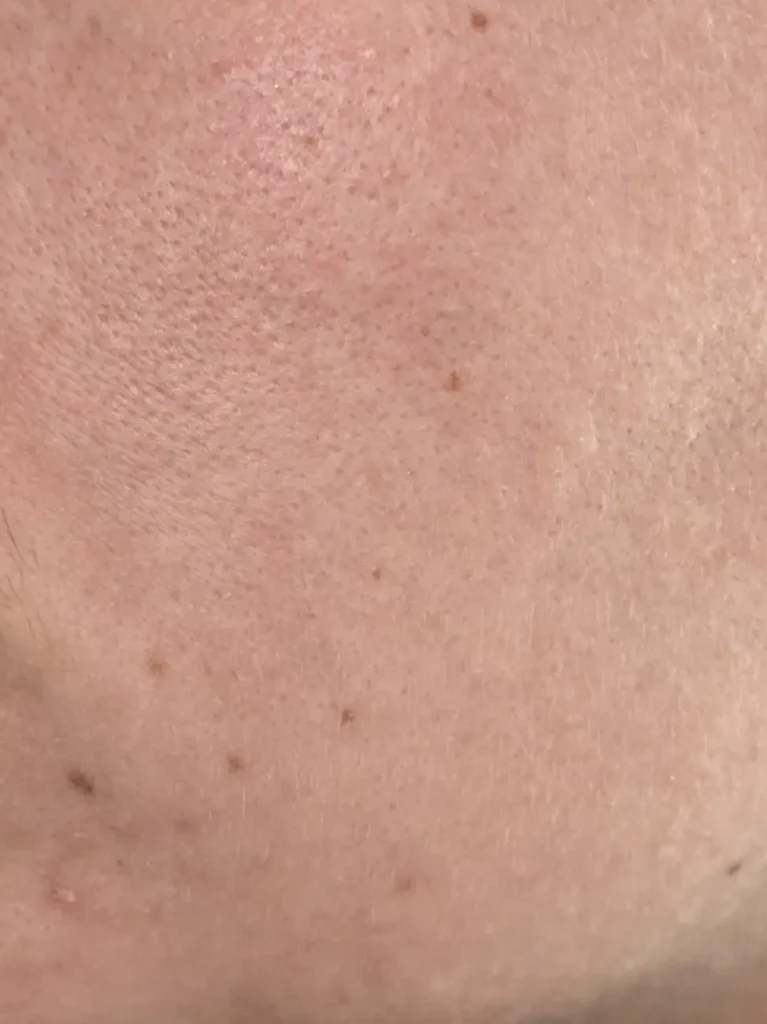
That isn’t the Omnilux LED mask damaging my skin. Both LED masks replaced the same denser one, and only the weaker of the two lost me ground, so I read those 8 weeks as my skin settling back to its baseline, not as harm done by the panel. The whole test is in my Omnilux Contour Face review.
Omnilux’s study, and the before & afters
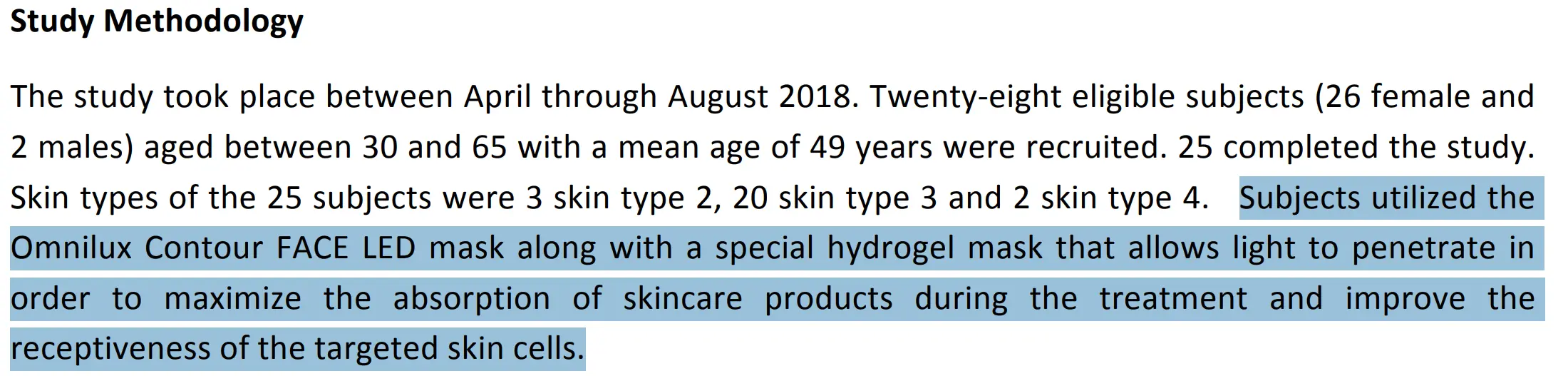
Omnilux recruited 28 volunteers between 30 and 65 and 25 of them reached the end, across 4 weeks at 3 weekly sessions of 10 minutes. The measuring kit is spelled out in full, which is rare on this market: VISIA photography, Cutometer, Corneometer, Mexameter, Visioscan, plus the Larnier wrinkle scale.
It is good to see the details of the study, but here is the catch: an Omnilux hydrogel sheet mask sat between the light and the skin of every volunteer, session after session. So the 37.6% reduction in wrinkles belongs to that pair, and nothing in the document splits them apart…
To support my point, look at the elasticity line: 21.4% up the moment the very first 10 minute session ended. Nobody builds collagen in 10 minutes. A hydrating sheet mask, on the other hand, moves a Cutometer exactly that fast…
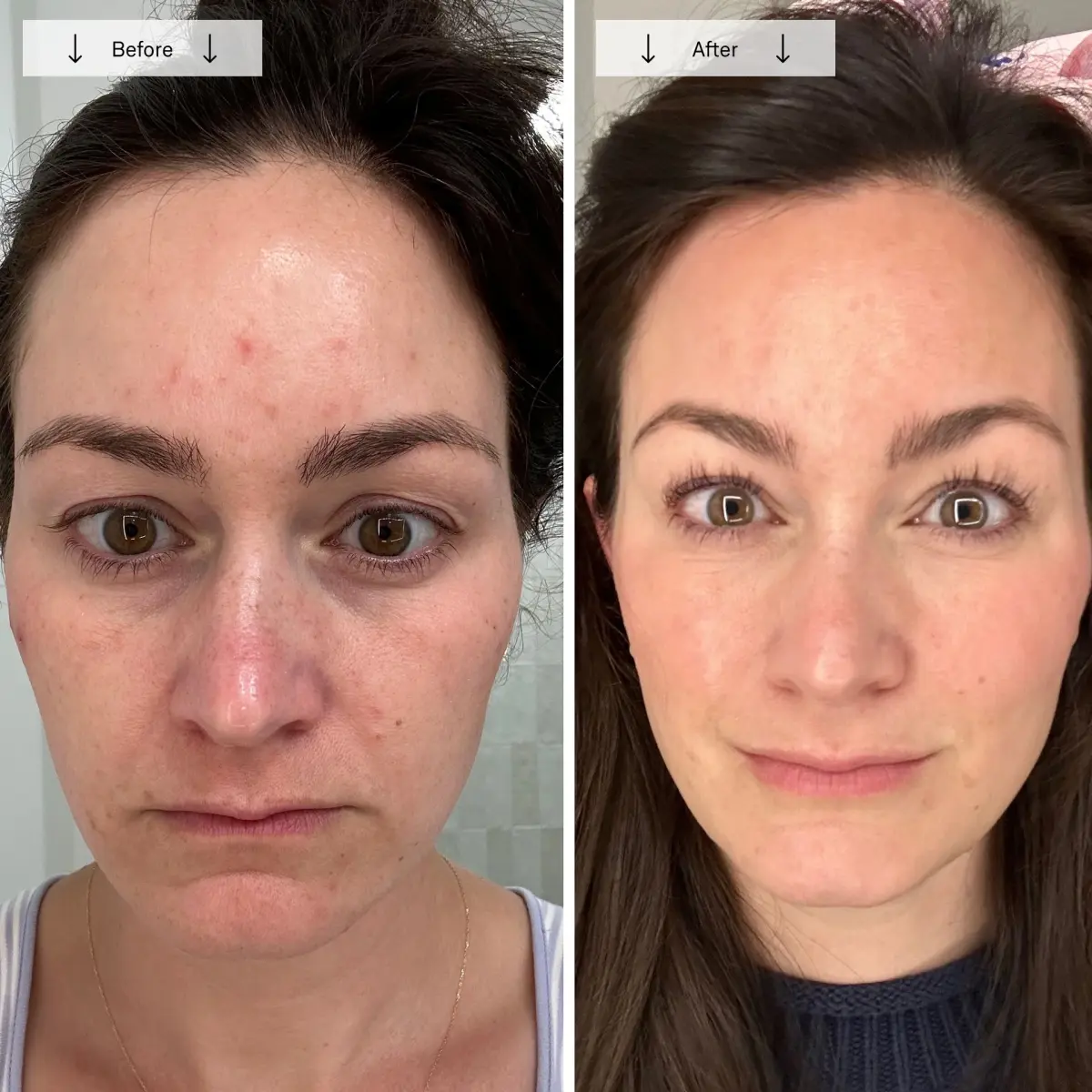
Their before & afters have the same weakness as CurrentBody’s, with even less attached: no session count, no interval between the frames, no lighting conditions, no name. Neither brand gave me a photograph I’d defend.
Irradiance: CurrentBody 3.5/5 · Omnilux 3/5
Irradiance says how much light power a square centimeter of your face receives, and the length of a session turns that into a dose in J/cm². Both Currentbody and Omnilux publish the same figure of 30 mW/cm².
- CurrentBody Series 2 30
- Omnilux Contour Face ~30
CurrentBody: 30 mW/cm² printed on the spec sheet
This figure is listed in the technical specifications, and a 10-minute cycle corresponds to 18 J/cm². This is lower than the 30 J/cm² typically used in studies, which explains why CurrentBody requires 5 sessions per week to achieve sufficient light output over a full week. However, the technical data sheet does not specify whether the value of 30 mW/cm² was measured at the skin surface or at the LED.
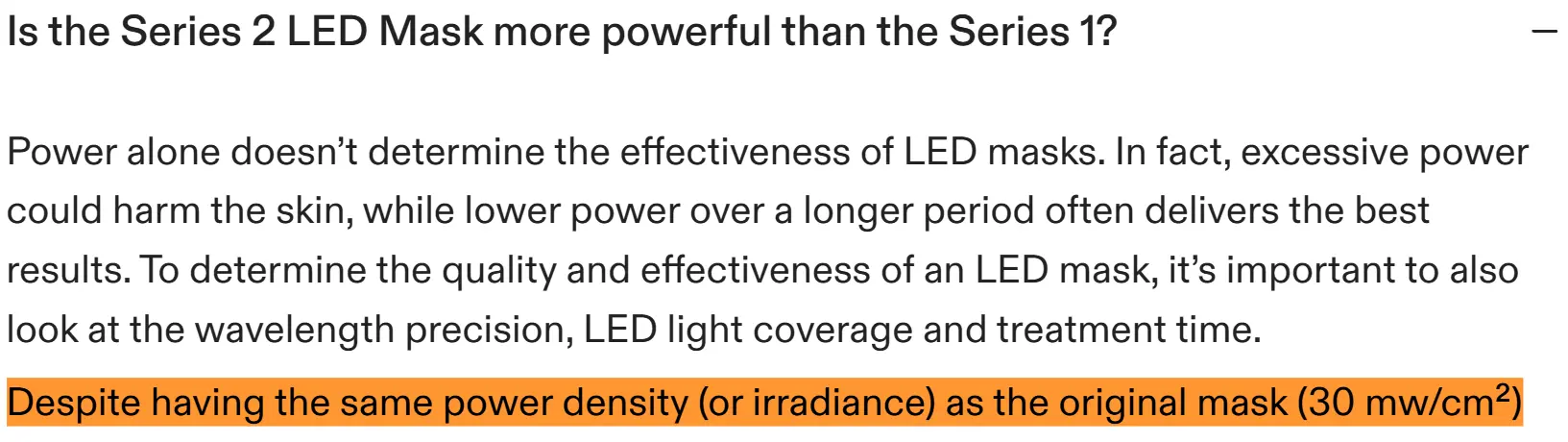
Omnilux: ~30 mW/cm², hidden in a FAQ accordion
Omnilux publishes its light output too, but it takes digging: nothing on the box, nothing in the spec block, and the answer folded into a collapsed question near the foot of the product page. It reads ~30mW/cm2, tilde included, with no distance attached. Same dose as the CurrentBody, published half as clearly.
Neither brand tells you whether that 30 was read at the surface of a bulb or at the skin, and a couple of centimeters of air between the two costs a large part of it. So the published figures are a tie, and what actually reaches your face is decided by the next criterion.
Coverage: CurrentBody 3.5/5 · Omnilux 2/5
This is where the two LED masks stop being comparable, and it works on two things at once: how many points of light you get, and how far they sit from your skin.
A diode doesn’t light a disc evenly. It projects a cone, strongest straight ahead and weaker toward the rim, so what I want is neighboring cones running into each other rather than landing side by side with a dark strip between. Below that density, skin sitting under a bulb and skin sitting halfway between two bulbs come out of the same 10 minutes with different doses.
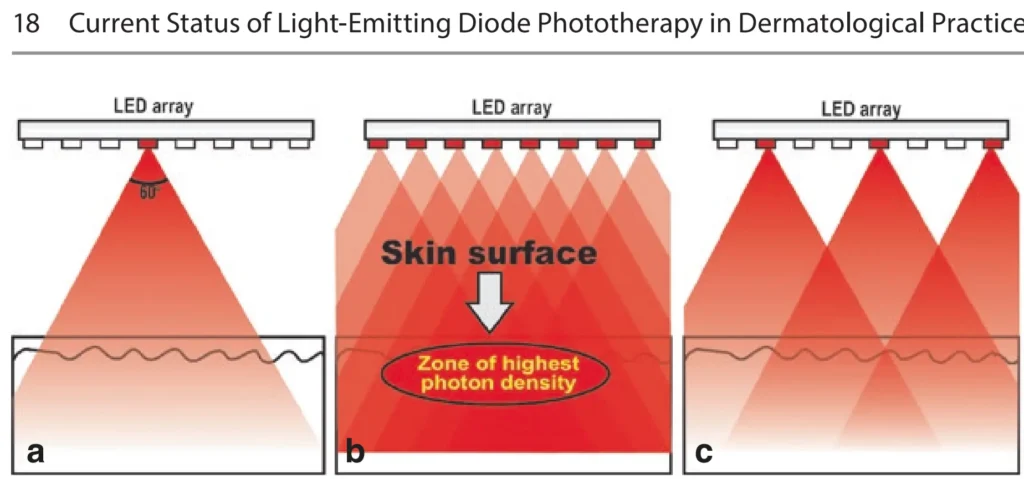
CurrentBody: 236 LEDs for about 110 light points
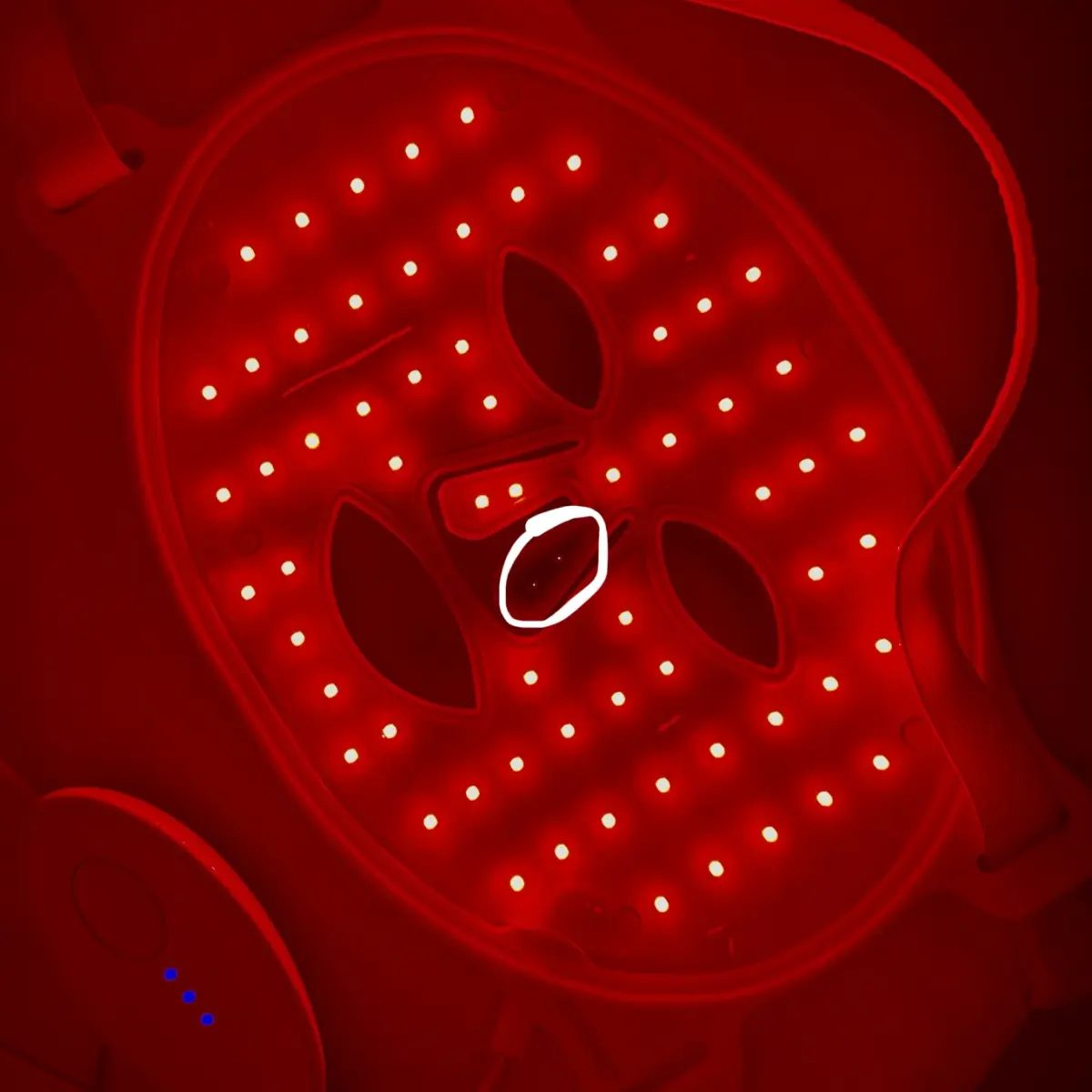
The 236 bulbs split into 110 red at 633 nm, 110 near-infrared at 830 nm and 16 deep near-infrared at 1072 nm. Red and near-infrared share their positions in the mold, so there are about 110 spots. One thing to weigh before paying for the upgrade: the 1072 nm that headlines the whole Series 2 runs on 16 diodes sitting on the forehead, and nowhere else…
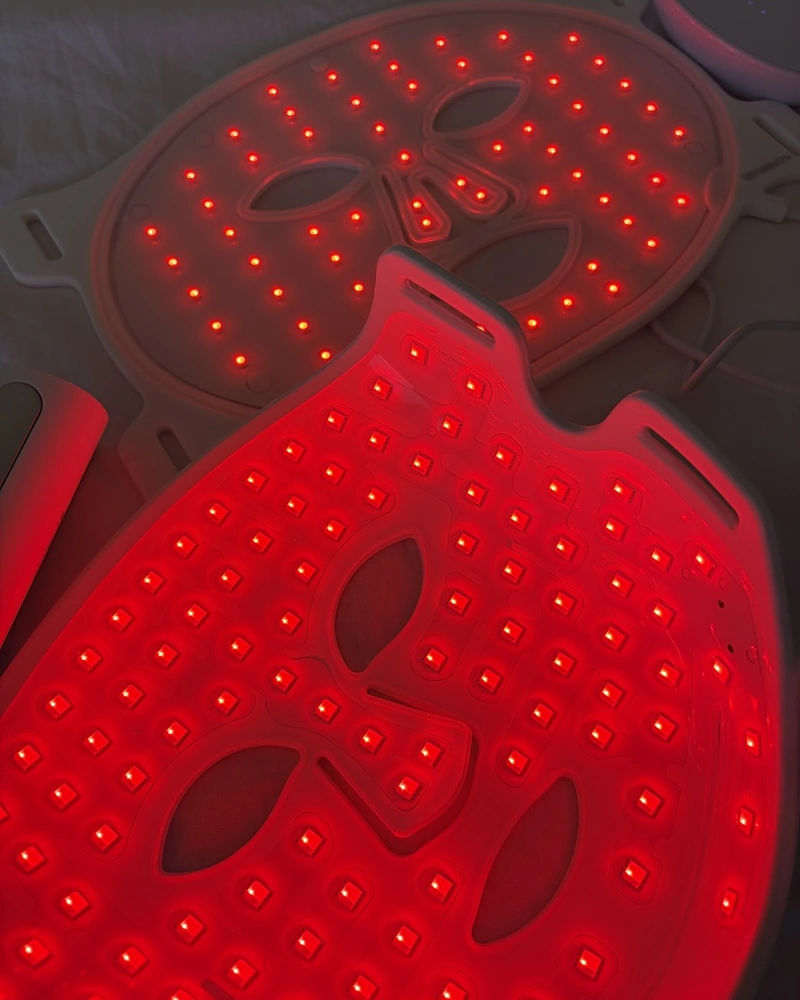
The shell is molded, so it rides my cheeks and keeps contact all the way down to the jaw and under the chin, and the light has no air to cross before it arrives. Plenty of LED masks I’ve worn give up at the cheekbones. Where this one goes dark is at its openings: over the nose, above the lip, and on the ring of skin closest to the eyes.
Omnilux: 132 LEDs for 66 light points
Omnilux is upfront about how it’s built: 66 bulbs, each carrying one red chip and one near-infrared chip, which is where the 132 comes from. The count is honest. What lands on your face is still 66 light sources, so against the CurrentBody you’re wearing 40% fewer points of light over the same surface, and at that spacing the cones stop meeting.
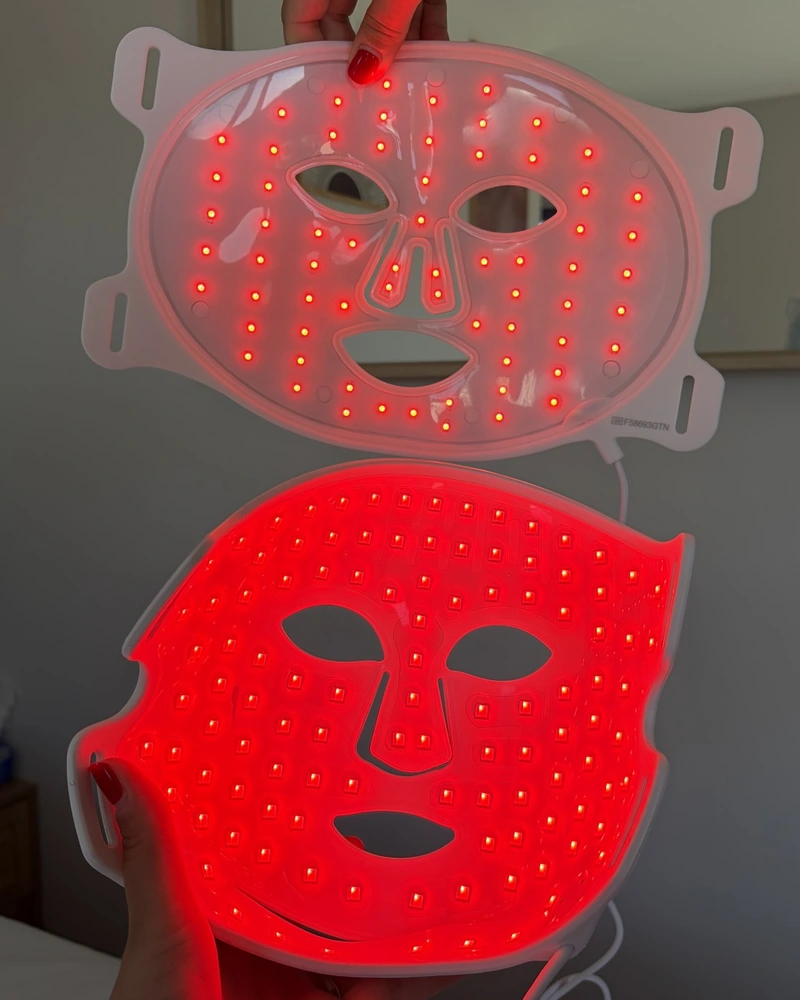
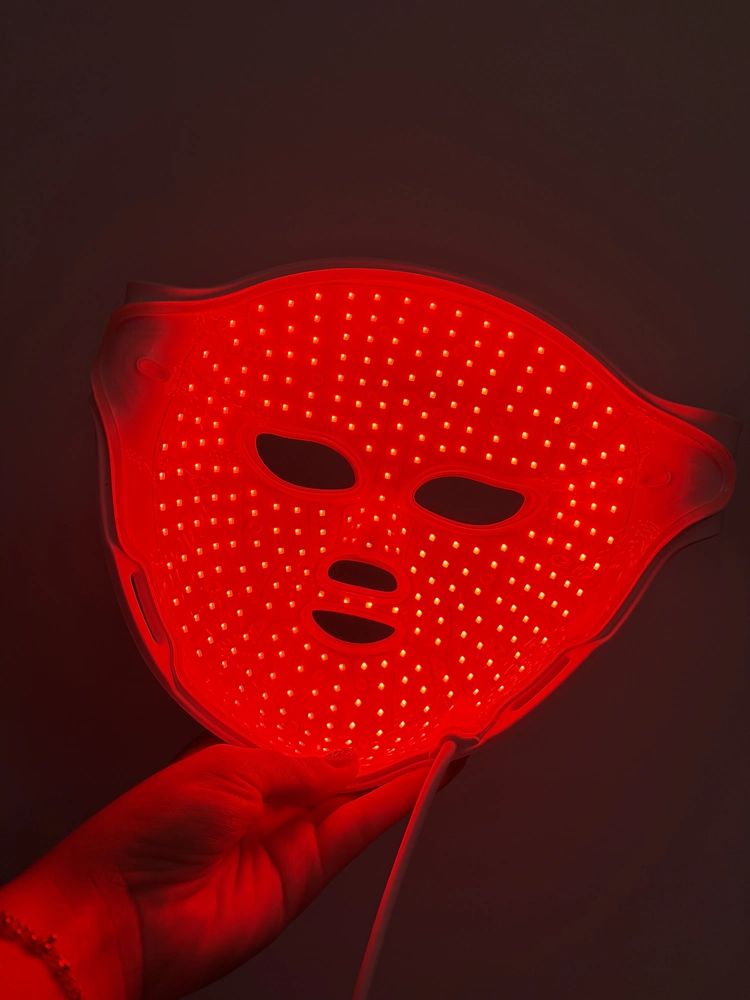
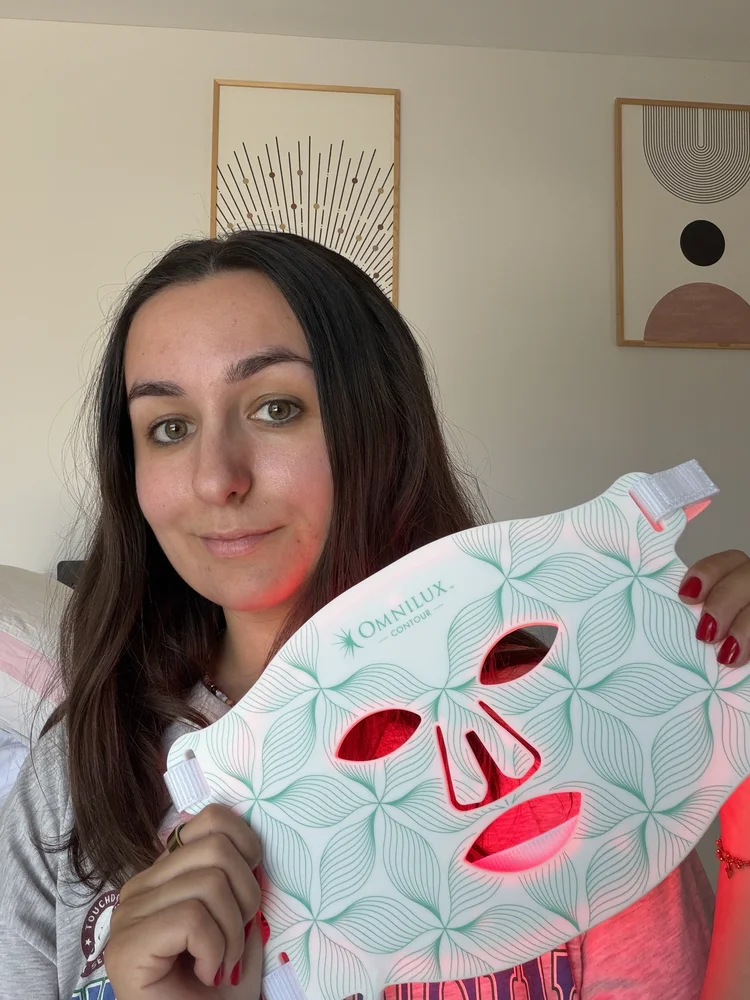
The Omnilux panel bends, but it has no shape of its own, so once it’s strapped on it spans cheekbone to cheekbone and hovers over everything in between. Every millimeter of that gap is output you paid for and never receive. And the strip above the lip carries no bulb at all, which is exactly where smoker’s lines sit. CurrentBody has an opening in the same spot, so neither one treats it.
Proof: CurrentBody 4.5/5 · Omnilux 3/5
| Audit point | CurrentBody Series 2 | Omnilux Contour Face |
|---|---|---|
| Wavelengths given in nm | ✓ 633, 830, 1072 | ✓ 633, 830 |
| Dose per session calculable in J/cm² | ✓ 18 J/cm² over 10 minutes | ✓ 18 J/cm² over 10 minutes |
| FDA clearance number cited and verifiable | ✓ K250966, verifiable, though CurrentBody never prints it | ✗ K191629 exists, but Omnilux prints it nowhere |
| Clinical study run on this exact model | ✓ run on the Series 2 itself | ✓ on the Contour Face |
| Study documented: size, duration, laboratory | ✓ 35 subjects, 56 days, laboratory named, measurement points listed | ✓ 25 finishers, 28 days, instruments named, downloadable summary |
| Photobiological safety declared | ✓ IEC 62471 listed in the FDA summary of K250966 | ✓ conforms to IEC/EN 62471, stated in plain words |
| Warranty and support documented | ✓ 2 years, returns policy published | ✓ 2 years, contraindications and drug interaction sheets |
CurrentBody: a study run on the LED mask
CurrentBody tested the Series 2 itself and put the method on the table: 35 people, 56 days, a named laboratory, and the list of what was measured and when. That’s enough to disagree with, which is more than most brands leave you.
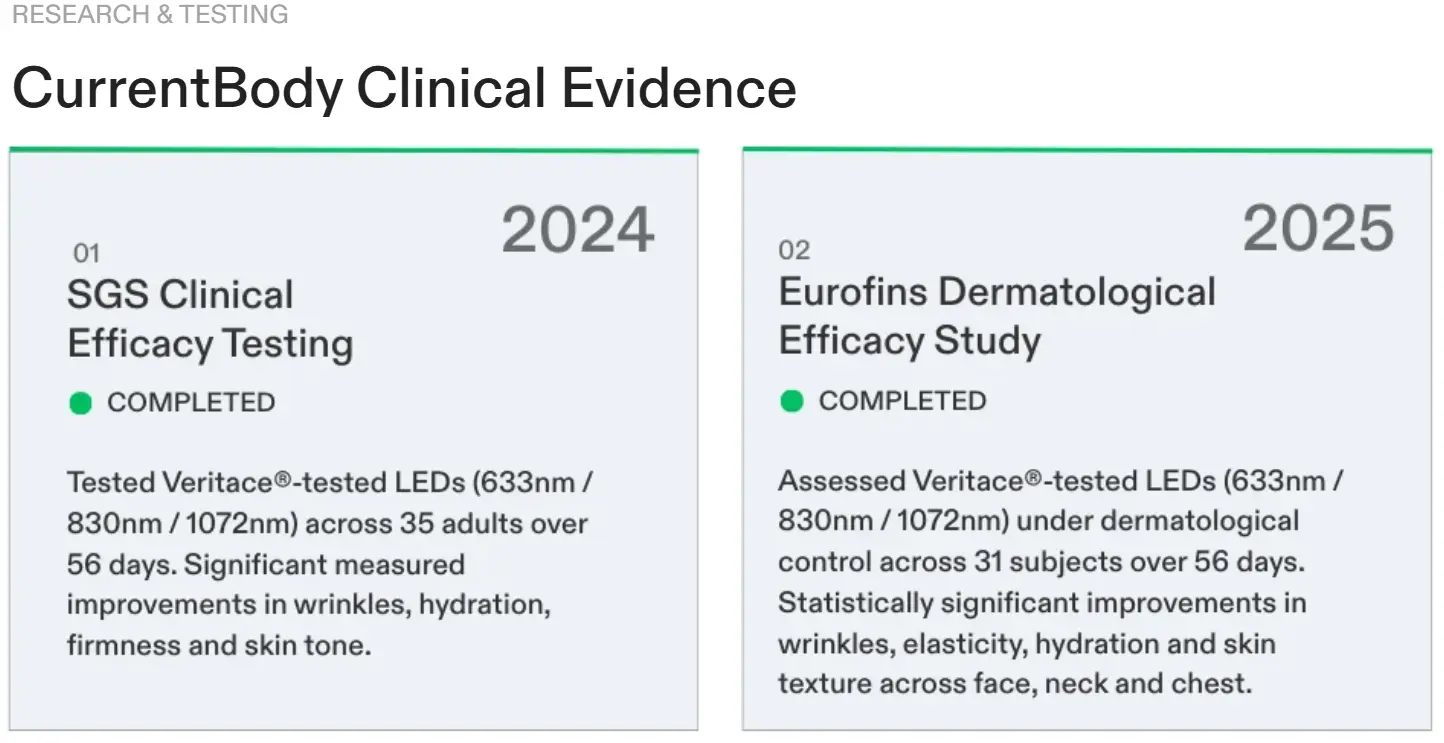
The photobiological safety test is in the FDA summary of K250966 too. What the same file shows is that the company answering for the device is the plant that builds it, Shenzhen Kaiyan Medical Equipment Co., Ltd., and not the brand whose logo is on the strap.
Omnilux: wrong numbers for the study…
On the Contour Face product page, the block titled Clinical studies are the proof you need to feel confident carries 96% skin felt firmer, 96% fine lines less visible, 95% skin brighter. But the paper credited underneath ran 7 weeks on acne, pairing 415 nm blue with 633 nm red, and there is no blue diode anywhere in the Contour Face.
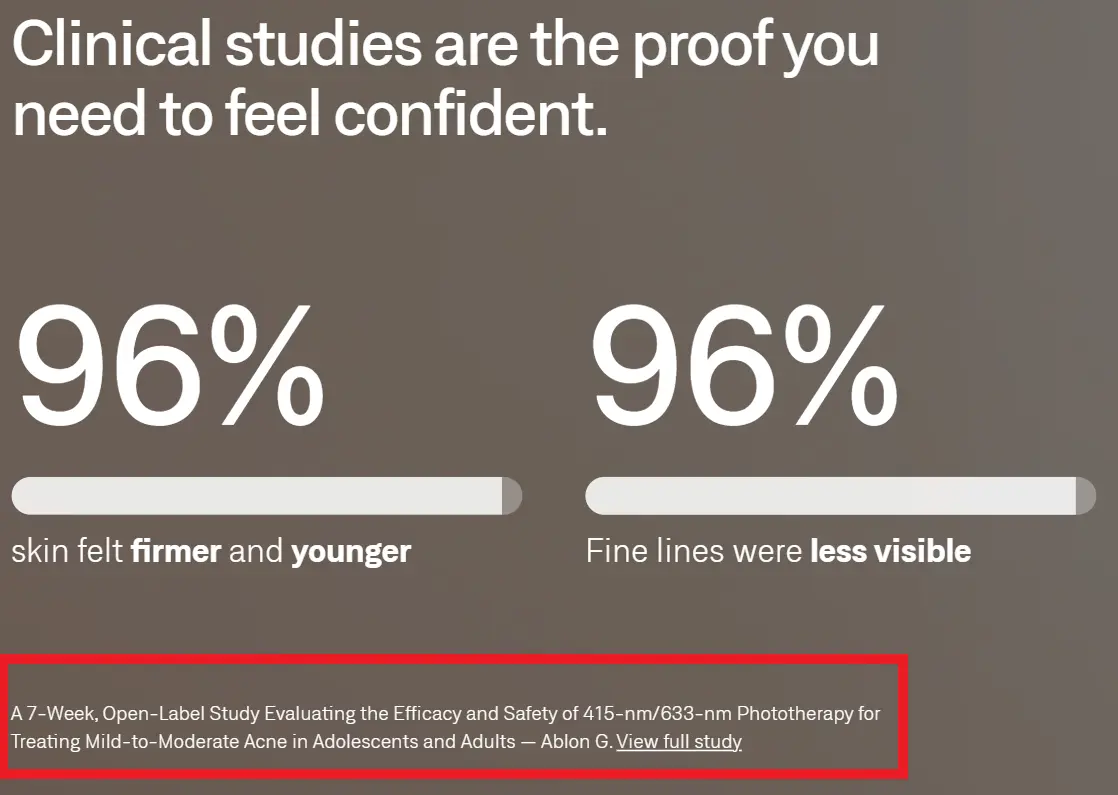
So three anti-aging percentages rest on a paper about a different device, treating a different problem, using a color this LED mask cannot even produce.
The second miss is that Omnilux writes FDA-cleared without a number, and the Contour Face is covered by K191629 with the device named faceLITE on the record. The establishment registrations carrying that design list more than 20 brand names between them…
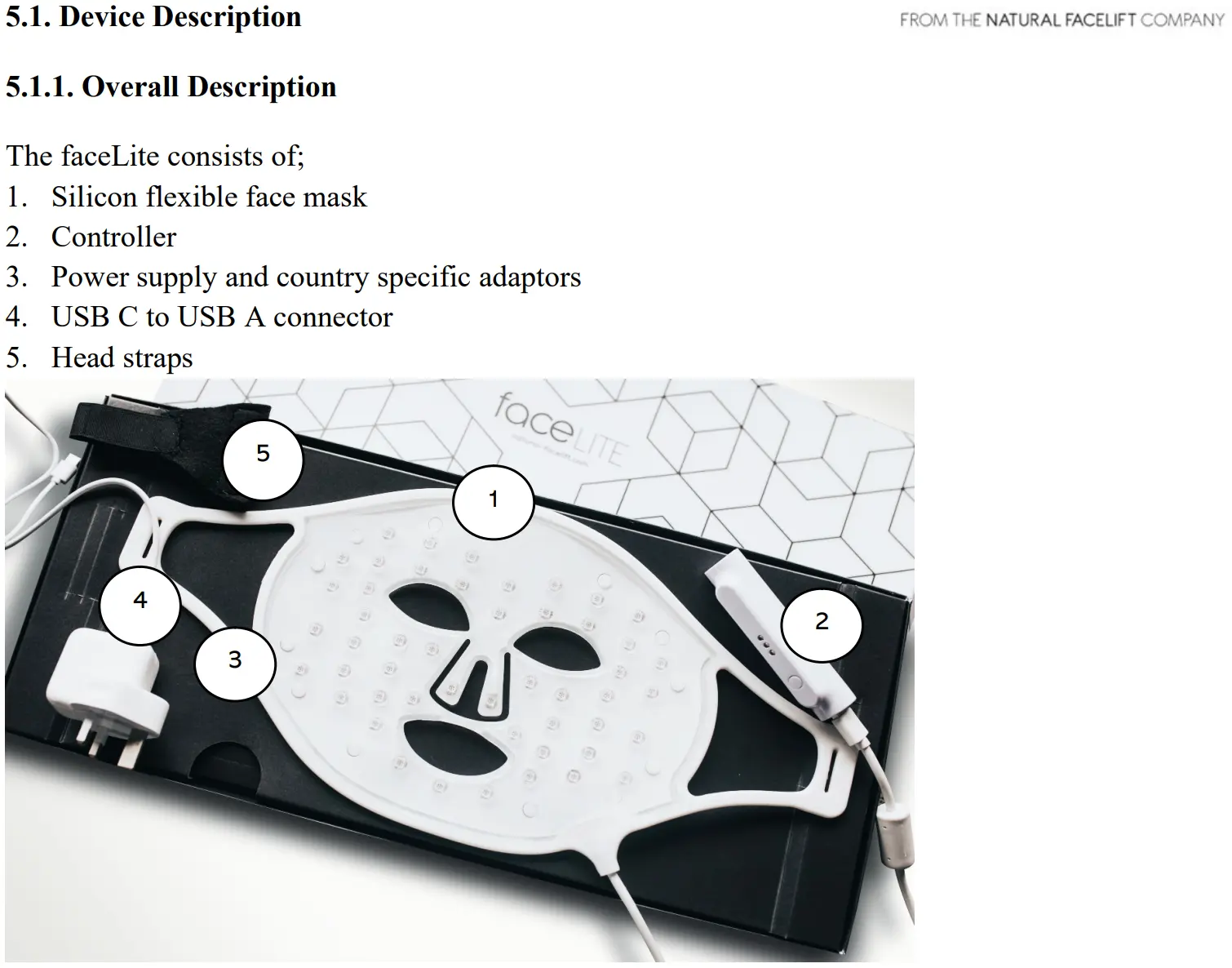
So neither of these two LED masks holds its own clearance. And the one you’d expect to, with 20 years of professional systems behind the name, holds the older and more widely shared of the two files.
Comfort: CurrentBody 4/5 · Omnilux 3/5
CurrentBody: eye inserts
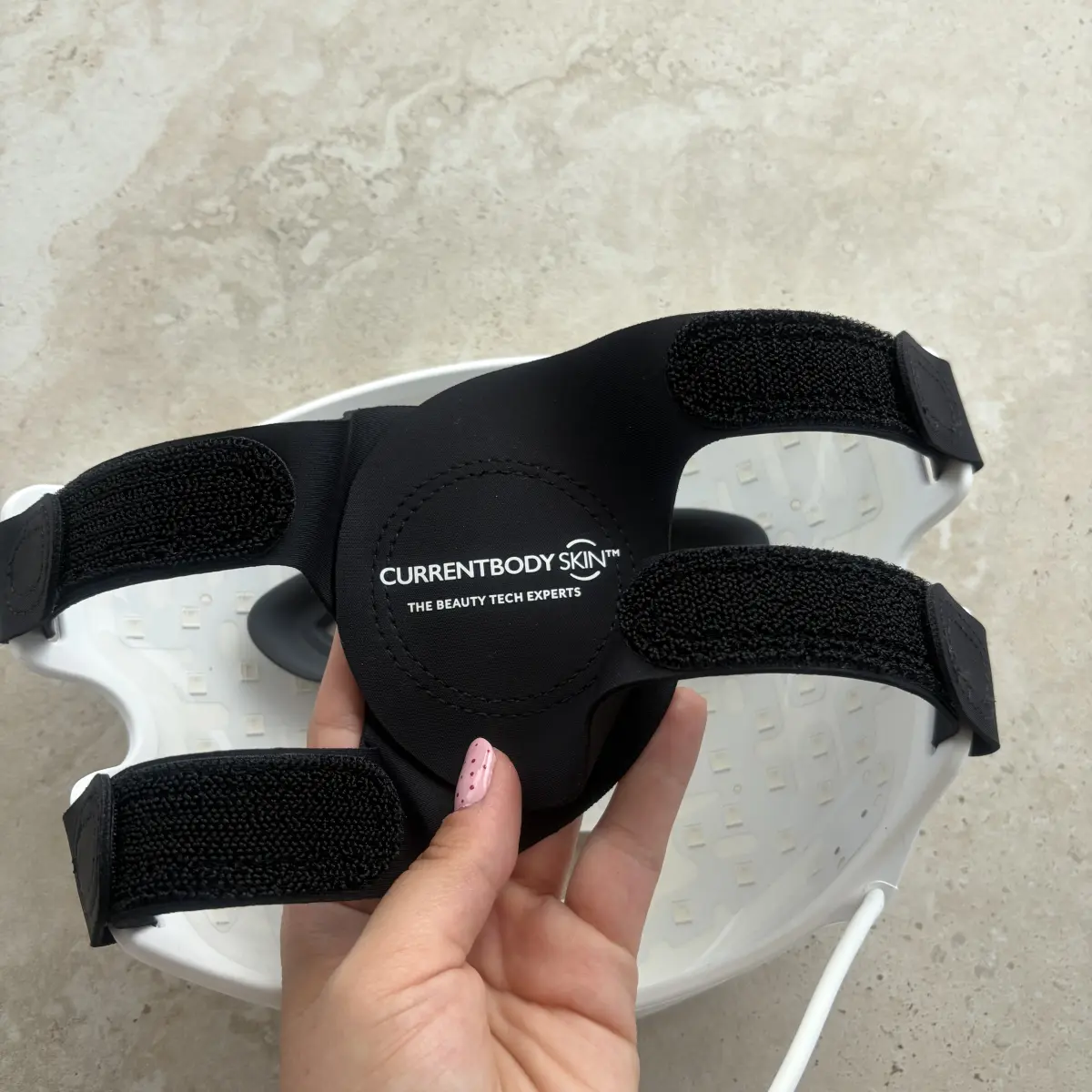
Wearing this one costs me nothing. The silicone stays cool against the skin, the shape sits down on my cheeks and jaw rather than hovering over them, and a session is two gestures and a wait: fasten, clip, and the LED mask cuts out on its own at 10 minutes. Over 50 evenings, the device was never the reason I put one off.
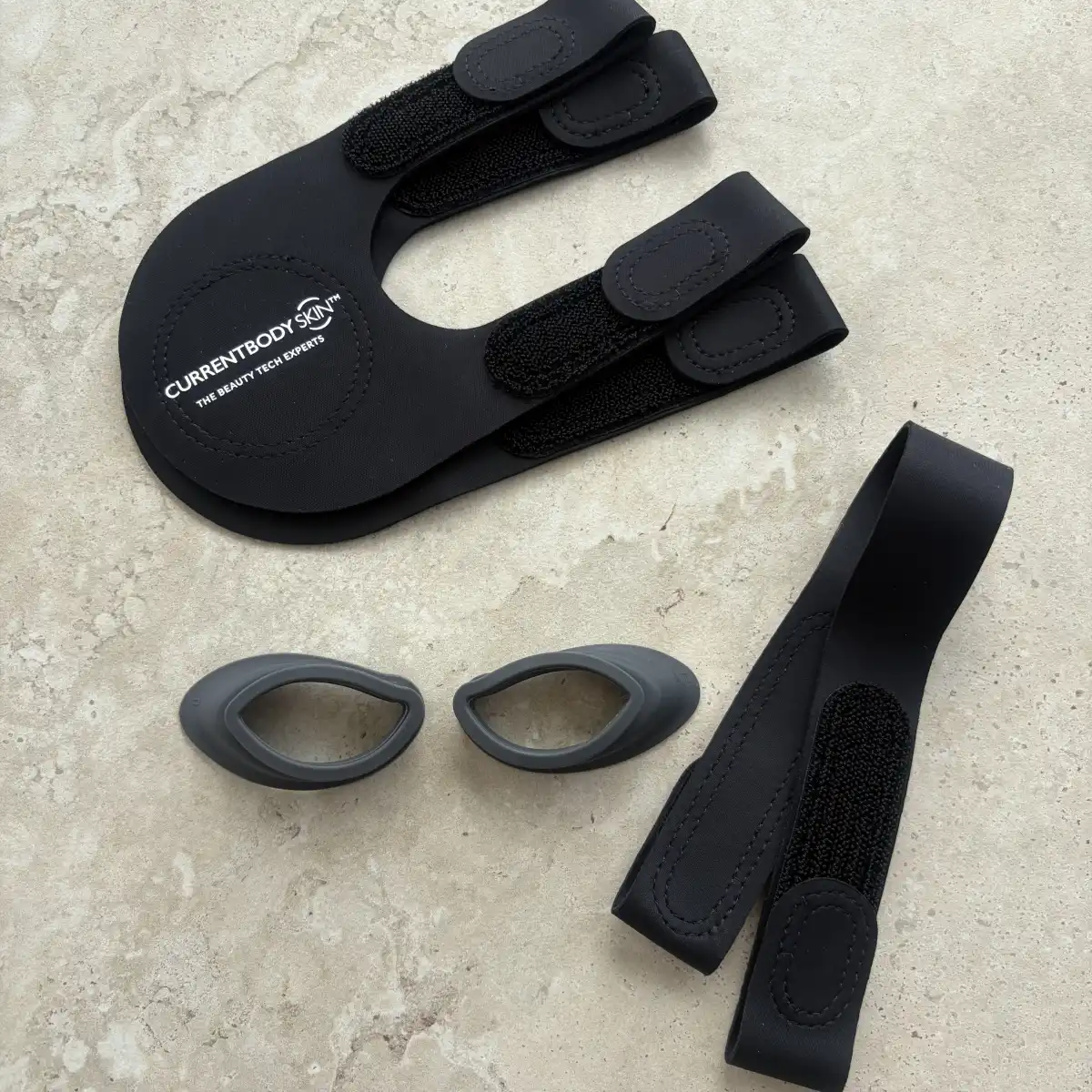
If I could save one accessory from this box it would be the two grey eye pieces. Pushed into their sockets, they let me spend the whole session with my eyes open and my phone in hand, and stand up afterwards with no spots floating in my vision. They just arrive loose instead of already fitted, which is my only complaint here.
Omnilux: no timer, and no eye protection in the box
The panel is the good part: soft, barely there, and it folds down small. At the 10 minute mark I had no urge to pull it off, which I can’t quite say about the CurrentBody’s nose ridge. Then you pick up the controller and the $395 disappears. It feels cheap in the hand and it counts nothing, so all 40 sessions ran on a phone timer while the CurrentBody was switching itself off.
The real gap is eye protection. Nothing ships with it, and Omnilux’s position is that nothing needs to, since the Contour Face passes IEC/EN 62471 and carries no blue diode. I gave that a week. The light left my eyes feeling like a long evening in front of a screen, so I dug out my own opaque goggles and kept them on from then on.
I’d sooner wear protection than take a standard’s word for it, and that decision costs the one thing a home LED mask is for. Goggles on, I can’t read, reply to anything or walk around the house, so the session turns into 10 minutes of sitting in the dark, 5 evenings a week.
Value: CurrentBody 3.5/5 · Omnilux 2/5
CurrentBody: $469.99
At $470 this is the more expensive of the two, and I still think it’s the better buy. The money goes into the mold, the straps, the inserts and the battery, and 110 light points is what the extra $74.99 gets you. What it doesn’t buy is light on my nose or my upper lip, and 30 mW/cm² remains a low output. That’s why Value stops at 3.5.
Omnilux: $395 direct, $439.99 on Amazon
$74.99 is what you save, and here is what the box gives back for it: 66 emitters on a bendy panel, a controller that counts nothing, a pouch, and nothing to put over your eyes. A thin saving for 40% fewer light points and a panel that never touches most of the face it covers.
The rest of the price is the badge, and I do understand why that reassures people. Two decades of in-clinic machines and a name dermatologists repeat is a real thing to buy into. It just isn’t what sits in this box, and the record behind this panel is filed under another product’s name.
Safety & support: CurrentBody 4/5 · Omnilux 3/5
CurrentBody support
CurrentBody’s manual is the more careful of the two. It lists who shouldn’t use the device, tells you to try it on your inner arm and wait a day before it goes near your face, and gives you 2 weeks to send it back if your skin objects. Mine never once warmed up over 50 sessions. The warranty runs 2 years, and the returns terms are published rather than promised.
What’s missing is the IEC 62471 risk group itself, the classification that tells you how long a light source can be looked at without harm: the FDA summary says the test was run, and CurrentBody never prints the result.
Omnilux support
On paper Omnilux hands over more: 2 years of warranty, IEC/EN 62471 conformity written out rather than implied, and four documents to download from the product page, one of them devoted to drug interactions. That last one earns its place, since a photosensitizing prescription is the single most common reason to stay out of red light therapy.
Then the returns page undoes it. 30 days, seal intact, and $15 to send it back, which means the window shuts the moment you try the thing. Omnilux tells you to expect 4 weeks before anything shows. You cannot reach week 1 and still qualify.
Who shouldn’t buy the CurrentBody or the Omnilux
Skip both of these LED masks if you recognize yourself
- The lines you want gone are above your lip, along your nose, or in the ring closest to your eyes. Both LED masks are open at exactly those spots, so you would pay for light that never arrives where you want it.
- You already own an LED mask with more than 120 light points. I made that trade twice to write these reviews, and the Omnilux round cost me 8 weeks and a flatter complexion.
- You want a LED mask with power density higher than 30 mW/cm² Higher density allows you to have less sessions every week, and a stronger light output on your skin.
Am I still using the CurrentBody or the Omnilux?
Updated September 2026. Neither one daily, since I have a denser LED mask than both, the Nooance Elite X600, and I went back to it the evening each test ended. The CurrentBody Series 2 is still the one I hand to someone buying their first LED mask. The Omnilux stays in the drawer, and I keep it to film what 66 emitters light up.
CurrentBody vs Omnilux: your questions
Which LED mask is better, the CurrentBody Series 2 or the Omnilux Contour Face?
The CurrentBody, and it takes all seven criteria: 72/100 against 52/100. My face came out of both tests unchanged, so what separates them is how they’re built. CurrentBody lands roughly 110 points of light against 66, on a shell that holds them against the skin instead of hovering the way the flat Omnilux panel does.
Is the Omnilux more powerful than the CurrentBody?
No, and several comparison pages get this wrong in both directions. Omnilux publishes ~30 mW/cm² and CurrentBody publishes 30 mW/cm², so a 10 minute session works out at about 18 J/cm² on either one. Neither brand says where the figure was measured, which is why the distance between the light and your skin decides what actually arrives.
How many LEDs do the CurrentBody Series 2 and the Omnilux Contour Face really have?
The counts are real, and they aren’t points of light. CurrentBody’s 236 bulbs are 110 red, 110 near-infrared and 16 deep near-infrared, and because red and near-infrared share positions the LED mask lights about 110 spots. Omnilux’s 132 LEDs sit in 66 dual chip bulbs, which the brand states itself, so it lights 66 spots.
Are the CurrentBody and Omnilux LED masks FDA approved?
No, and the wording matters. Both are FDA cleared, which is the 510(k) route: the agency accepts a device because something comparable is already on sale. CurrentBody’s file is K250966, applicant Shenzhen Kaiyan Medical Equipment. Omnilux’s is K191629 from September 2019, applicant Ismart Marketing Svcs, and the record names the device faceLITE.
Does the Omnilux Contour Face come with eye protection?
No, the box has none, and Omnilux argues that none is required: the panel passes IEC/EN 62471 and runs no blue diode. CurrentBody supplies 2 clip-in inserts. I sat under the Omnilux for a week, found it wearing on the eyes, and used my own opaque goggles from session 6 on, which turned a readable 10 minutes into 10 minutes of nothing.
Test log
- Exact models
- CurrentBody Skin LED Light Therapy Face Mask: Series 2, red light version, MK-90H · Omnilux Contour Face, US version, 633 nm and 830 nm, single mode
- How I got them
- Paid for out of my own pocket, both of them. No affiliate link and no contact with either brand
- Test durations
- CurrentBody 12 weeks · Omnilux 8 weeks. The two tests did not run at the same time
- Sessions
- CurrentBody every other day, 10 minutes, about 50 sessions · Omnilux 5 evenings a week, 10 minutes, 40 sessions. 90 in total
- Protocol deviation
- Omnilux: goggles worn from session 6 onward, the first 5 run bare because the box supplies no eye protection
- Photo protocol
- Omnilux: one fixed camera position and one lamp, Sunday mornings, bare skin
- Brand data checked
- currentbody.us product page and spec sheet, omniluxled.com product page and FAQ, the Omnilux Contour FACE Clinical Study Summary PDF, both returns and warranty policies

About Emilie
I have tested LED masks since 2023. I buy the devices, use them for weeks, and read the spec sheets nobody reads, because this market runs on numbers most brands never publish. Not a dermatologist, and I say so whenever a question needs one.