
I buy the devices I test unless the article says otherwise. Some links and discount codes on this site are paid links: if you buy through one, I earn a commission. It never changes a score or a verdict.
I tested the JOVS 6D Laser & EMS Anti-Aging Therapy Mask for 4 weeks, 2 sessions a week, right after 8 weeks with its previous model, the JOVS 4D. But it’s the same molded silicone laser mask, with 10 metal electrodes added into the laser array.
So here is what the EMS actually feels like, why I switched it off after 2 sessions, and my full review of the JOVS 6D.
42/100
Shelved since October 2026After 4 weeks, there is no positive changes on my skin. The soft molded shell is still the best thing about this laser mask. But the electrodes made the sessions unpleasant, they take room on an laser array that only has 68 light points, and JOVS does not share anything about the “510-1940 nm” spectrum.
Buy it if
- You want the JOVS silicone fit and you plan to run it in laser-only mode.
- You already like facial EMS and want it in the same device as your light.
Skip it if
- You expect light on every part of your face.
- You want red light therapy sessions: this laser mask is not an improvement but a step backward.
- You already own the JOVS 4D.
What I tested: the JOVS 6D Laser & EMS mask
I bought the JOVS 6D on JOVS shop for $899, with no code and no affiliation. The page shows it crossed out from $1,299, but $899 has been the price since the mask launched in July 2026, so I don’t count the $400 as a saving.
I ran it for 4 weeks, 2 sessions a week. The first 2 sessions were in M1, the mode that adds low-intensity EMS to the lasers. After that I used M0, the laser-only mode, because I couldn’t keep using the EMS, way too uncomfortable.
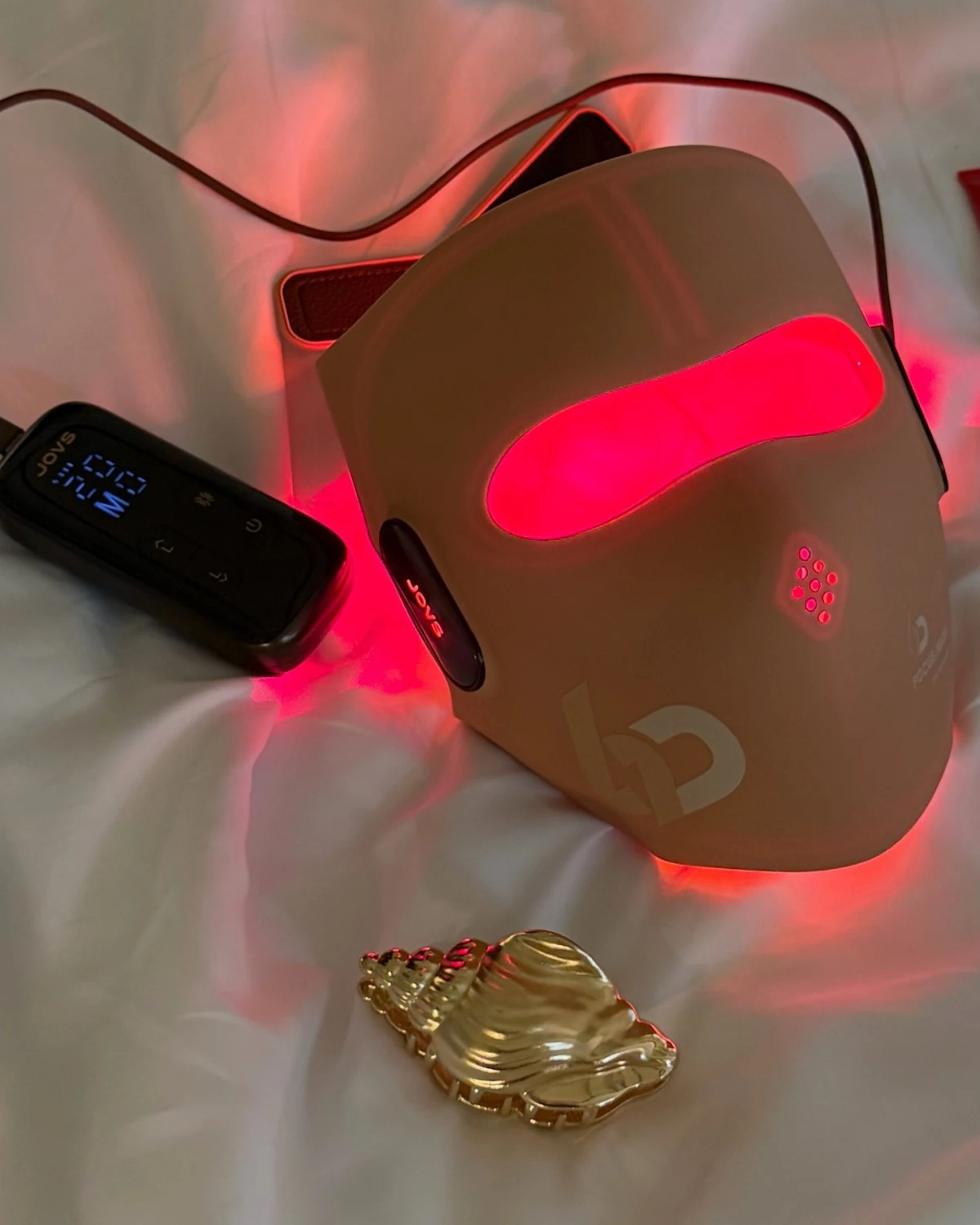
I also kept 1 session a week with my other LED mask, since after 8 weeks on the JOVS 4D, which had left my skin slightly worse, I wasn’t ready to leave my face to a JOVS mask alone again. I used it on clean, dry skin, no serum, which is how I run every light therapy session.
Results: 2.5/5
What changed on my face following my test, including my before-and-after photos. I also evaluate the “before-and-after” examples provided by the brand being tested, as well as the results of any studies that may have been conducted on the mask.
Read my results guideMy own results with JOVS 6D Mask
After 4 weeks of using JOVS 6D Mask, my skin looked the same as on day 1. Nothing got worse this time, which is already better than my 8 weeks with the JOVS 4D, but I can’t give the JOVS 6D the credit for this. This time, my Nooance X600 was running once a week on the same face.
I stopped this test at 4 weeks because I wasn’t convinced by JOVS products following my previous test. The EMS was off also, and at that point I was wearing a 4D with 2 fewer light points.
JOVS 6D Mask Results according to the brand
The 6D page lists 64.9% at week 1, 78.4% at week 2 and 91.9% at week 4 for firmness, with a +9.58% elasticity index. But those are the figures JOVS released for the 4D in November 2025.
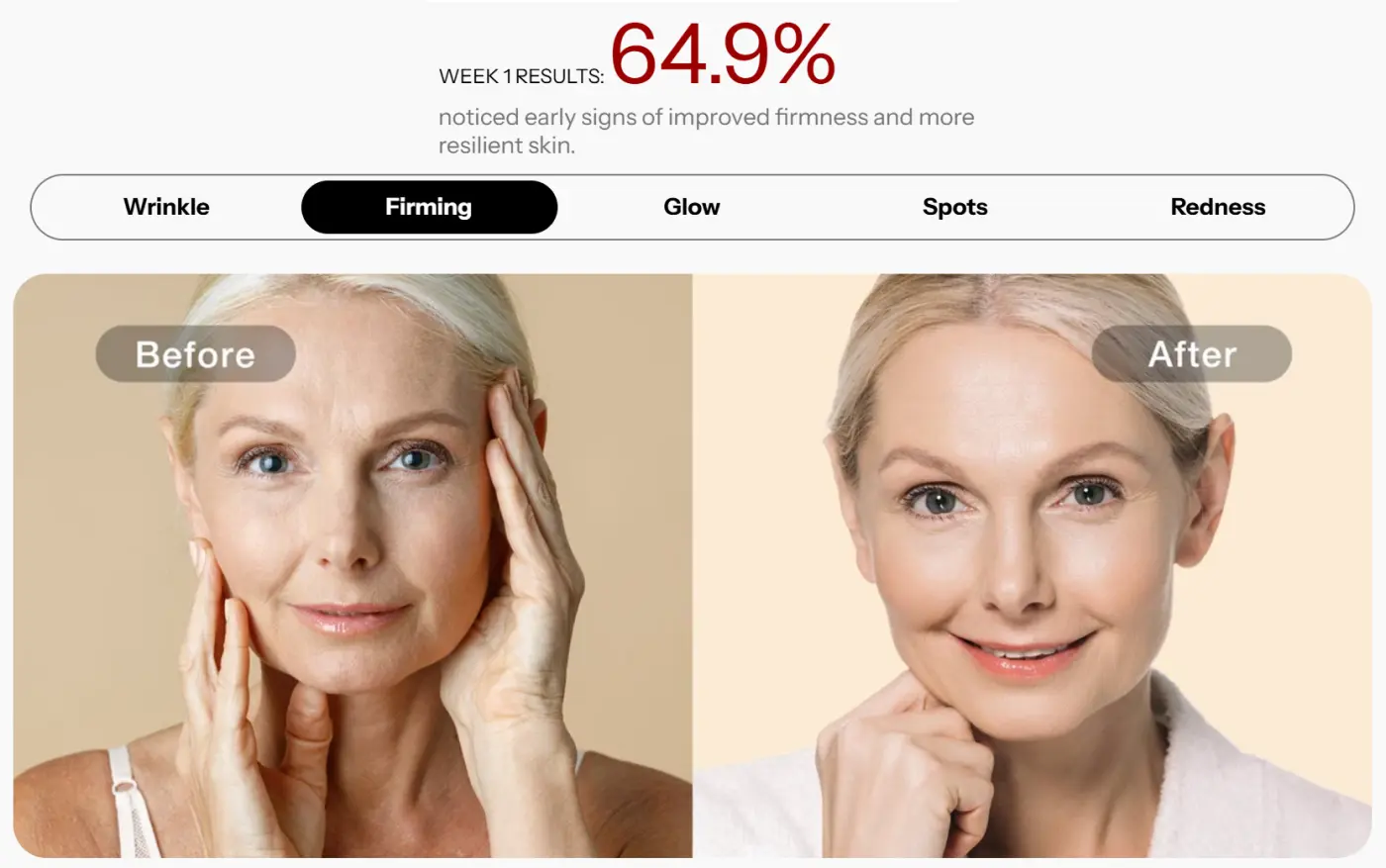
And once again, no study is named for the 6D, and none for the EMS at all... So what can I take away from this? Not much, since the figures provided don’t even apply to this mask model. I’m very disappointed by this oversimplification, which shows no difference from the cheaper 4D model.
Irradiance: 3/5
How much light reaches the skin, in mW/cm²? I evaluate this value, as well as how the information is presented, the conditions under which it was measured, and the total dose received in a single session. If the brand does not communicate it, I give it a severe rating.
Read my irradiance guideJOVS 6D: 143 mW/cm² for 20 minutes
JOVS publishes 143 mW/cm² for the 6D, the same number as the 4D, without saying whether the measurement was taken at the skin surface or not. As a reminder, irradiance is the power of the light output : it must be at least 30 mW/cm² to trigger biological mechanisms.
And the session duration is the problem here because M0, the laser-only mode, runs 20 minutes. At the published irradiance, that’s 143 mW/cm² × 1,200 seconds, or about 172 J/cm² on each lit point. The two EMS modes run 10 minutes, so 86 J/cm².
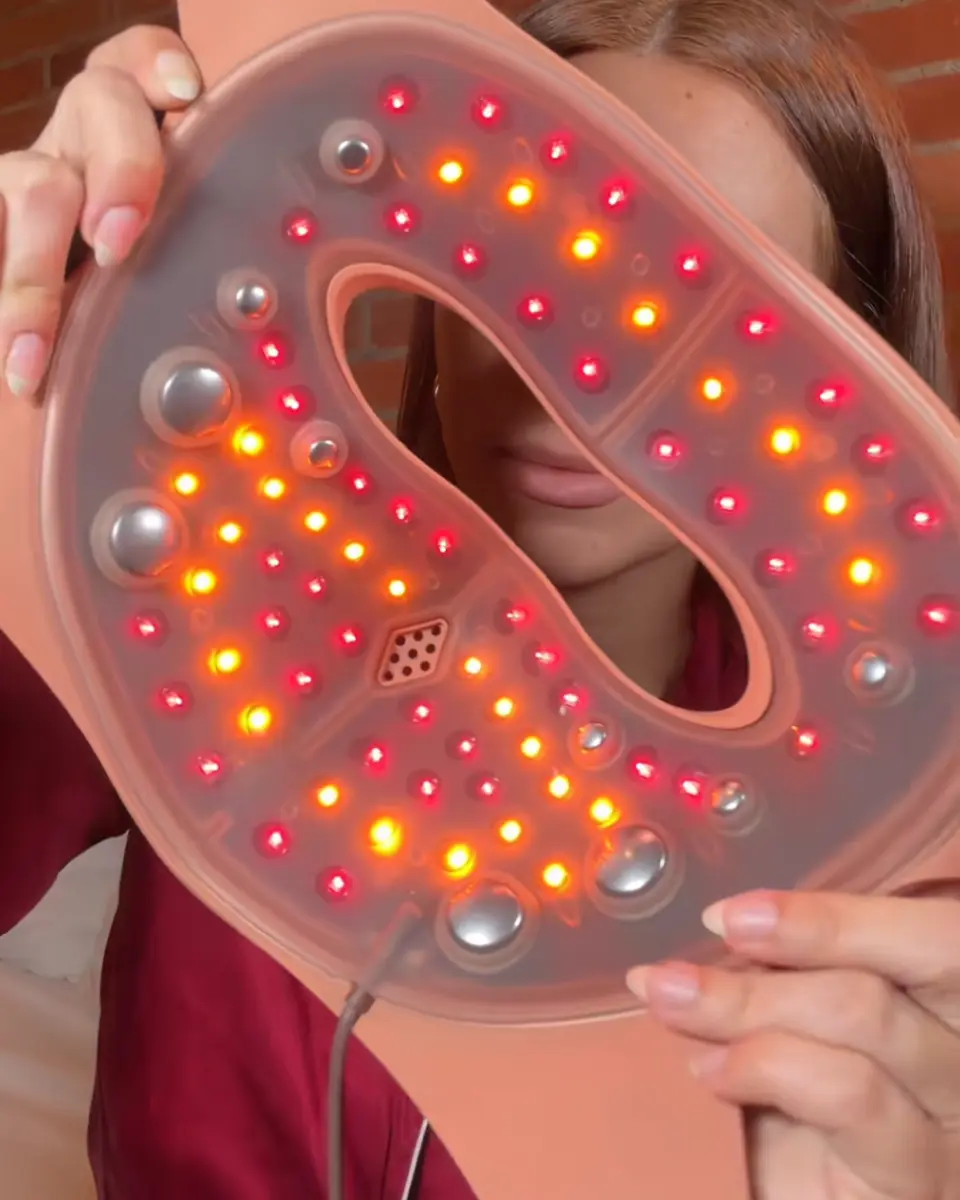
I’ll explain the other problem with irradiance in the next section, considering it’s concentrated in these few points.
The light therapy research gets its results between roughly 30 J/cm², which is roughly between 30 and 50 mW/cm² for a 10-15 minute session. Above that range, the photobiomodulation literature describes a biphasic response, which means more light stops helping and can start to do the opposite.
- JOVS 6D 143
- Nooance Elite X600 50
- CurrentBody Series 2 30
- Omnilux Contour Face 30
So 143 mW/cm² isn’t a strength to me: it pushes the session far outside what has been studied, three times over on the 20-minute mode.
Coverage: 1/5
How many points of light does the mask actually feature, how evenly are they distributed, and which areas remain uncovered? Note that I am counting “bulbs” and not LEDs, because the number of LEDs often includes two, three or more diodes per bulb, which inflates the apparent coverage area.
Read my coverage guideJOVS 6D: 68 light points and 10 electrodes
JOVS does not publish the number of lasers in the 6D, so I counted them myself. On the 6D’s matrix, I count 68 light spots, which are distributed around the 10 metal domes. I cannot determine, based on a technical specification sheet that gives no indication, whether each spot contains 1 or 2 laser cores, but this has no bearing on the coverage: there are only 68 light spots in total that reach the skin.
- JOVS 6D 68
- JOVS 4D 70
- CurrentBody Series 2 110
- Nooance Elite X600 300
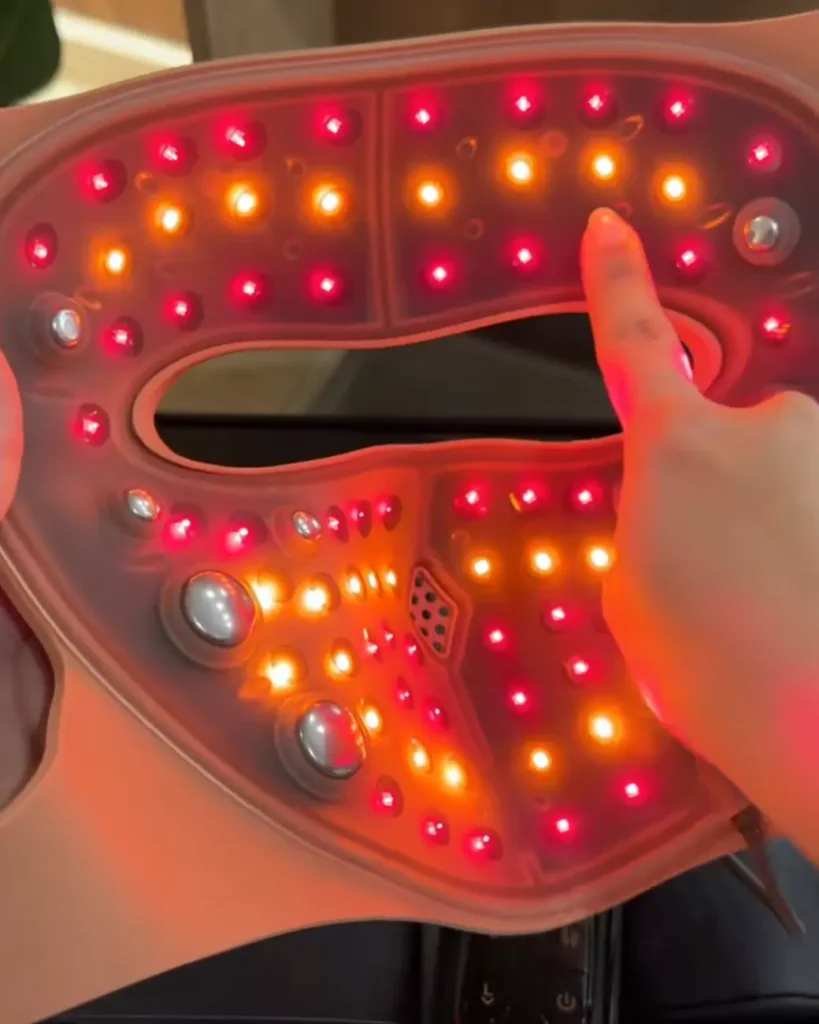
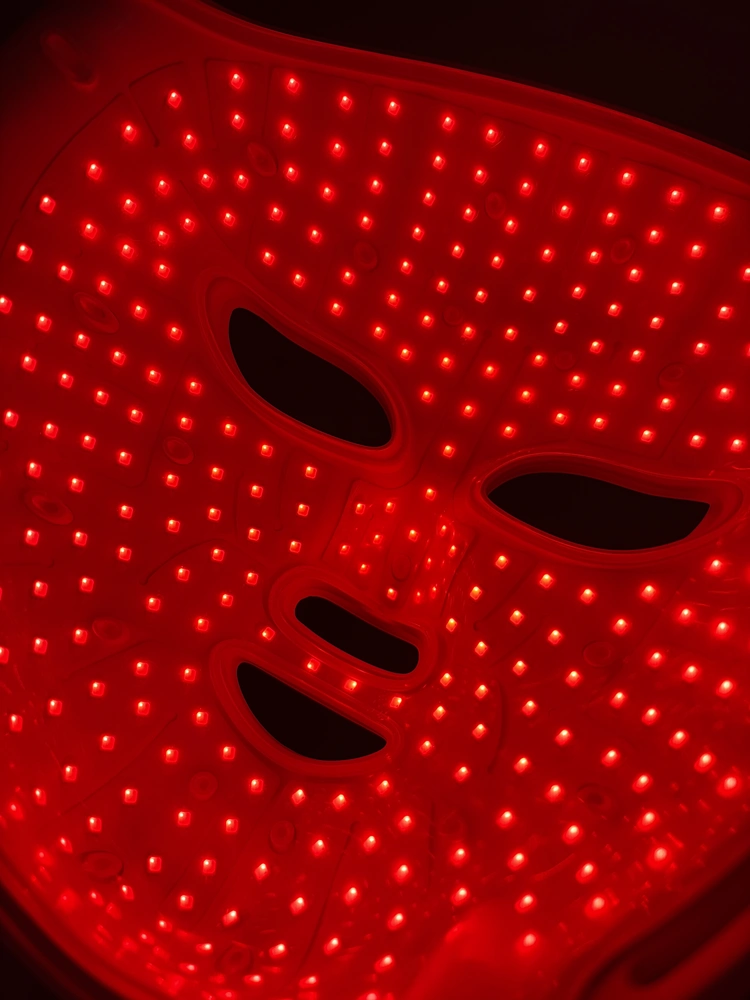
And this figure is really important, since an array of 68 lasers is not at all the same as 68 LEDs. JOVS specifies a divergence of 18 to 20° for its lasers, whereas an LED covers an angle of 120° or more. This wide cone allows the light to overlap and cover the entire face evenly, which is the whole point of a light therapy session! The result here with JOVS is a face lit in dots, with skin in between that gets nothing.
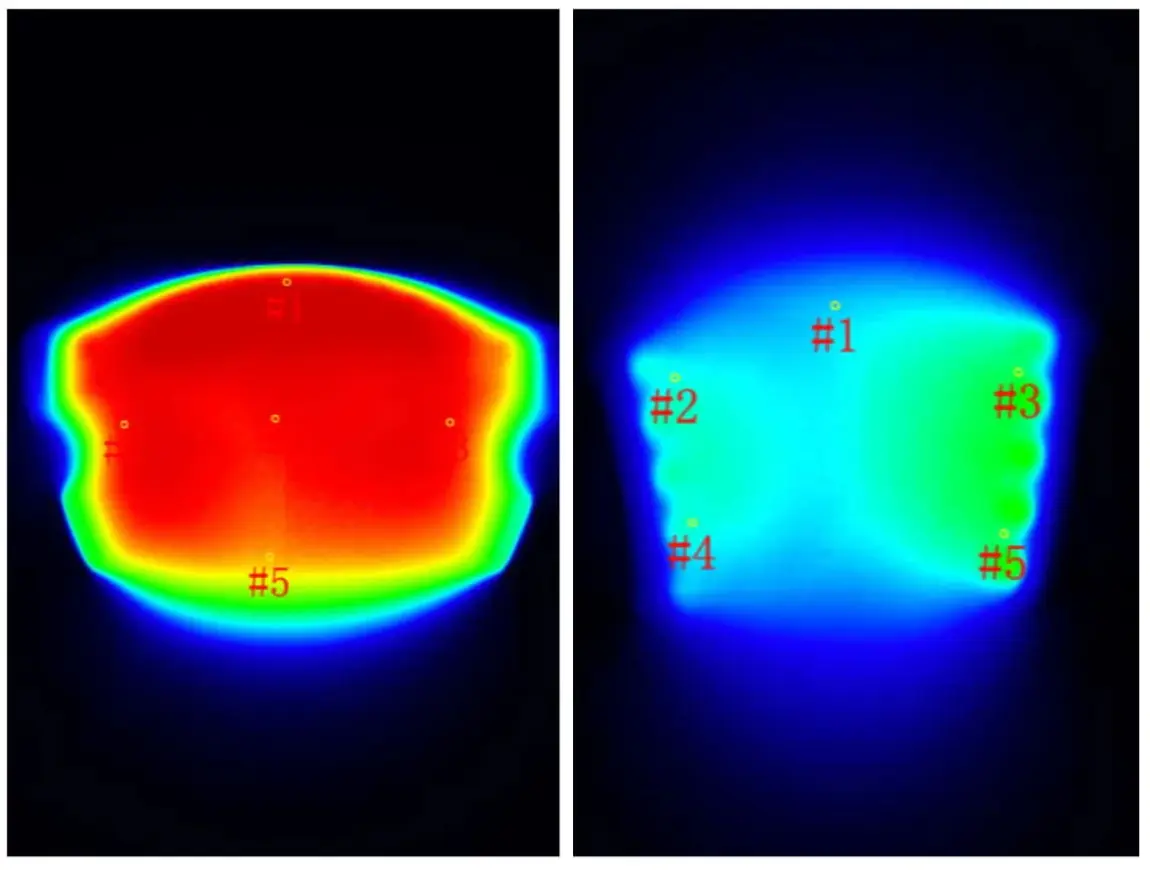
Then there’s the open visor, which is convenient, and I’ll come back to it in Comfort, but it also means the nose and part of eye contour is not covered properly. In conclusion: too few light points that aren’t spread out enough, resulting in terrible coverage for the JOVS 6D mask.
Proof: 2/5
What the brand clearly displays and what I check in the FDA file: wavelengths (in nm), emitted dose, FDA clearance number, product study, safety tests, warranty.
Read my proof guideWhat the brand publishes
- Published: Wavelengths in nm: 660, 850, 940 and 1064 nm for the lasers
- Published: Dose per session calculable: 143 mW/cm² and timers of 10 or 20 minutes
- Missing: FDA clearance number verifiable for this model: none found for a laser and EMS mask
- Missing: Clinical study on this model: the page reuses the 4D figures
- Missing: Documented study: no sample size, duration or lab named
- Not disclosed: Photobiological or laser safety test: no standard or laser class named for this mask
- Published: Warranty and support documented: 1 year, 60-day returns
Proof: 2/5
Is the JOVS 6D mask FDA-cleared?
The product page carries an “FDA Cleared” badge, and a few screens lower it says “FDA-approved“, which is a different thing and which no LED mask has. So I went to the FDA’s 510(k) database and pulled every file from Shenzhen Qianyu Technology, the manufacturer behind JOVS.
And if found 7 products:
- Laser masks are covered by K244020, for the models JM1 and JM2B, which is the 4D.
- K250227, from October 2025, is the only electrical stimulation file, and it describes a handheld device, not a mask.
- And the newest file, from August 2026, covers a range of LED masks. No file names a laser and EMS mask.
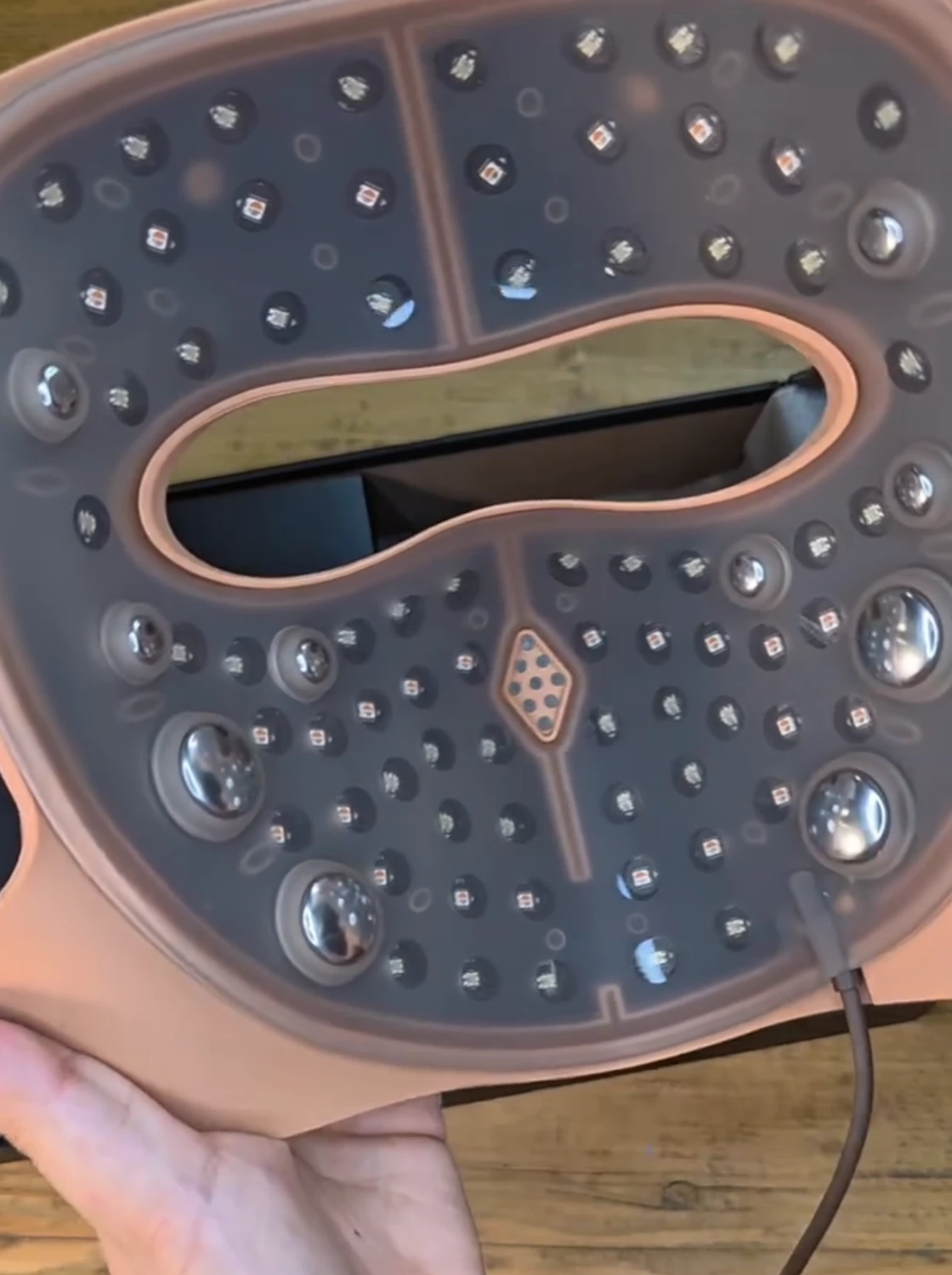
I find this very concerning because JOVS 6D isn’t only the 4D with a new sticker: it adds 10 electrodes, which are a medical device of their own. Until JOVS prints a K number for this mask, I treat the badge as borrowed from the 4D.
What is the “510-1940 nm full spectrum” on the JOVS 6D?
Next to the 4 laser wavelengths of the 4D (660, 850, 940 and 1064 nm), the JOVS 6D page adds a “510-1940 nm Wide Spectrum“. I looked for what emits it and found nothing… The spec table doesn’t name a source, a count or a power for it, and the same page’s own lasers are VCSEL chips, which emit one wavelength each, not a band of 1,400 nm.
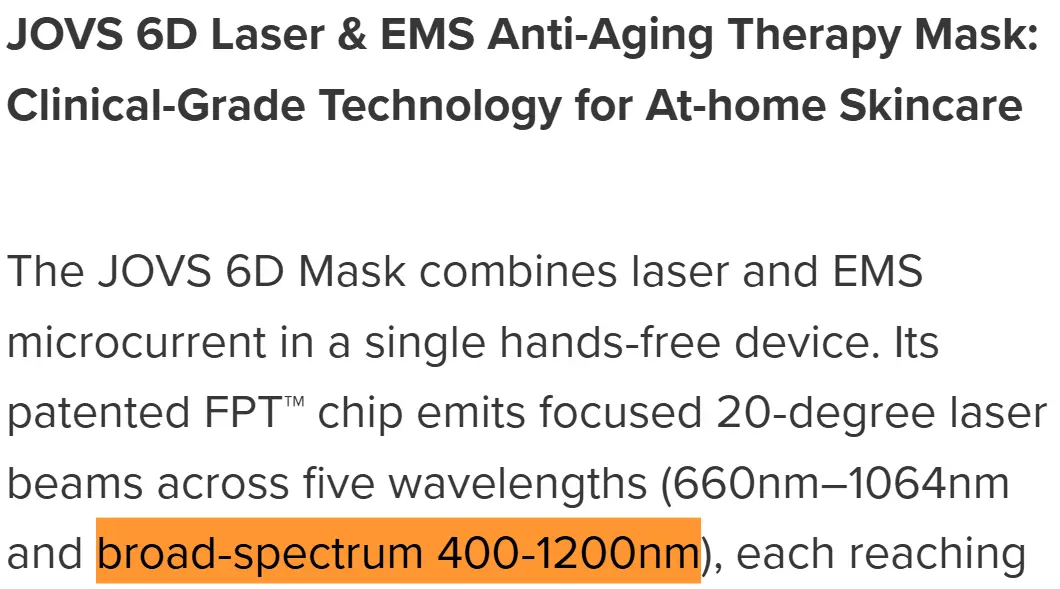
What bothers me is also that JOVS’s other “full-spectrum” products, the bag and the mat, are LED arrays listed at 590 to 1200 nm. And the press release announcing the 6D in August 2026 even gives a different range, 400 to 1200 nm, for the same mask.
Can EMS and light therapy work at the same time?
This is the whole pitch of the 6D, “1 + 1 > 2“, and it’s where I disagree with the product on principle. An electrode is a metal disc pressed on the skin. The skin under it receives current and no light. Also, in M1 and M2, sessions are 10 minutes long, so you get a shorter light session than for M3..
If you want EMS, do it as a separate session, not inside your light therapy: those are different technologies with different objectives unmatchable.
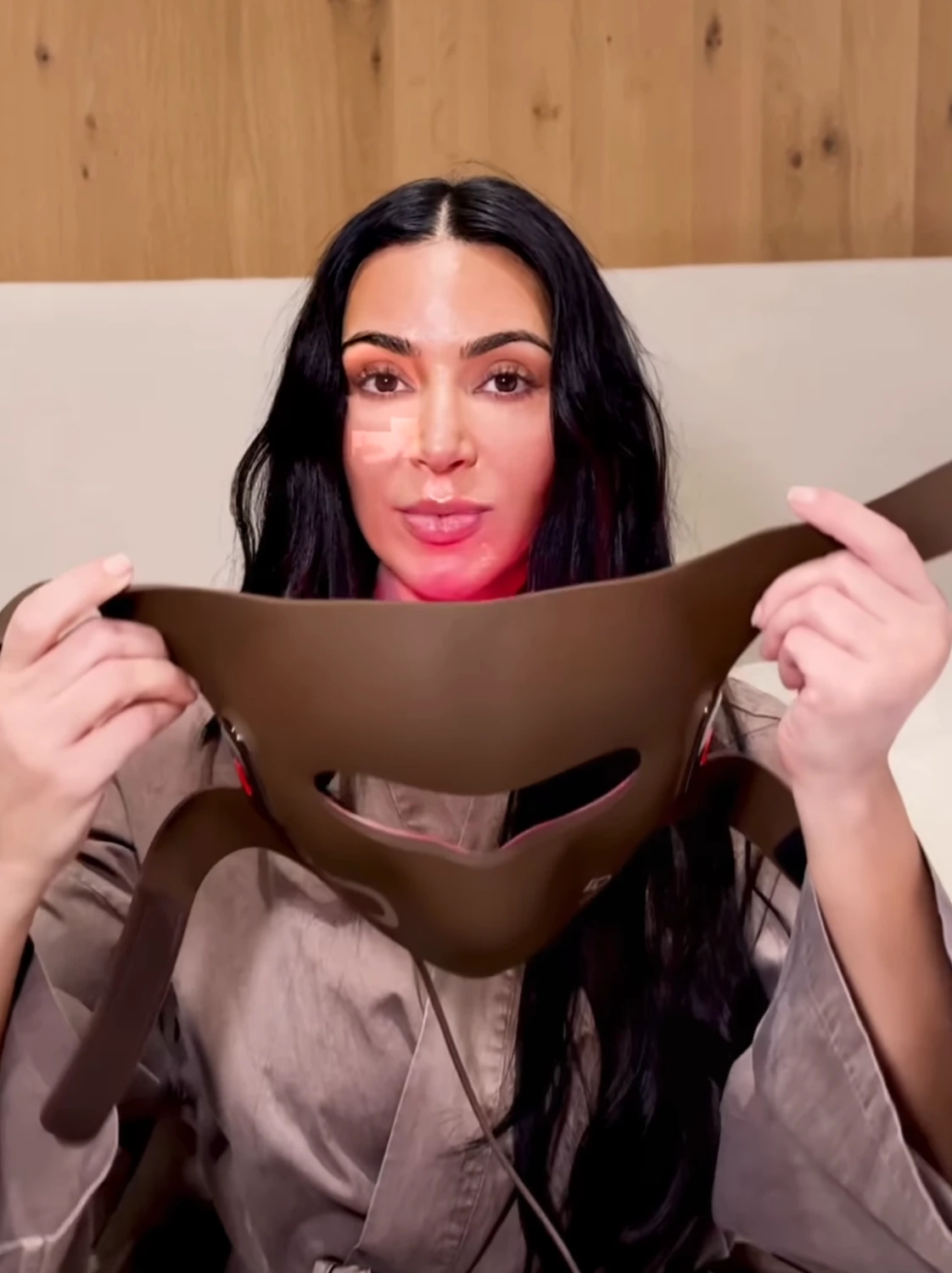
One last thing about the proof you’ll see online: the laser mask Kim Kardashian showed on Instagram is the 4D, in a video posted on the JOVS account with a discount code. I went through which LED masks Kim Kardashian actually uses in a separate guide, and the 6D isn’t in that story.
Comfort: 2/5
Fit, weight, heat, eye comfort and minor inconveniences: straps, timer, battery. A mask that becomes a chore to wear several evenings a week scores poorly in these areas, as using it should be a pleasant experience!
Read my comfort guideWhat the EMS feels like on the JOVS 6D
Even before you switch anything on, the 10 metal beads press on the skin, and on a dry face that’s a small, constant discomfort. Then I started M1 at level 1, the lowest of the 8 levels, and my skin began to jump under the electrodes. The worst spots were around the eyes.
The current makes my whole skin vibrate, and it’s most bothersome around my eyes. I spent both sessions just waiting for the timer to run out…
I was really surprised because no one mentions this discomfort, so I looked it up and found the brand’s FAQ, which states that a tingling sensation or “electric shock” in the teeth is normal and recommends lowering the intensity, but I was already at the lowest setting.
Two sessions were enough for me, and I completed the rest of the test in M0 mode.
Good point: the 3D molded shell of JOVS
To be honest, the mask’s design is its only real selling point. It’s lightweight, and the silicone is flexible and 3D-molded, which makes the mask fit snugly against the face, unlike rigid masks.
As for the eyes, the open visor is also comfortable: I can read or move around during the session. But the 10 EMS balls still push the pad away from the skin and apply pressure to it.
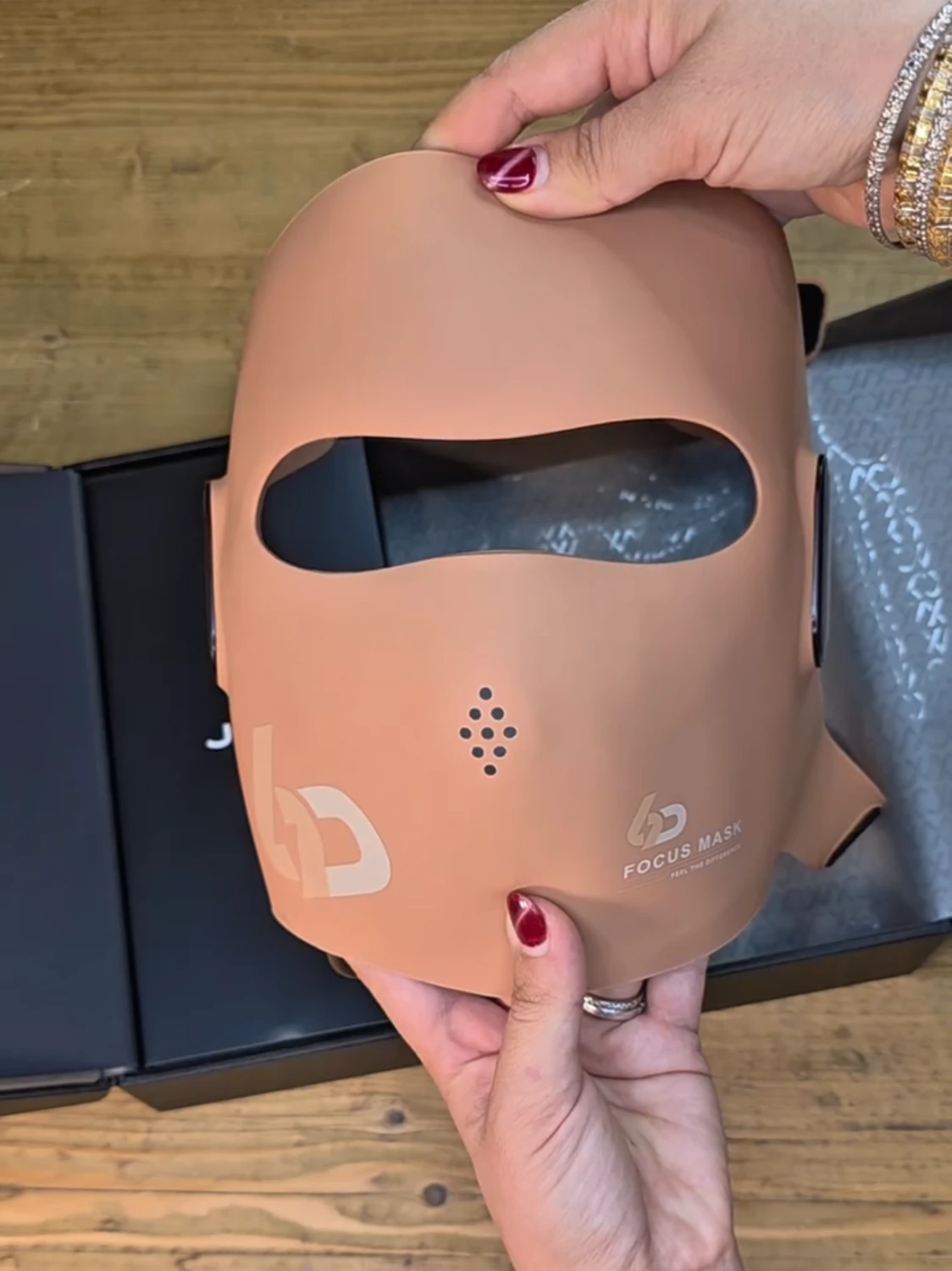
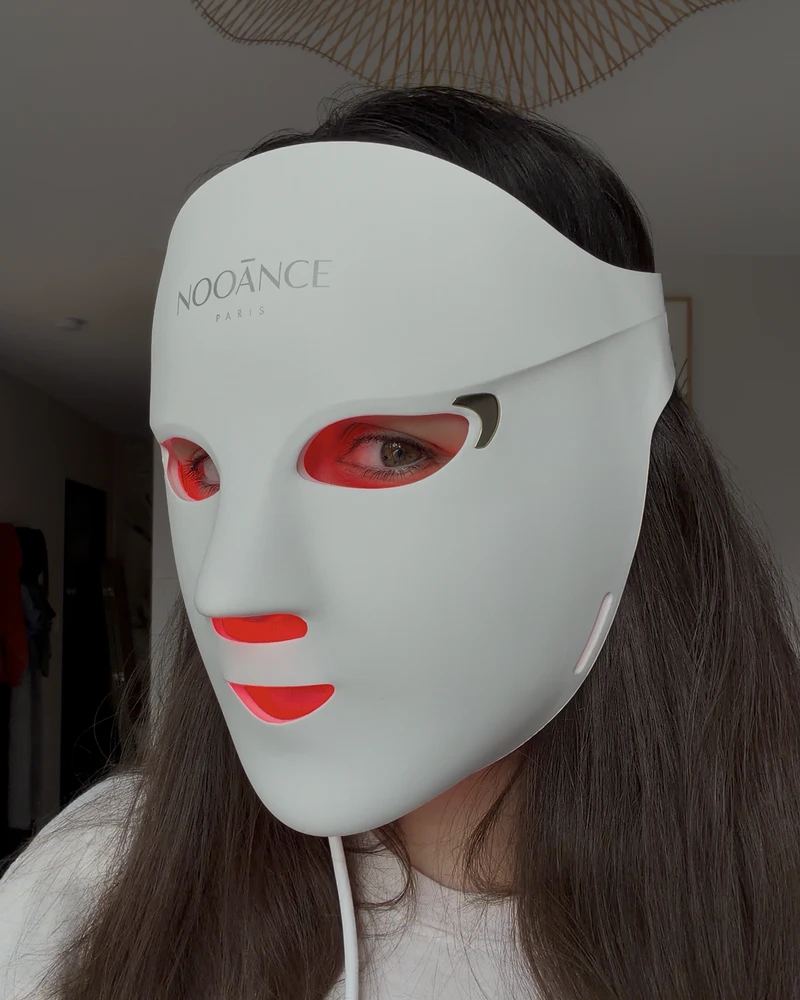
The JOVS 6D nose is also an issue: there’s no cutout, just a diamond-shaped pattern of small ventilation holes, and during a full session, I found this suffocating, even worse when I turned on the EMS. Finally, a 20-minute session is honestly too long when all the other LED masks I use only take 10 minutes.
Value: 1.5/5
The price I paid, when viewed in the context of the results achieved and compared to other masks I have tested, both within this price range and at different price points.
Read my value guideAt $899, the 6D costs $170 more than the 4D’s $729 for the same lasers and a feature I switched off.
For $749, the Nooance Elite X600 gives you 300 light points at 50 mW/cm² in a better shell, and that’s the mask I kept wearing.
Returns are 60 days, but JOVS’s policy keeps 20% on an opened mask and deducts $12 of shipping, so trying the 6D and sending it back costs you about $192.
Honestly, I think this price is way too high for these specs.
Safety & support: 2/5
Eye protection, build quality, warranty, returns, responsiveness of customer support, and the mask’s ability to remain functional over time.
Read my safety & support guideLasers, electrodes and your eyes
These are lasers, not LEDs, and the visor is open, so when I look down I can see the beams around the opening. JOVS publishes no laser class for the 6D and names no safety standard for it. This is not what I expected.
For the EMS, the brand’s own safety page lists pacemakers and implanted devices, epilepsy, pregnancy and open wounds as reasons not to use it, and calls twitching, tingling and the sensation in the teeth normal.
The electrodes closest to the eyes are the ones I felt the most, and nothing in the manual addresses that zone specifically. Add the “FDA Cleared” badge on a mask with no file, and I can’t go above 2 here.
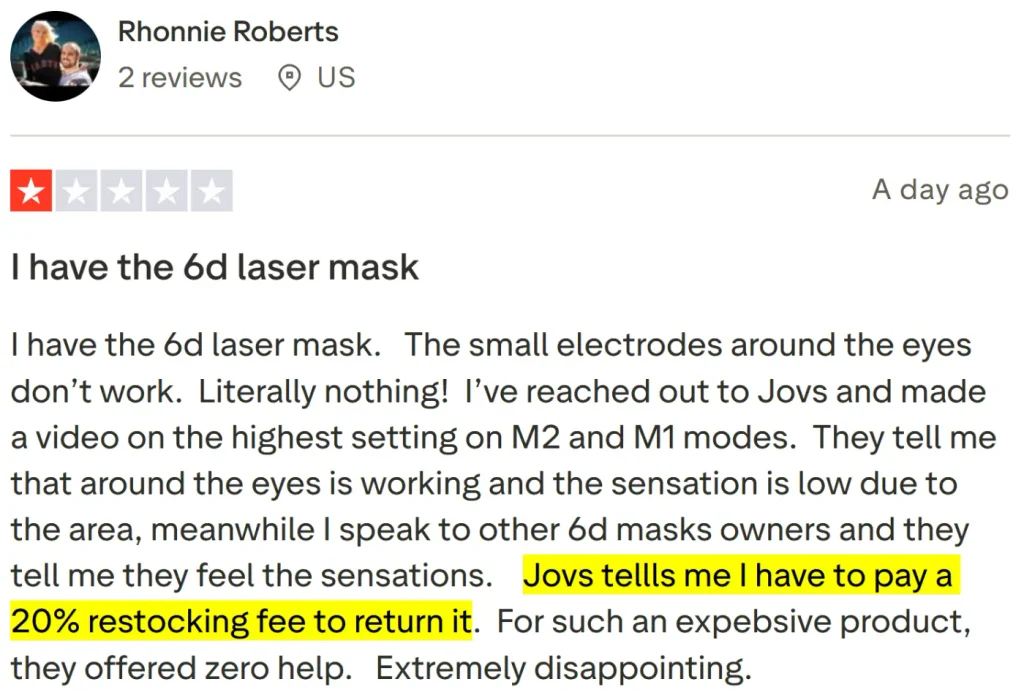
The warranty is 1 year, but on Trustpilot, 6D owners report masks that stopped lighting, remotes that died and units that wouldn’t charge after a few months. The problem is with returns: JOVS charges a 20% restocking fee for any return.
Who shouldn’t buy the JOVS 6D
Skip this one if you recognize yourself
- You already own the JOVS 4D. The lasers are the same, you lose 2 light points.
- You want light on your whole face, eye contour included. 68 narrow beams, 10 metal domes and an open visor leave most of the skin dark.
- You have a pacemaker or an implanted device, epilepsy, or you are pregnant. JOVS lists all three on its safety page as reasons not to use the EMS.
- You want the FDA clearance to name the mask you buy. The K number JOVS holds covers the 4D, and nothing in the FDA database names this mask.
Am I still using the JOVS 6D?
Updated November 2026. No. I stopped at 4 weeks, the 6D went back in its box, and my Nooance X600 is the LED mask I kept in my routine.
What I still want to know about the JOVS 6D
How many lasers are in it (like multi-core chips for example ?), since JOVS printed 140 for the 4D and prints nothing for the 6D.
What emits the “510-1940 nm” band, if anything does.
And whether a 510(k) for a laser and EMS mask is on its way, because the badge is already on the page.
If what draws you to JOVS is the soft molded shell, the 4D gives you the same lasers for $170 less, and my review of it says where that mask lands.
If what you want is a face covered in light, the Nooance X600 is still the one I’d point you to. And if you want EMS, I’d buy it as its own device and keep it out of your light sessions.
JOVS 6D Laser & EMS mask: your questions
Is the JOVS 6D mask FDA-cleared?
I found no 510(k) for a laser and EMS mask in the FDA database. The clearance JOVS holds for laser masks, K244020, names the JM1 and JM2B models, which are the 4D, and the company’s only electrical stimulation file describes a handheld device.
How many lasers does the JOVS 6D have?
JOVS doesn’t publish a count for the 6D. I counted 68 light points on the array, 2 fewer than the 70 I counted on the 4D, because electrodes take their place.
Can I use the JOVS 6D without the EMS?
Yes. M0 is the laser-only mode and runs 20 minutes. M1 and M2 add the EMS for 10 minutes, with 8 intensity levels. I used M0 for 8 of my 10 sessions.
What is the difference between the JOVS 4D and the JOVS 6D?
The same 4 laser wavelengths and the same 143 mW/cm². The 6D adds 10 metal EMS electrodes, a “510-1940 nm” spectrum that no component on the spec sheet explains, and $170 to the price. I counted 68 light points on the 6D against 70 on the 4D.
Does the JOVS 6D EMS hurt?
It didn’t hurt me, but at the lowest level my skin twitched under the electrodes, the worst around the eyes, and JOVS says a tingling in the teeth is normal. I found it unpleasant enough to stop after 2 sessions.
Is the JOVS 6D the mask Kim Kardashian uses?
No. The mask in her Instagram video is the JOVS 4D, without electrodes, and the video was posted on the brand’s account with a discount code.
Test log
- Exact model
- JOVS 6D Laser & EMS Anti-Aging Therapy Mask, remote with screen, US version
- How I got it
- Bought on JOVS website, $899, no code, no affiliation
- Test window
- 4 weeks, 10 sessions, 2 a week
- Sessions
- M1 at level 1, 10 minutes, for the first 2, then M0, laser only, 20 minutes, on clean dry skin without serum
- Data checked
- OpenFDA for Shenzhen Qianyu Technology, Trustpilot.
About Emilie
I have tested LED masks since 2023. I buy the devices, use them for weeks, and read the spec sheets nobody reads, because this market runs on numbers most brands never publish. Not a dermatologist, and I say so whenever a question needs one.