
I buy the devices I test unless the article says otherwise. Some links and discount codes on this site are paid links: if you buy through one, I earn a commission. It never changes a score or a verdict.
The Nanoleaf LED mask looks better on paper than it does on a face. The product page leads with 432 LEDs, 7 treatment colors and unusually high irradiance, but the mask actually has 108 light points, its flat silicone panel lifts away from my jaw and chin, and Nanoleaf’s published power does not match the FDA record the company cites.
So here is what 4 weeks got me, what the FDA database says about who actually builds this LED mask, and my full score.
My Nanoleaf Review in short
47/100
Shelved since August 2026I used the Nanoleaf LED mask for 4 weeks at maximum intensity and saw no improvement in glow or skin tone. It was comfortable enough for television or work, but its 108 light points leave weak coverage around my nose, upper lip, jaw and chin. Nanoleaf publishes an unusually high irradiance that conflicts with the FDA record.
Buy it if
- You want a soft cordless panel you can wear while you work, with eye shields that don’t steal coverage.
- A 2 year warranty and a 30 day return matter more to you than a documented dose.
Skip it if
- You want to know how much light actually lands on your skin.
- You want a high density of LED on your face for better results.
- You’re buying this for the lines above your lip, because almost nothing reaches them.
- You want clinical results published for the exact mask you are buying.
What I tested: the Nanoleaf Light Therapy Face Mask
I bought the Nanoleaf Light Therapy Face Mask, SKU NLEDK00-1TFM. I paid for it myself, I have no relationship with Nanoleaf, and there are no affiliate links in this review. I returned the mask at the end of the test, which is the shortest way I can tell you what I thought of it.
My protocol was 10 minutes every two days in red mode, at intensity level 5 of 5, with the eye shields on. That came to 14 sessions over 4 weeks. Normally I’d run 8 weeks before I write anything, and the grid I use is published on how I test.
But I’d already tested a very similar flat LED mask under another name. The Silk’n Face Mask F100 is the same soft rectangle of silicone, down to the hinged nose flap, so when I recognized the object in the box I already knew roughly what 4 weeks would tell me and roughly what it wouldn’t.
Results: 2/5
I always have an LED mask in rotation for testing, so what I really did over those 4 weeks was swap a denser mask out and put this one in. But I did not expect this: by week 4 my skin looked slightly worse than it does with my usual routine, which I interpreted as a return to normal rather than a negative effect.
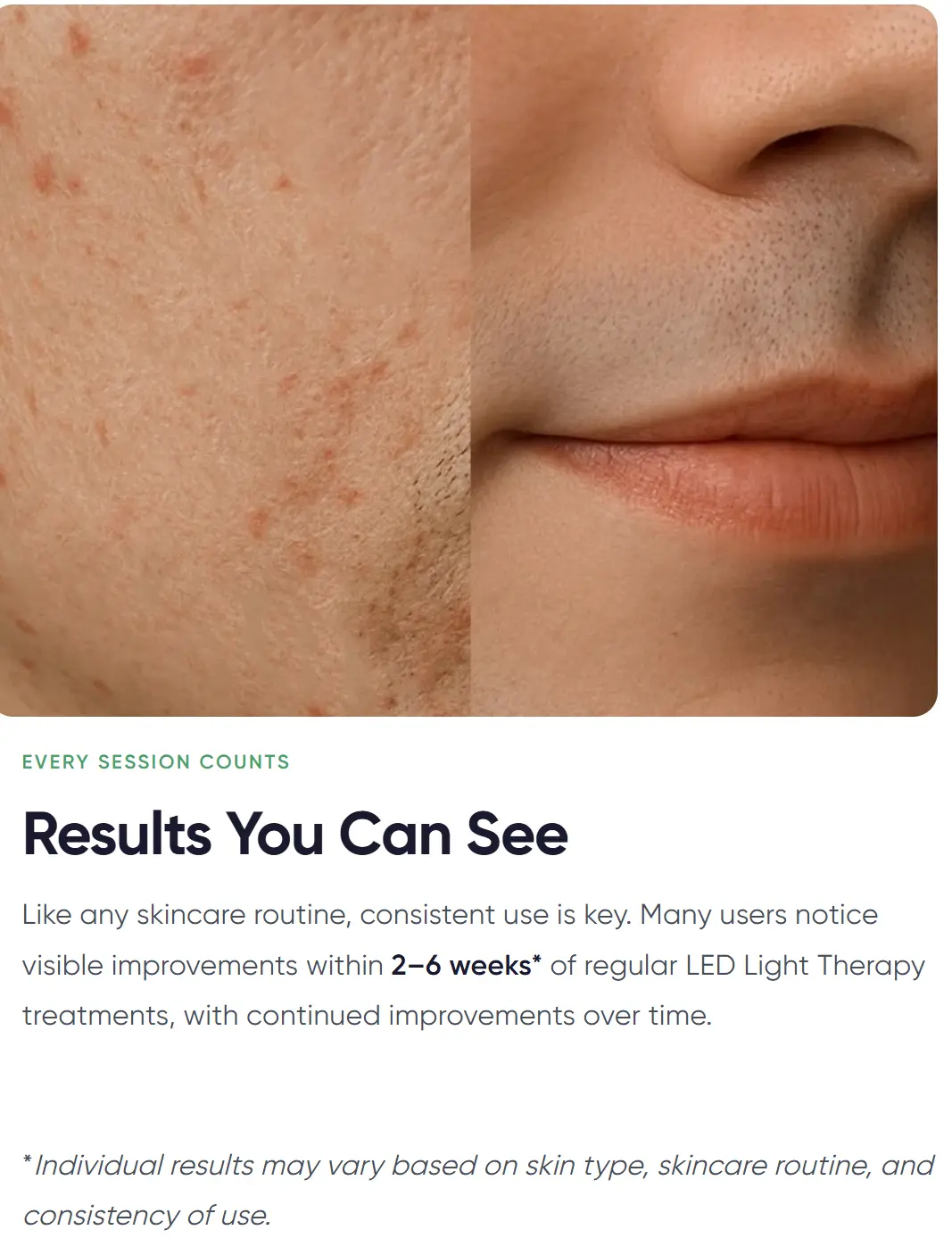
Nanoleaf also publishes its own results, but they carry no subject count, no date, no capture conditions and no lighting note.
Serious brands of LED masks publish instrument readings, a named lab and a fixed photo protocol, and I go through what that looks like in my iRestore Illumina review, which is backed by at least one registered clinical trial.
The final source of results to supplement my own is buyers, and the Amazon listing shows a rating of 3.8 out of 5 on over 400 ratings. The average rating isn’t very good: 58% of reviews give 5 stars, 16% give 1 star, and 8% give 2 stars. The fact that a quarter of buyers give the lowest rating is a sign of a device that either works or breaks, and the Safety section below is where that goes.
Irradiance: 1.5/5
Nanoleaf publishes an irradiance, which already puts it ahead of most LED mask brands, but it is not clearly displayed. It publishes one figure per mode: 91.9 mW/cm² in red, 98.9 in blue, 103.1 in cyan, 78.4 in green. They’re in the spec table on the product page and in the support center, and I had to go looking.
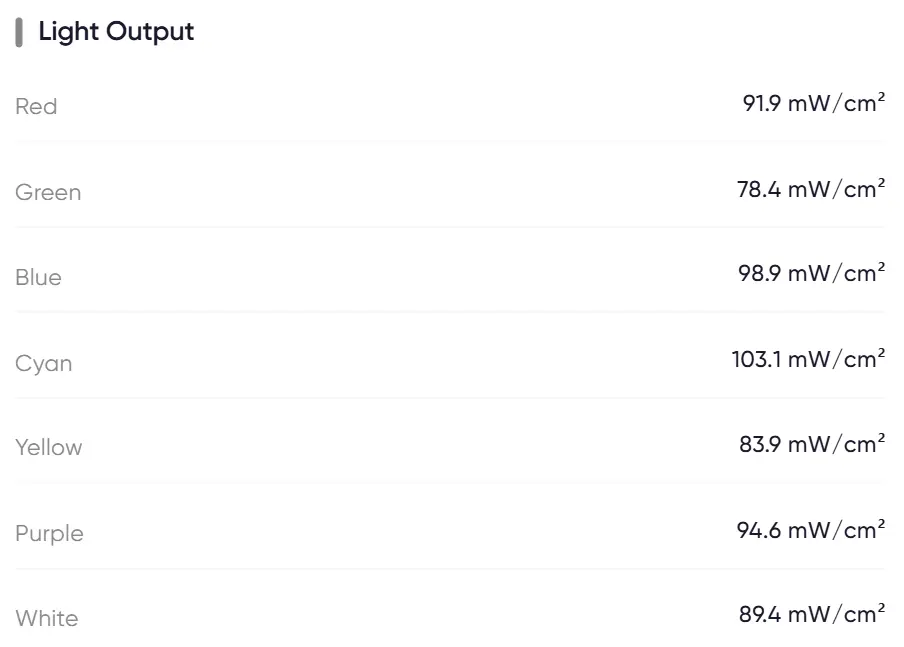
What’s missing is where it was measured. No distance, no note saying it was calibrated at skin contact, nothing. Moreover, the documented working band for an LED mask is roughly 30 to 50 mW/cm², where 10 minutes deposits about 30 J/cm².
So Nanoleaf is supposed to use an irradiance nearly twice as high, but when I compare this figure to the rest of the spec sheet, I find inconsistencies…
The product page and FDA record : the true light intensity
| Public document | Red + NIR wavelengths | Irradiance | Routine |
|---|---|---|---|
| Nanoleaf retail specifications | 640 nm + 850 nm | 91.9 mW/cm² in red mode | 5 to 10 minutes |
| FDA K243555 summary | 630 nm + 850 nm | 6 to 8 mW/cm² in red + NIR mode | 10 minutes |
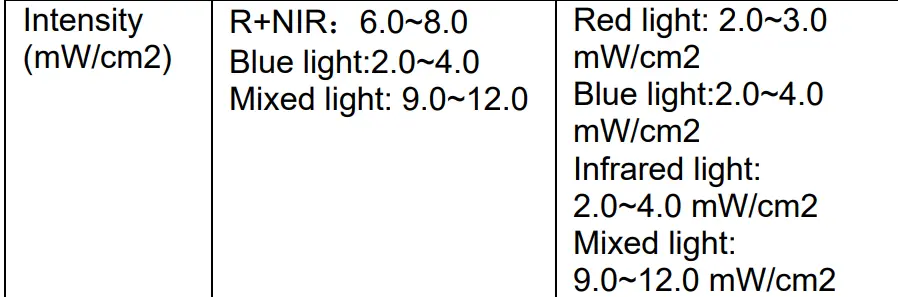
The Nanoleaf LED mask is covered by FDA clearance K243555, which covers 10 model codes built by the same factory. That record gives 6 to 8 mW/cm² for the red plus near-infrared mode, which would equal only 3.6 to 4.8 J/cm² over ten minutes. It also lists 630 nm red and 415 nm blue, while the retail page lists 640 nm and 460 nm. This is very concerning to me because 6 to 8 mW/cm² is very low, making the LED mask almost useless.
The remote to control the intensity
The controller lets you drop the intensity, but the only dose figure Nanoleaf ever prints is for full power, so the other four levels are unlabeled. I ran level 5 for all 14 sessions, partly because the lower ones look visibly faint and partly because it’s the only setting the brand has attached a number to.
- Nanoleaf LED mask, claimed on the product page 91.9
- Nanoleaf LED mask, in its own FDA record 6 to 8
- Recommended LED masks 50
- CurrentBody Skin Series 2 30
- iRestore Illumina not disclosed
Coverage: 2.5/5
Real number of LED for Nanoleaf LED mask
Nanoleaf is one of the very few brands that states it on its own product page: 108 LEDs, each carrying 4 light chips, for a total of 432 LED chips. Colors are red, green, blue and near infrared, and the 7 modes are mixtures of those 4.
The problem is what 108 light points can cover once they are spread across an entire face.
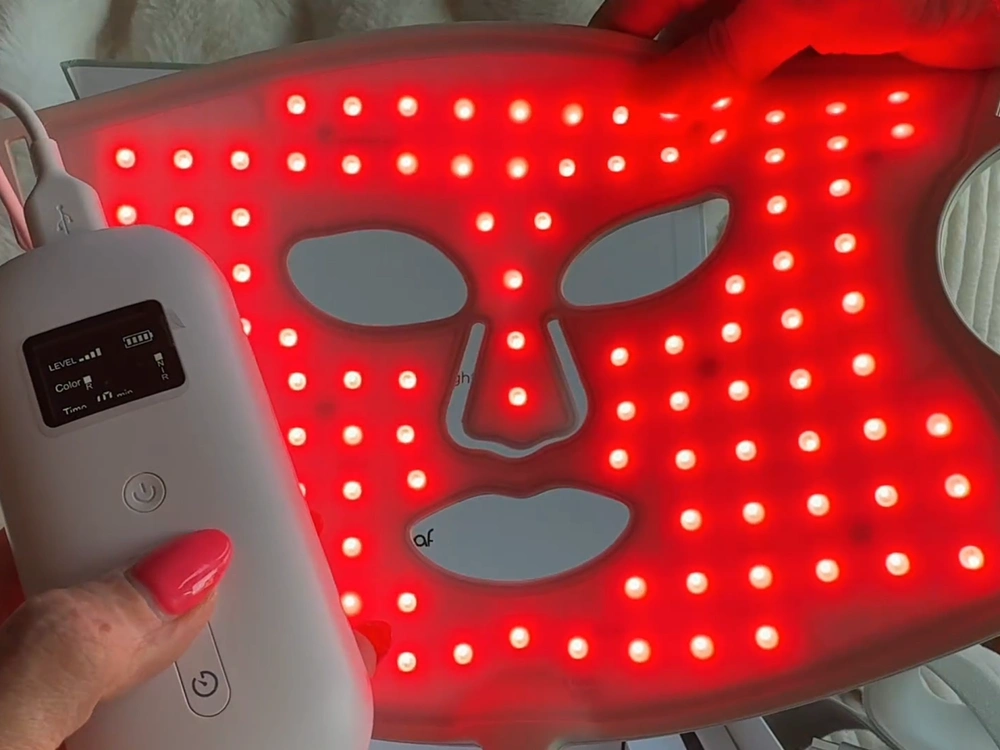
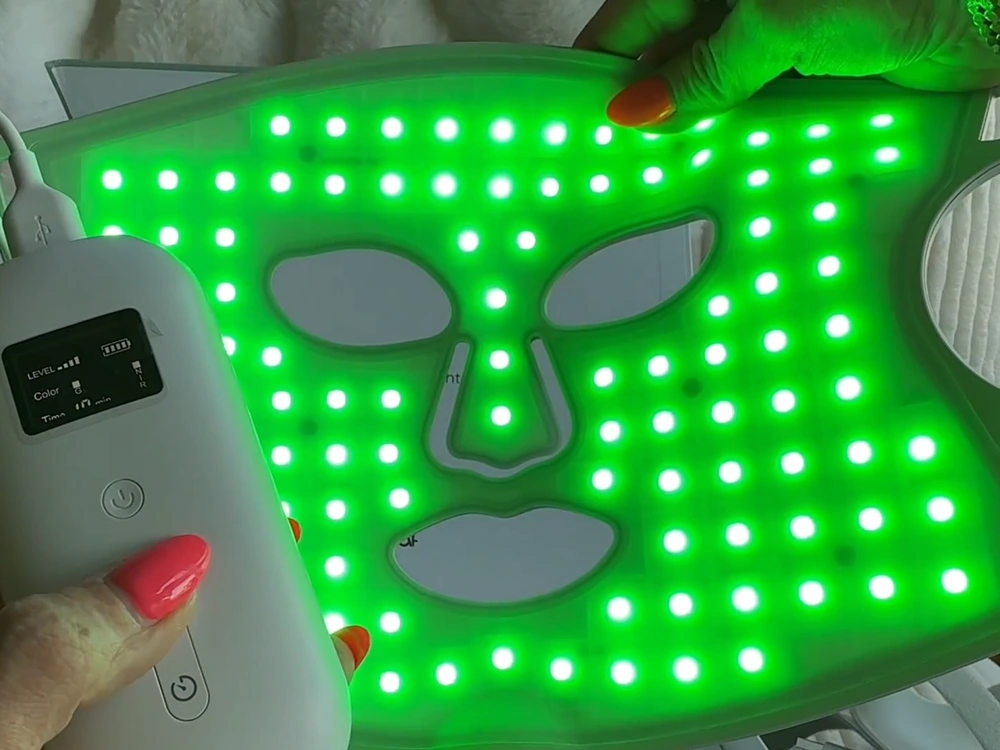
In red mode, the one with the strongest evidence behind it, you’re using 2 chips out of 4 per LED, the 640 nm red and the 850 nm near infrared. So the light hitting your face comes from 108 points, not 432, and 108 points is a pretty low number for an LED mask (120 is the bottom baseline).
I state 108 as a low number considering my own LED mask has 300 light points. It is the Nooance Elite X600, which I use beside of my testing periods.
Count along the nose and you get about 4 points, and the strip between the nose cutout and the mouth cutout carries almost nothing. That strip is where smoker’s lines sit, and it’s one of the areas people buy an anti-aging mask for in the first place.
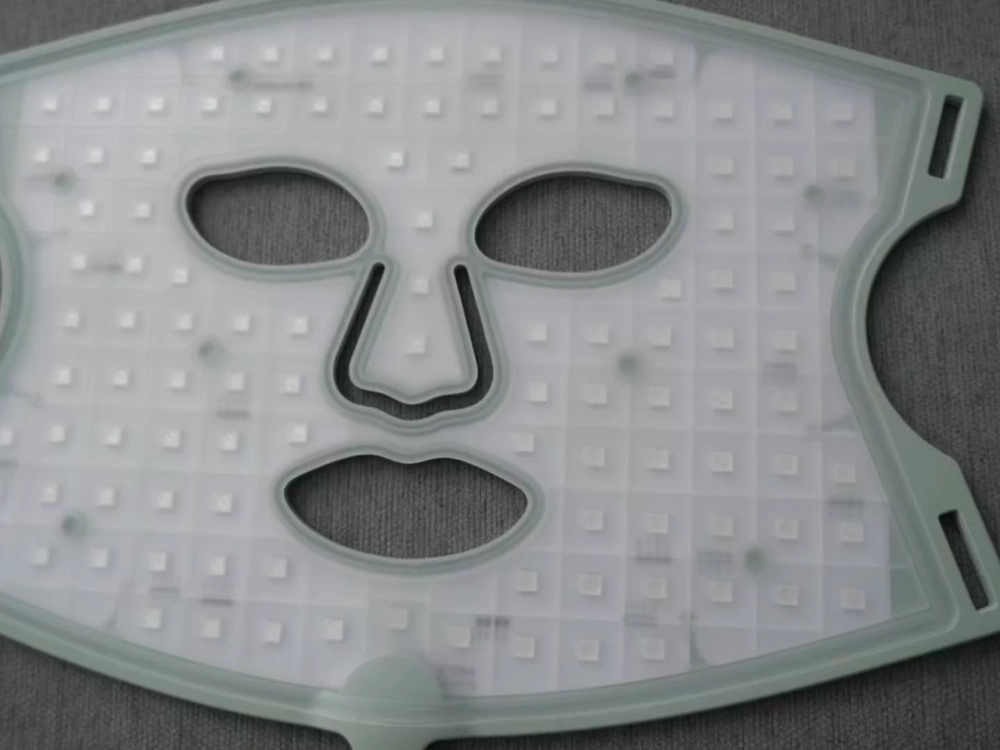
Flexible models beat rigid ones, and this LED mask is flexible. But it’s also flat: it covers the face without conforming to it, which means it lifts up especially around the jaw and chin, where I could feel a gap. The light that travels through the air before reaching the skin arrives weaker and more scattered than if the LEDs were touching the face directly. As a result, the areas farther from the skin receive the least light, regardless of the irradiance.
On the plus side, the eye shields are separate silicone rings and the skin around my eyes still got light. That sounds small until you compare it with the iRestore Illumina, where the big open visor that lets you keep your eyes open is also the largest LED-free surface on the mask, sitting right over the crow’s feet.
Proof: 2.5/5
What the brand publishes
- Published: Wavelengths in nm, mode by mode
- Published: Dose per session in J/cm²
- Published: FDA clearance number, verifiable in the database
- Missing: A clinical study on this mask
- Missing: Study documentation: sample size, duration, named lab
- Published: Photobiological safety, via a documented CE mark
- Published: Warranty and support, 2 years and 30 day returns
Proof: 2.5/5
Five out of seven points would normally correspond to a score of 3, but I deducted half a point because the light output specifications are not entirely clear, as explained earlier. There is also the “before-and-after” comparison titled “Visible Results,” which is not based on any clinical studies and is poorly executed.
Who actually holds the Nanoleaf LED mask’s FDA clearance?
The clearance behind the FDA-cleared badge is K243555, decided on February 5, 2025, and the applicant is Shenzhen Eyco Technology Co., Ltd., from China. It’s a class II clearance and its official title lists 10 different model codes.
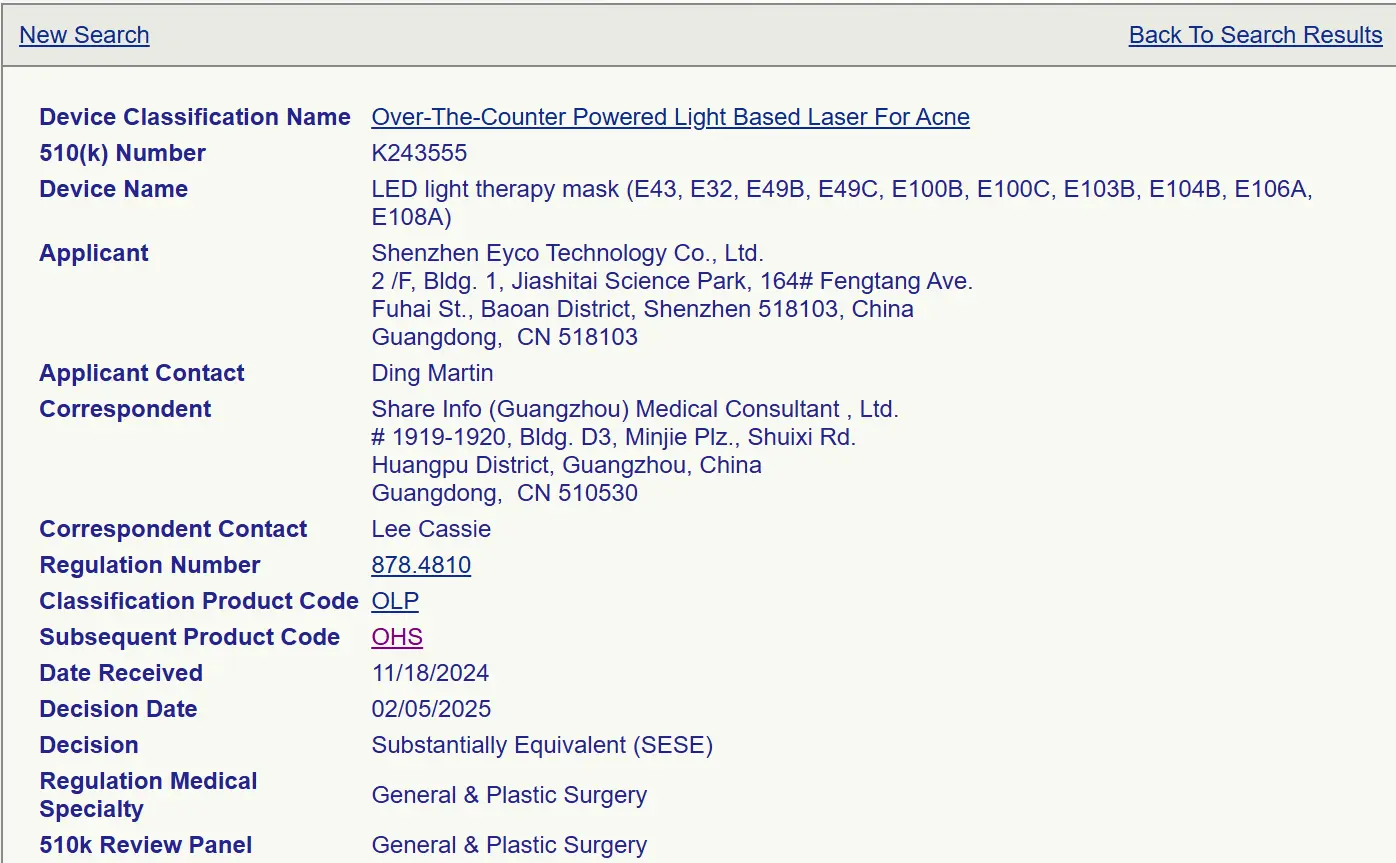
The interesting part is Eyco’s establishment registration, which spells out the brand names attached to those codes. It reads, word for word: LED light therapy mask (model: (Nanoleaf)E43, (Zongjiang)E32, E49B, E49C, E100C…), then a few lines later Brand: Pure Daily Care LUMA Light LED Therapy Facial Mask (Model: E43), and elsewhere renpho rejuven, Peachaboo Glo, Dreame. The same factory, the same clearance, and at least half a dozen labels on the front.
None of that proves the Nanoleaf and the Pure Daily Care masks are identical units, only that the registration files them under the same model code. And Nanoleaf is named in that listing, which is more than several better-known brands manage.
Do the 7 colors on the Nanoleaf LED mask do anything?
Research on light therapy focuses on red light and near-infrared light to combat the signs of aging, and a few studies examine blue light and its antibacterial effect against acne. But acne is multifactorial, so a blue mask may have no effect on some people.
Cyan, yellow, purple, and white are combinations of the same four chips, and I have never found a study supporting any of these combinations.
In fact, LED masks used in beauty clinics rely solely on red and infrared light.
Nanoleaf incorporates 4 chips into each LED to offer 7 different modes, and each additional chip takes up space and consumes energy at the expense of those with proven effectiveness. The 640-nm red light in this mask accounts for only one-quarter of an LED, which reduces its power.
Therefore, I never recommend multicolor LED masks, which are just a marketing gimmick.
Comfort: 3.5/5
At ~250 g with the controller on a cable rather than on your face, it’s light, the strap holds properly, and I could watch television or answer emails through a session without touching it. The warmth is mild and even, which is normal for LED masks and never bothered me.
The one complaint I have is the nose. The nose section is a hinged flap on a flat sheet rather than a molded pocket, so it rests on the bridge and presses slightly. It’s minor, I never cut a session short over it, and it’s the same compromise every flat panel makes.
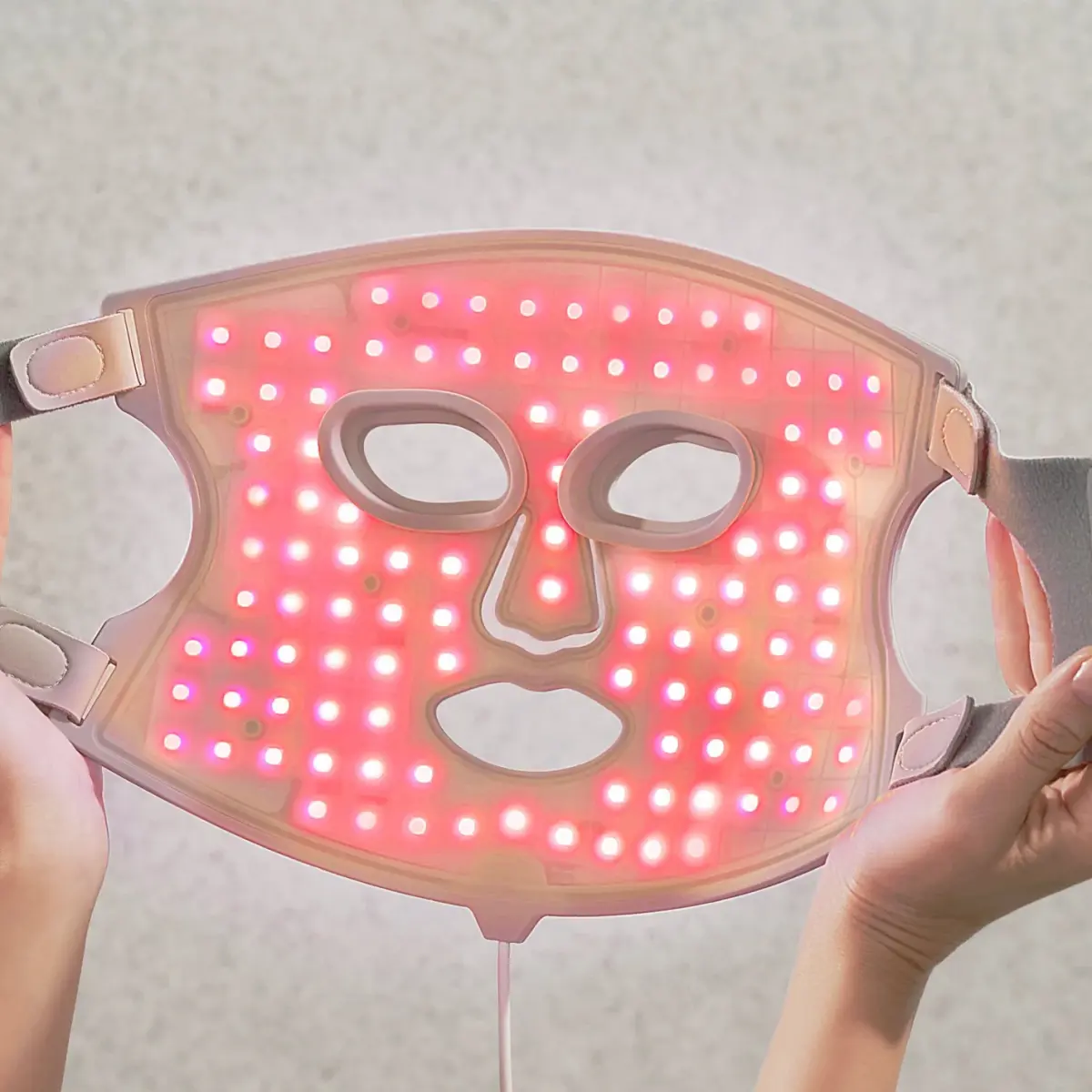
But the battery capacity is low, and 3.5 hours of charging buys 80 minutes of use, so at 10 minutes a session you’re plugging it in every eighth session.
Do the eye shields block the light around your eyes?
I always wear eye protection with an LED mask because I’d rather not experiment with my own retinas, and the two silicone rings Nanoleaf includes sit on the eye itself rather than covering the whole socket. My eyes were properly shielded and the skin around them still got lit, which is the combination you want and which not every LED mask manages.
Value: 2/5
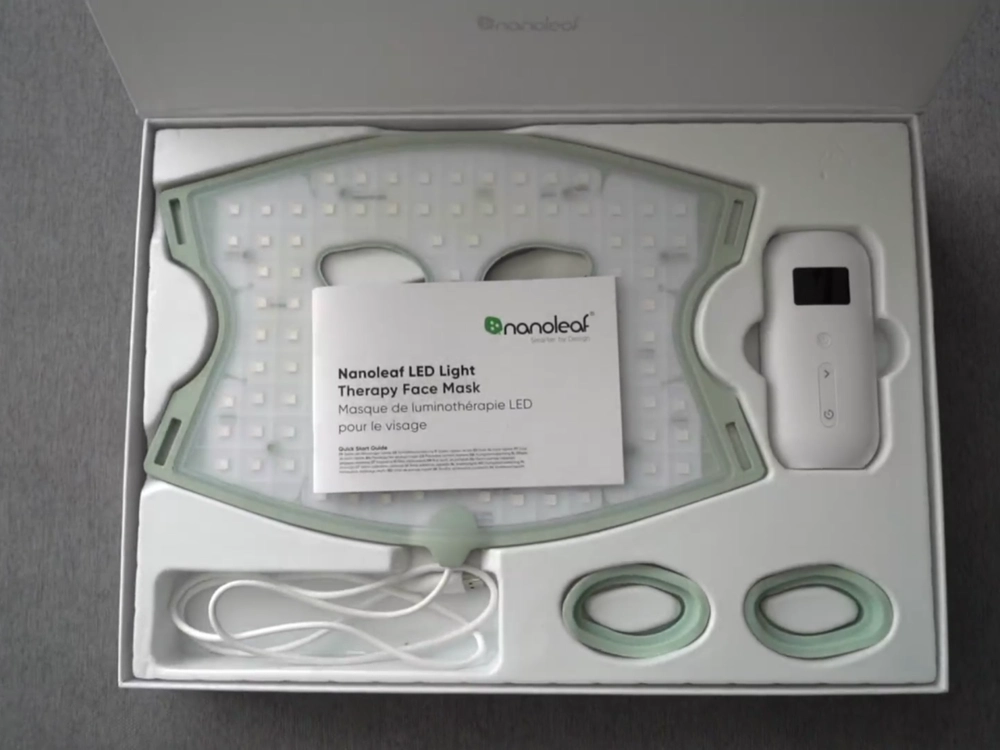
I paid $249.99, and the packaging is really nice. But you’re paying the markup of a well-known lighting brand on an LED mask model that its factory sells to anyone who asks for it, and all Nanoleaf adds to this frame is a spec sheet.
Against that, $250 is real money for an LED mask rather than a bargain, and it buys 108 emitting points on a flat sheet. My verdict on the value question is the thing I actually did with the mask at the end of week 4, which was put it back in the box and print the return label.
Safety & support: 3.5/5
Nanoleaf gives 2 years of warranty and 30 days of returns, includes eye shields instead of selling them, carries CE, FCC and RoHS marks, and publishes a full spec sheet in its support center down to the weight of the controller. Very few LED mask brands do that.
Then there are some 1 star reviews, and one of them comes with a photograph.
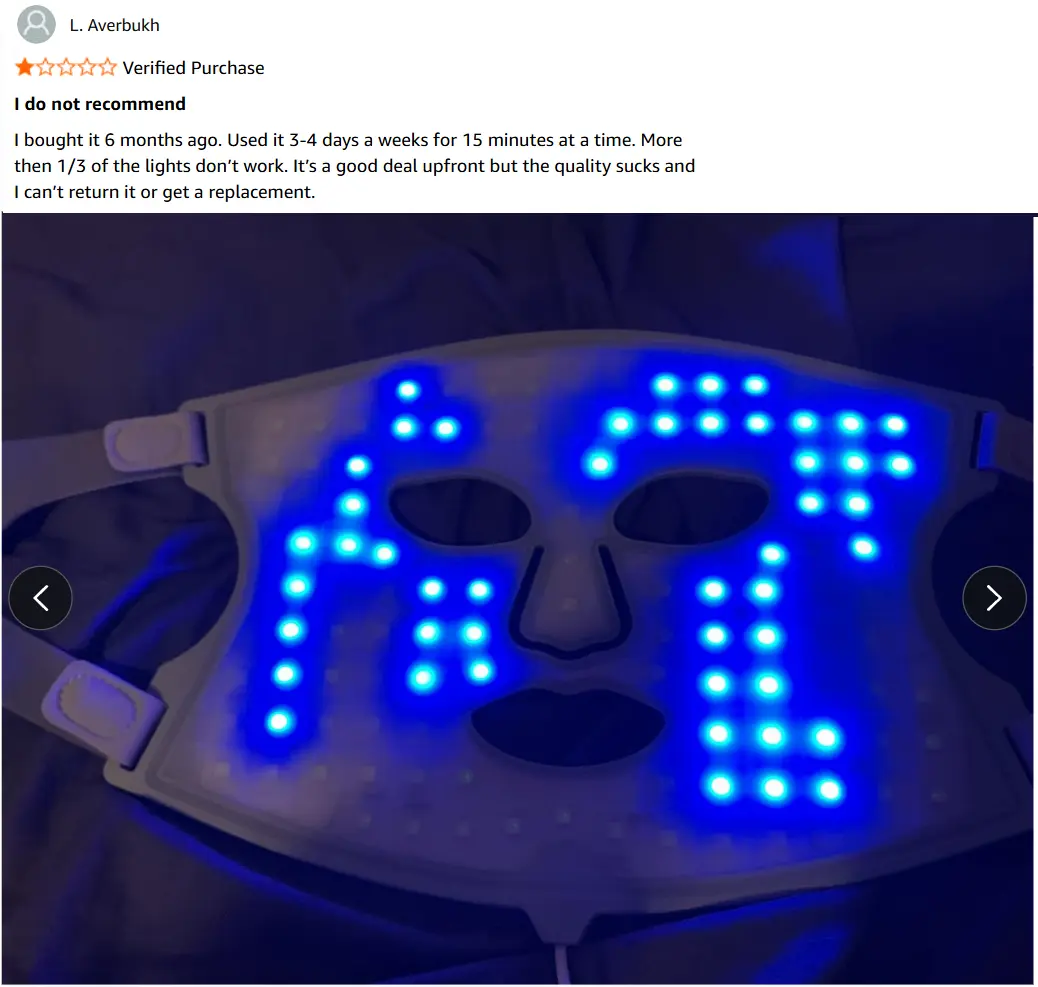
Six months in, 3 to 4 sessions a week, and this buyer reports more than a third of the lights dead. LEDs don’t normally fail like this: a diode reaching end of life dims slowly, and failures scatter. What the photo shows is whole contiguous zones out and the survivors grouped in rectangles, which is the pattern you get when a driver channel on the flex circuit gives up and takes a whole string with it.
Nanoleaf’s own Amazon FAQ points at the same weak spot from the other direction. It asks you to store the mask flat and avoid folding, twisting or rubbing it, because excessive pressure may affect the internal LED components over time.
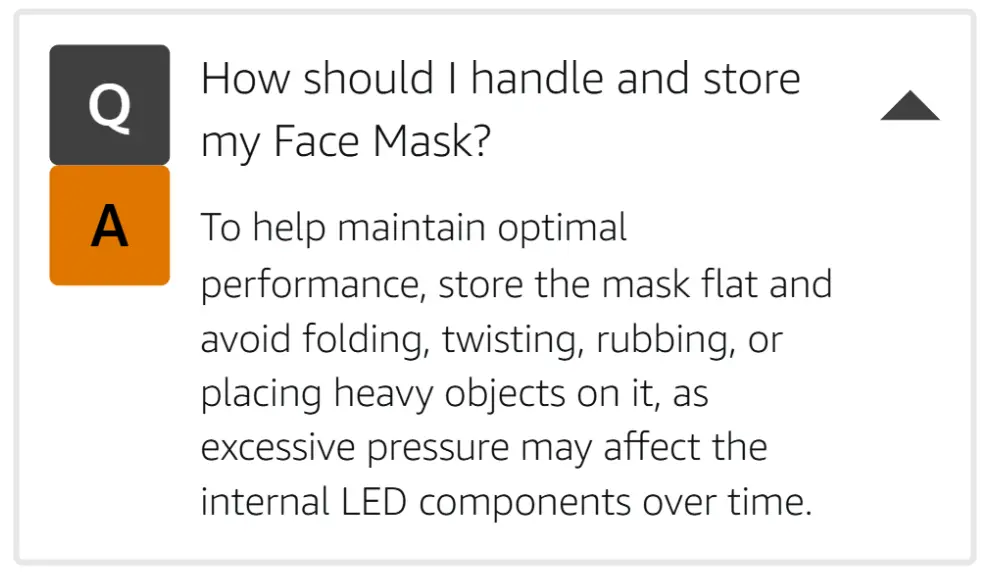
I bought through Amazon and returned through Amazon, so I never tested Nanoleaf’s own support desk, and the buyer above says they couldn’t get a replacement. Half a point comes off for a documented failure mode the brand acknowledges in a storage tip instead of a warranty policy.
Who shouldn’t buy the Nanoleaf LED mask
Skip this one if you recognize yourself
- You’re treating the lines above your lip. The strip between the nose and mouth cutouts carries almost no LEDs, so that’s the one area this mask can’t reach.
- You want a clear light output. The product page says 91.9 mW/cm² and the FDA record for the same device says 6 to 8, and 4 of the 5 intensity levels have no figure at all.
- You already own a mask that follows your jawline. Trading a contoured shell for a flat sheet is the experiment I ran on myself here, and it cost me a month.
- You want a good LED density. Nanoleaf has only 108 LED emitters, which is too low.
Am I still using the Nanoleaf LED mask?
Updated August 2026. No. I returned it to Amazon at the end of week 4 and went back to the LED mask it had replaced, so I can’t tell you how this one holds up at 6 months. The buyers who kept theirs can.
What I still want to know about the Nanoleaf LED mask
- The distance and method used to obtain 91.9 mW/cm².
- The irradiance and dose at each of the five intensity levels.
- An explanation for the wavelength and irradiance differences between the retail specifications and K243555.
- A clinical study on this model with the population, protocol, instruments and full results.
Nanoleaf LED mask: your questions
Is the Nanoleaf LED mask FDA-approved?
No, and the two words aren’t interchangeable. It’s FDA-cleared, under 510(k) number K243555, which means the FDA agreed it’s substantially equivalent to a device already on the market. FDA-approved is a far heavier process that almost no consumer beauty device goes through. The clearance is also held by the manufacturer, Shenzhen Eyco Technology, not by Nanoleaf.
Does the Nanoleaf LED mask really have 432 LEDs?
It has 108 LEDs, each carrying 4 light chips, which is 432 LED chips in total, and Nanoleaf publishes that breakdown itself. In red mode you’re using 2 of the 4 chips per LED, so the light reaching your face comes from 108 points.
How long should a Nanoleaf LED mask session be?
Nanoleaf says 5 to 10 minutes, 3 to 5 times a week, and describes 5 minutes as delivering 30 J/cm². I ran 10 minutes every other day at full intensity. I’d treat the dose figure with caution for the reasons in the Irradiance section, but the schedule itself is reasonable and matches the rest of the LED mask market.
Which intensity level should I use on the Nanoleaf LED mask?
Level 5, because it’s the only one Nanoleaf attaches a number to. The controller offers 5 levels and the brand publishes a dose for full power only, so the lower settings tell you nothing about what you’re getting. They also look visibly faint next to level 5.
Why do LEDs stop working on the Nanoleaf mask?
Buyers report large groups of dead LEDs after several months, and in the photos the dark areas come in blocks rather than scattered points, which suggests a connection or driver failure rather than the LEDs themselves wearing out. Nanoleaf’s own FAQ asks you to store the mask flat and avoid folding or pressing it, because pressure can affect the internal LED components.
Test log
- Exact model
- Nanoleaf Light Therapy Face Mask, SKU NLEDK00-1TFM, US version
- How I got it
- Bought on Amazon, $249.99, no affiliate link and no contact with the brand
- Test window
- 4 weeks, ended with a return to Amazon
- Sessions
- 14 sessions, 10 minutes, every other day, red mode, intensity level 5 of 5, eye shields on
- Protocol deviations
- 4 weeks instead of my usual 8, because I had already tested the same flat panel as the Silk’n Face Mask F100 and chose to return this one
- Brand data verified
- Product page, support center spec sheet and Amazon listing, August 2026
- FDA record verified
- 510(k) K243555 and the Shenzhen Eyco establishment registration, openFDA, August 2026

About Emilie
I have tested LED masks since 2023. I buy the devices, use them for weeks, and read the spec sheets nobody reads, because this market runs on numbers most brands never publish. Not a dermatologist, and I say so whenever a question needs one.