
I buy the devices I test unless the article says otherwise. Some links and discount codes on this site are paid links: if you buy through one, I earn a commission. It never changes a score or a verdict.
I wore the Therabody TheraFace Mask for 8 weeks, 5 evenings a week, in Red + Infrared mode only: 40 sessions of 9 minutes. It’s the newer of Therabody’s two LED masks, the one with 648 LEDs, a vibration massage built into the shell.
So here are my before and after photos, my score, and what the 144 extra LEDs actually cost you on the face.
57/100
Shelved since September 2026After testing it for 8 weeks, my skin looks exactly the same. The 648 LEDs and the 73 mW/cm² irradiance Therabody publishes are real numbers. But the thick pads around the eyes hold the whole LED array more than 1 cm off the skin, and the new shell leaves a column with no light at all from the forehead to the chin. It’s heavy, the vibration is loud, and the older Glo covers more of your face for $270 less.
Buy it if
- You want a rigid LED mask you can wear with your eyes open, with red, red + infrared and blue in one shell.
- You have already decided on Therabody and the vibration massage is the reason.
Skip it if
- You want a better coverage of your face during red light therapy.
- You want to relax during the session: the vibration is loud and you can’t turn the mask into a quiet one.
- You travel with your LED mask. This one doesn’t fold and doesn’t fit in a carry-on.
What I tested: the Therabody TheraFace Mask
The TheraFace Mask in white, bought on Therabody online shop at $649.99. I also have the older TheraFace Mask Glo on my desk for the side by side photos further down, but the 8 weeks were spent in the Mask, not the Glo.
The preset program gives you 3 minutes of each color for 9 minutes total. I only wanted the Red + Infrared mode, so I restarted that mode every 3 minutes to hold it for the full 9. Therabody’s recommends 2 to 5 sessions a week, and I ran 5, the top of their own range.
I didn’t use blue light during my test, because acne is caused by multiple factors, and I don’t recommend using an LED mask to treat this skin condition (unless it’s used as a supplement to a proper acne treatment protocol)
Results: 3/5
What changed on my face following my test, including my before-and-after photos. I also evaluate the “before-and-after” examples provided by the brand being tested, as well as the results of any studies that may have been conducted on the mask.
Read my results guideMy own results with before & after
Nothing changed on my skin after 8 weeks of Theraface LED Mask. Not the tone, not the pores along my nose, not the fine lines at the corner of the eyes, which I couldn’t have expected anyway since the thick pads sit right on top of them. Nothing went backwards either, which is more than I could say after the Shark CryoGlow.
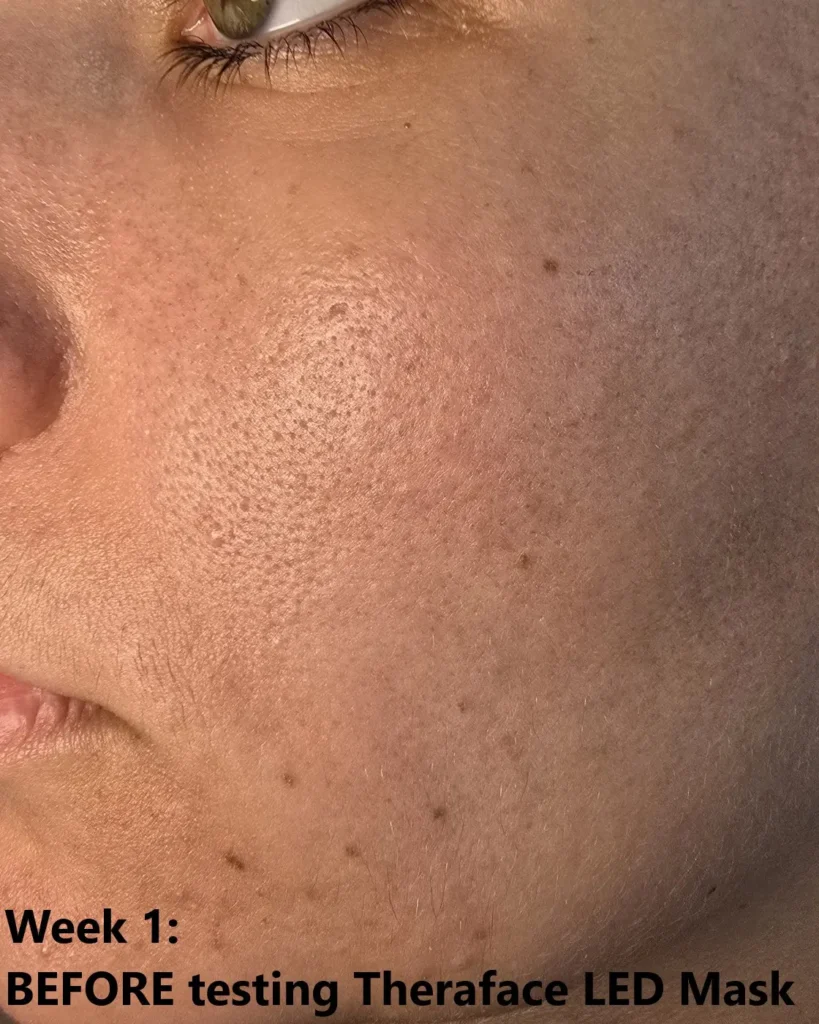
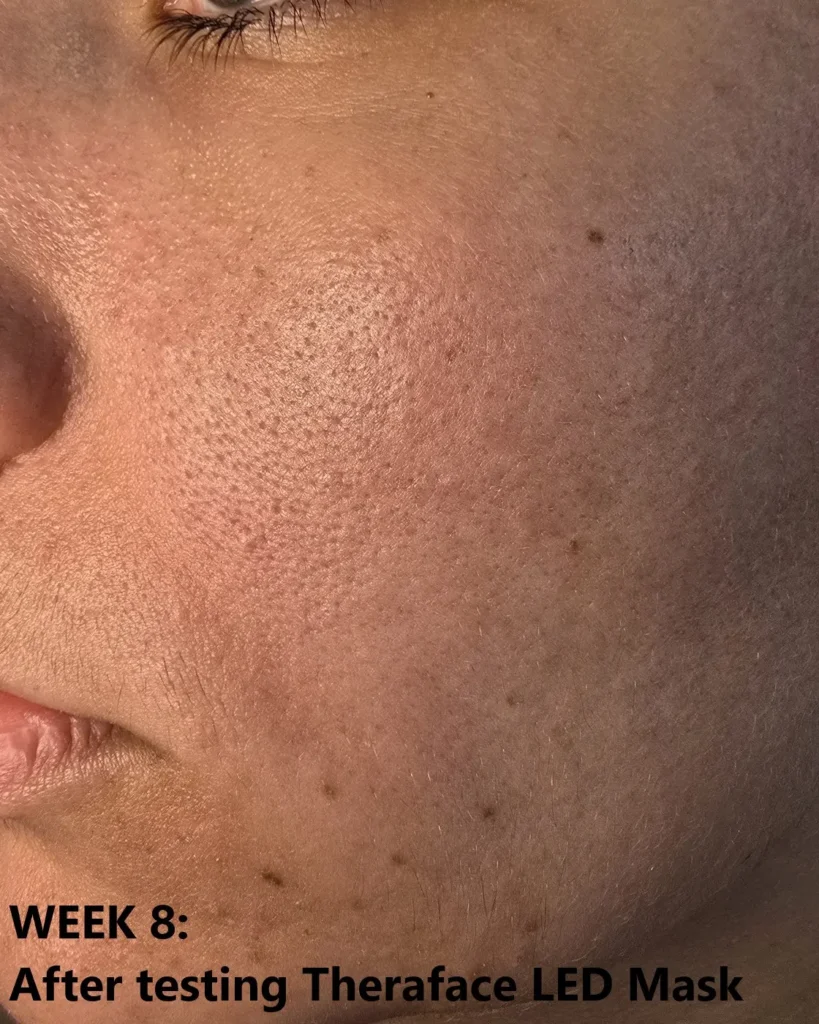
Therabody’s results according to own study and before & after
Therabody’s own before and after, published by the brand, come from a 12-week study on 31 people using the 9-minute preset once a day. The result “83% of participants saw improvements in facial contour”, carries a footnote: it’s a perception survey, and the participants were paid. So I do not consider it as a measurement.

Buyers are kinder than my photos. On Best Buy the TheraFace Mask sits at 4.5 out of 5 over +350 reviews, and smoother, brighter skin is the most repeated praise, ahead of ease of use.
Irradiance: 3/5
How much light reaches the skin, in mW/cm²? I evaluate this value, as well as how the information is presented, the conditions under which it was measured, and the total dose received in a single session. If the brand does not communicate it, I give it a severe rating.
Read my irradiance guideTherabody publishes the numbers of the irradiance on their FAQ and in the 510(k) summary: 73 ±5 mW/cm² in red, 64 ±5 in blue, 73 and 55 in Red + Infrared, which gives a dose of 13.14 J/cm² for 3 minutes of red.
This is a gap because the recommended dose is at 30 J/cm² of red light therapy session. And this irradiance measurement does not specify where the sensor was located: at the LED, at the skin’s surface…? However, with this thick shell, it is precisely the distance that poses a problem.
The pads around the eyes are the thickest part of the shell, so the LED array never touches the face. It hovers at least 1 cm above the skin, and more than that on the cheeks and the jaw, where the shell curves away. You need to know that every millimeter of air between an LED and your skin costs you light power, because the beam spreads before it lands.
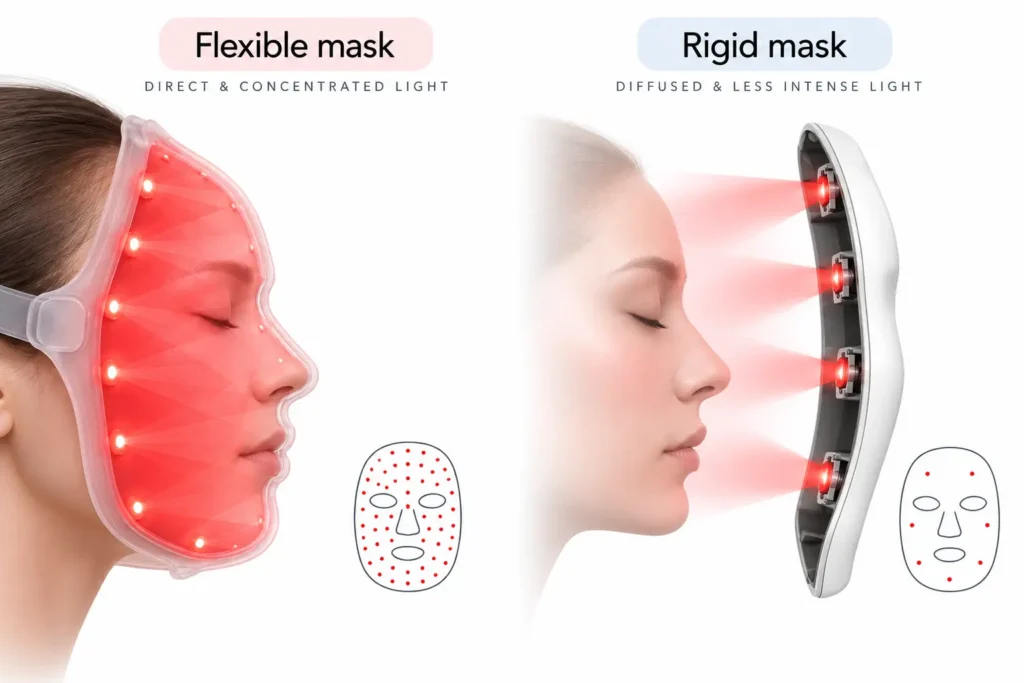
A flexible silicone LED mask rests directly on the face, so its specified irradiance is close to what the skin perceives. However, a rigid shell held at a distance by pads delivers a lower irradiance, and the 73 mW/cm² figure cited by Therabody does not allow me to accurately measure the extent of this difference.
I had the same problem with the Shark CryoGlow LED mask (my review), whose shell and eye pads look like a close cousin of this one, and Shark at least writes that its figure was taken at the source of the LED. On my grid a published figure without its measurement condition lands between 2.5 and 3.5, and 73 is above the 30 to 50 mW/cm² band where the research sits, which doesn’t earn anything extra. So I rate it a 3.
- Therabody TheraFace Mask 73
- Shark CryoGlow 64
- Nooance Elite X600 50
- CurrentBody Series 2 30
- Omnilux Contour Face 30
Coverage: 3/5
How many points of light does the mask actually feature, how evenly are they distributed, and which areas remain uncovered? Note that I am counting “bulbs” and not LEDs, because the number of LEDs often includes two, three or more diodes per bulb, which inflates the apparent coverage area.
Read my coverage guide648 LEDs is the headline of that Theraface LED mask, and it’s true in chips. But each light point on this mask is a package holding 3 diodes, one per wavelength, so the face get 216 light points, as written in their doc: “648 LEDs in 216 packages“.
It is honestly pretty nice, that’s still 56 more points than the Shark Cryoglow and nearly twice the 110 lit positions of the CurrentBody Series 2. On paper this is a dense LED mask.
TheraFace Mask vs TheraFace Mask Glo
Now look at where those points are. The older TheraFace Mask Glo has 504 LEDs, 144 fewer, and yet its array runs across the bridge of the nose, over the upper lip and down the center of the chin.
The new Mask packs more LEDs into the cheeks and the forehead sides, then leaves a wide column with no LED at all from the middle of the forehead to the bottom of the chin. Nose, mouth, and the center of the forehead, which is exactly where most people have their expression lines, get nothing.
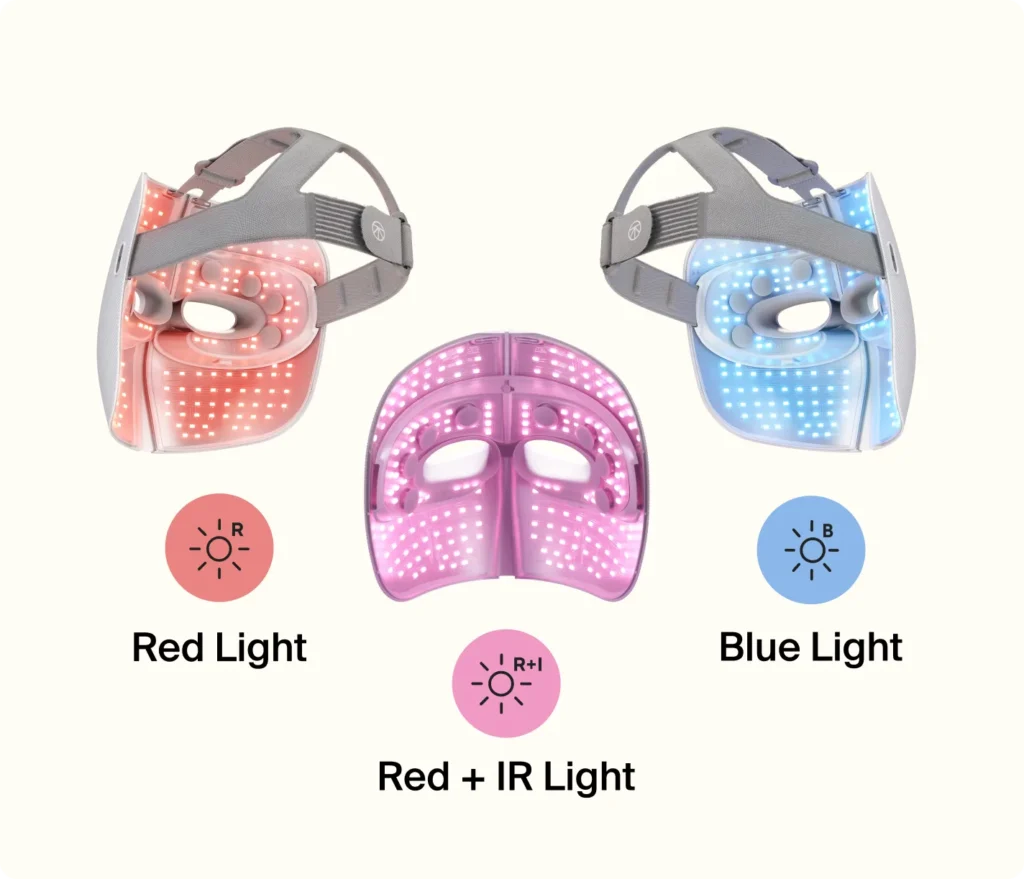
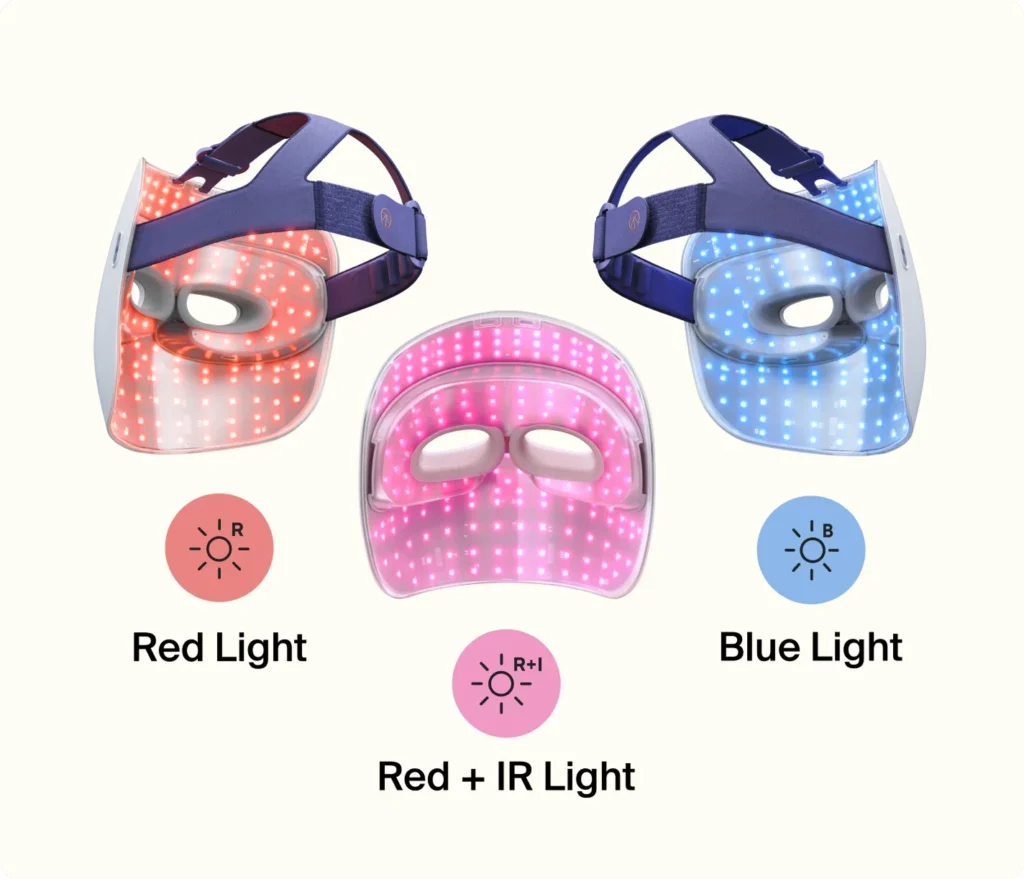
Adding light points is good for overall coverage, but taking the light away from the middle of the face is not, and I’d take the Glo’s layout over the Mask’s any day. Both shells keep the same thick band around the eyes, so both hold the array off the skin in the same way.
Does the TheraFace Mask really have 3x more LEDs than the competition?
Therabody’s page says “Designed with 3x more LEDs than the leading mask competitor“, with a footnote that reads “Based on 2024 market analysis“. In 2024 the mask everyone compared against was the CurrentBody Series 2 and its 236 LEDs, and 648 divided by 236 is 2.7. So the claim is roughly right if you count chips and pick that year.
But count light points instead, which is what your skin sees, and the 216 of the TheraFace sit below the 300 dual-core emitters of the Nooance Elite X600, an LED mask that reached the US after that analysis was done. I put the two side by side so you can see the gap between both.

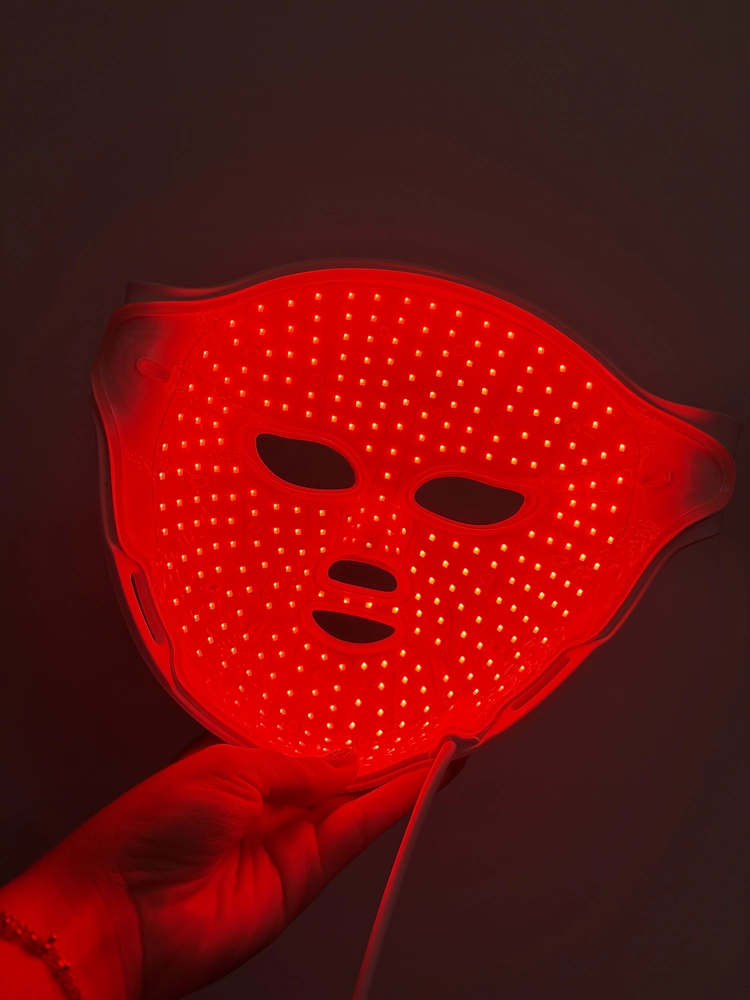
216 light points passes my floor comfortably, and that’s what holds Coverage at 3. What keeps it from going higher is the geometry: an empty column where the face needs light most, and a rigid shell, two problems that a molded silicone LED mask like the Nooance doesn’t have.
Proof: 3.5/5
What the brand clearly displays and what I check in the FDA file: wavelengths (in nm), emitted dose, FDA clearance number, product study, safety tests, warranty.
Read my proof guideThe FDA file is K230293, in Therabody’s own name, cleared on June 9, 2023. Most LED masks I test carry a clearance filed by the factory that builds them, so a good point here from Therabody.
The same summary lists every wavelength in nanometers with its tolerance, the power of every mode, the dose per session, and compliance with IEC 62471 for photobiological safety. The whole K230293 summary is 8 pages on the FDA’s 510(k) database.
What the brand publishes
- Published: Wavelengths in nm: 633, 830 and 415, each ±10 nm
- Published: Dose per session calculable: 13.14 J/cm² for 3 minutes of red, in the 510(k) summary
- Published: FDA clearance verifiable in the database: K230293, filed by Therabody, Inc.
- Published: A clinical study on this exact model: 12 weeks, 31 subjects
- Missing: Study documented with a named laboratory: none named for the Mask study
- Published: Photobiological safety declared: IEC 62471 in the 510(k) summary
- Published: Warranty documented: 1-year limited warranty
Proof: 3.5/5
I take half a point off for the study’s claims that the product “visibly reduces the appearance of fine lines and wrinkles” and “lifts and firms.”
The only figure Therabody cites comes from a perception survey conducted among paid participants: no instrumental measurements are mentioned, no evaluation by a dermatologist is performed, and no laboratory is involved.
Comfort: 2.5/5
Fit, weight, heat, eye comfort and minor inconveniences: straps, timer, battery. A mask that becomes a chore to wear several evenings a week scores poorly in these areas, as using it should be a pleasant experience!
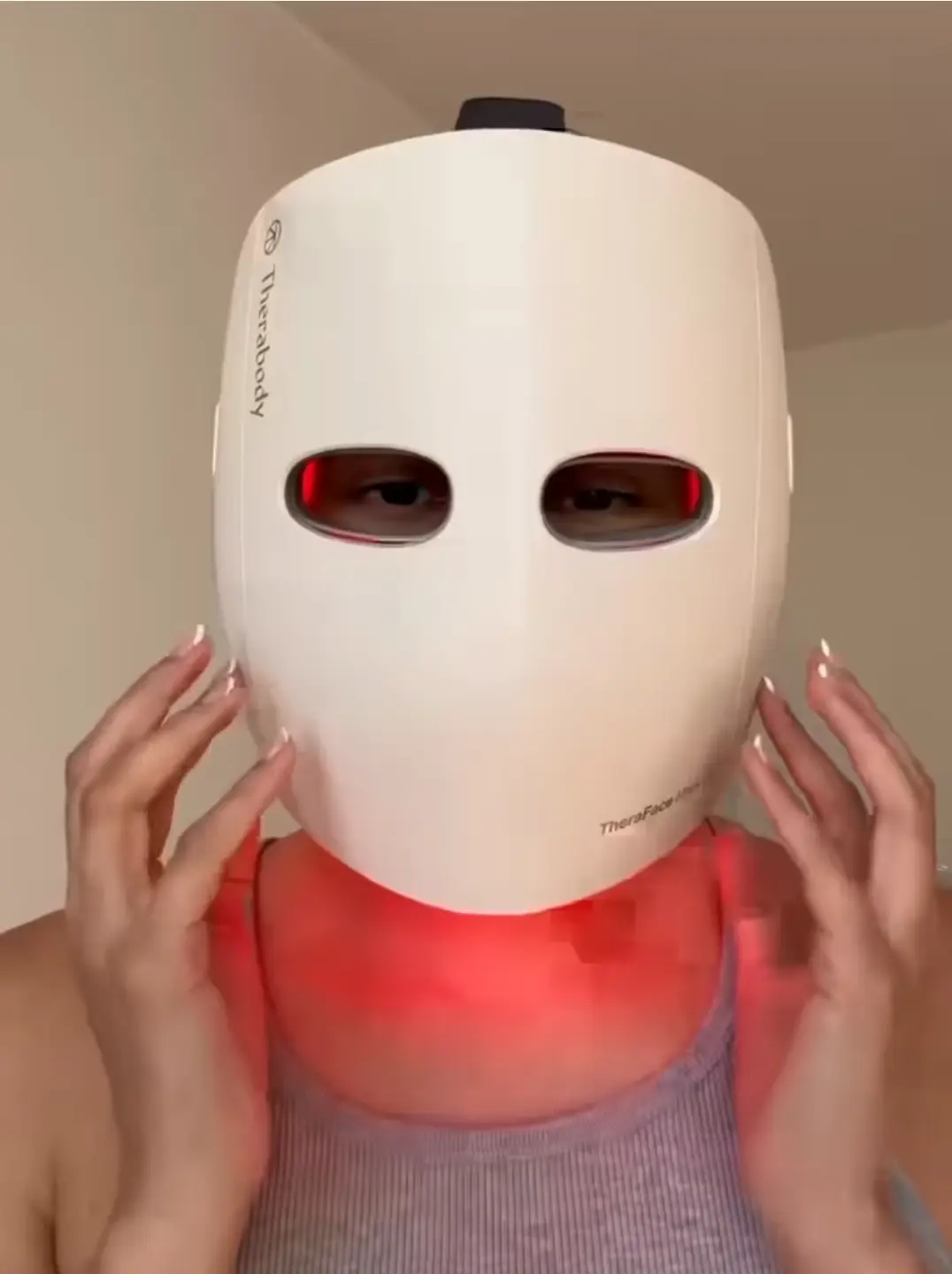
Read my comfort guide576 grams for a LED mask is pretty heavy, and you feel it because the shell is rigid and can’t spread the load the way a silicone LED mask does. Weight is also the single most repeated complaint in the Best Buy reviews, ahead of price, with several buyers mentioning marks on the nose. The straps take a minute to set the first time, and I show you how below.
The good part is the eyes. The removable shields let me keep my eyes open for the whole 9 minutes, so I read or scrolled through every session with no issues. The bad part is that the pads that make this possible are the same pads that cover the under-eye area, which is the one zone I most wanted the light to reach.
Is the TheraFace Mask vibration worth having?
No, because they buzz rather than massage, and the noise inside the shell is loud enough that I never once found it relaxing. One Best Buy buyer put it better than I can: “If it didn’t have the vibration feature, I’d give it 5 stars. That is one loud and an annoying sensation. Not good for trying to relax while wearing the red light mask.” You can run the light without it, and I did, but you still paid for 17 motors.

Everything is controlled by 2 buttons on the side: power, and a second one that steps through the colors. No remote, no screen, so I never knew how many minutes were left in a session other than by counting the 3-minute color changes. Therabody quotes 120 minutes of battery in light mode, which is correct according to my tests.
But the shell doesn’t fold, the stand adds another 60 grams, and the whole thing takes a lot of room in a bag si it is not easy to take if for a travel. The 9-minute session is the one thing that makes it easy to live with, and it’s why Comfort doesn’t fall to 2.
Value: 1.5/5
The price I paid, when viewed in the context of the results achieved and compared to other masks I have tested, both within this price range and at different price points.
Read my value guideIt is sold at $649.99 on Therabody website, and the Glo, with the same band around the eyes and the light running through the center of the face, is at $379.99. That’s $270 for 144 more LEDs, 17 vibration motors I switched off, and a hole in the middle of the array.
| LED mask | Price on the brand’s US site | LEDs published | Light points |
|---|---|---|---|
| Therabody TheraFace Mask | $649.99 | 648 | 216 |
| Therabody TheraFace Mask Glo | $379.99 | 504 | 168 |
| CurrentBody Series 2 | $469.99 | 236 | 110 |
| Nooance Aurion X252 | $449.00 | 252 | 121 |
| Nooance Elite X600 | $749.00 | 600 | 300 |
Against the rest of the LED mask market the TheraFace Mask is priced with the Nooance Elite X600, which has more emitters, a 3D flexible shell that sits on the skin and an irradiance calibrated at skin contact. It’s $180 more than the CurrentBody Series 2, which is more comfortable and covers the center of the face. Priced like the best mask I have tested and scoring 57, the TheraFace Mask lands in the middle of my ranking of the best LED masks.
Safety & support: 3.5/5
Eye protection, build quality, warranty, returns, responsiveness of customer support, and the mask’s ability to remain functional over time.
Read my safety & support guideThe Theraface LED mask is FDA cleared under K230293, IEC 62471 for photobiological safety and IEC 60601 for electrical safety in the filing. It has eye shields in the box, and a 1-year limited warranty. Charging is USB-C, which I really appreciate.
However I did not had the chance to contact the customer support so I can not assess that point. Still, considering the size of the brand, it should be a good point.
Who shouldn’t buy the Therabody TheraFace Mask
Skip this one if you recognize yourself
- You want the light on your skin. The eye pads hold the array more than 1 cm off the face, and the published irradiance is not what reaches your skin.
- Your lines are on the forehead, around the nose or the mouth. That’s the column with no LEDs. The Glo covers it, this one doesn’t.
- You want a session you can fall asleep in. The vibration is loud, and even switched off the 576 grams stay on your nose.
- You travel with your LED mask. It doesn’t fold and it doesn’t fit flat in anything.
Am I still using the TheraFace Mask?
Updated November 2026. No. I finished the 8 weeks, took my week 8 photos, and the TheraFace Mask went back in its box the same evening. It hasn’t come out since.
Therabody also sells the cheaper TheraFace Mask Glo, and I put the two side by side in my TheraFace Mask vs Glo comparison. For everything else, my LED mask picker has them all on one grid.
What I still want to know about the TheraFace LED mask
How much of the 73 mW/cm² reaches the skin at the distance this shell imposes. Therabody has the number, since it had to measure something to file K230293, and one line saying “at the LED” or “at 10 mm” would change my Irradiance score.
I don’t recommend either Therabody LED mask, because other brands do the same job closer to the face. But if it has to be a Therabody, buy the Glo: same band, same distance, no hole in the middle, and $270 saved.
If it doesn’t, the CurrentBody Series 2 was more comfortable on my face and covers the center of it. The Nooance Aurion X252 sits at a similar price to the CurrentBody in a flexible silicone shell, and the Elite X600, which costs about the same as the TheraFace, is the LED mask that actually gave me results, and my Nooance discount code takes 15% off it.
Therabody TheraFace Mask: your questions
Is the Therabody TheraFace Mask FDA approved?
No, it’s FDA cleared, which is a different thing. Clearance K230293 was granted to Therabody, Inc. on June 9, 2023, through the 510(k) route, meaning the FDA found it substantially equivalent to an LED mask already on the market. Approval is a heavier process that almost no consumer LED mask goes through.
TheraFace Mask or TheraFace Mask Glo: which one should I buy?
The Glo. It has 504 LEDs against 648, but its array covers the nose, the upper lip and the center of the forehead, where the Mask has no LEDs at all. Both keep the same thick band around the eyes, and the Glo costs $379.99 against $649.99.
How long is a TheraFace Mask session and how often should I use it?
The preset runs 9 minutes, 3 minutes each of red, Red + Infrared and blue. Therabody’s 510(k) summary recommends 2 to 5 sessions a week, and its product page talks about once a day. I ran 5 a week for 8 weeks, restarting the Red + Infrared mode to hold it for the full 9 minutes.
Can I keep my eyes open in the TheraFace Mask?
Yes. The removable eye shields block the light, and I read or scrolled through every session with my eyes open. The trade is that the pads holding those shields cover the under-eye area, so that zone gets no light.
Test log
- Exact model
- Therabody TheraFace Mask, white, FDA clearance K230293
- How I got it
- Bought on therabody.com, $649.99, no affiliate link, no contact with the brand
- Test window
- 8 weeks
- Sessions
- 5 evenings a week, 9 minutes, Red + Infrared only, 40 sessions.
- Photo protocol
- Week 0 and week 8

About Emilie
I have tested LED masks since 2023. I buy the devices, use them for weeks, and read the spec sheets nobody reads, because this market runs on numbers most brands never publish. Not a dermatologist, and I say so whenever a question needs one.