
I buy the devices I test unless the article says otherwise. Some links and discount codes on this site are paid links: if you buy through one, I earn a commission. It never changes a score or a verdict.
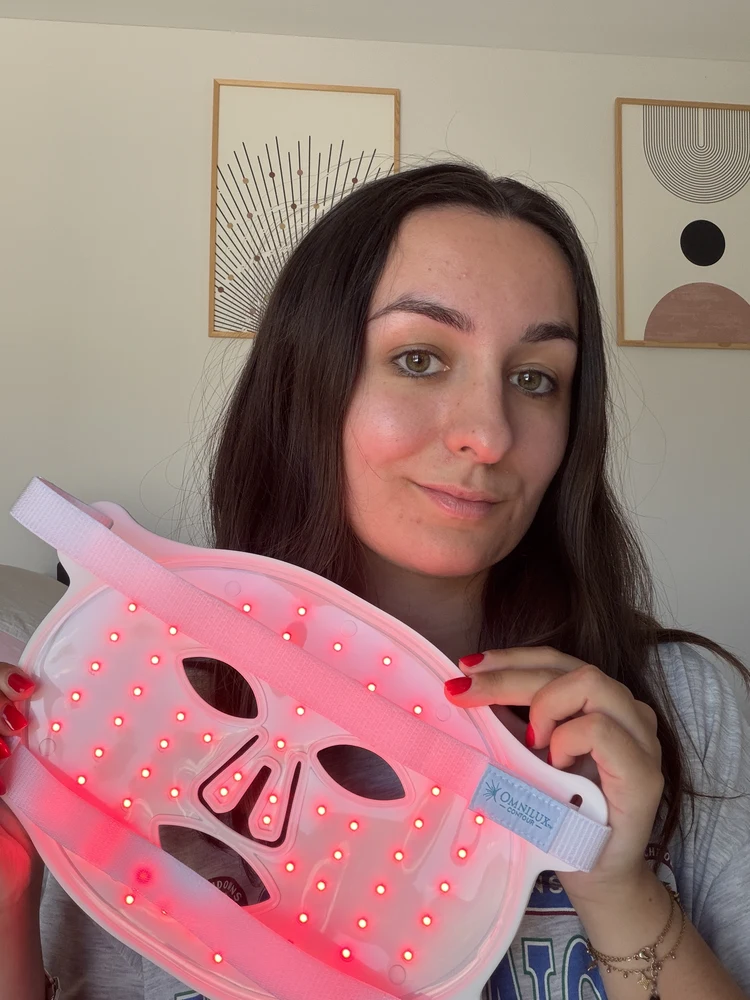
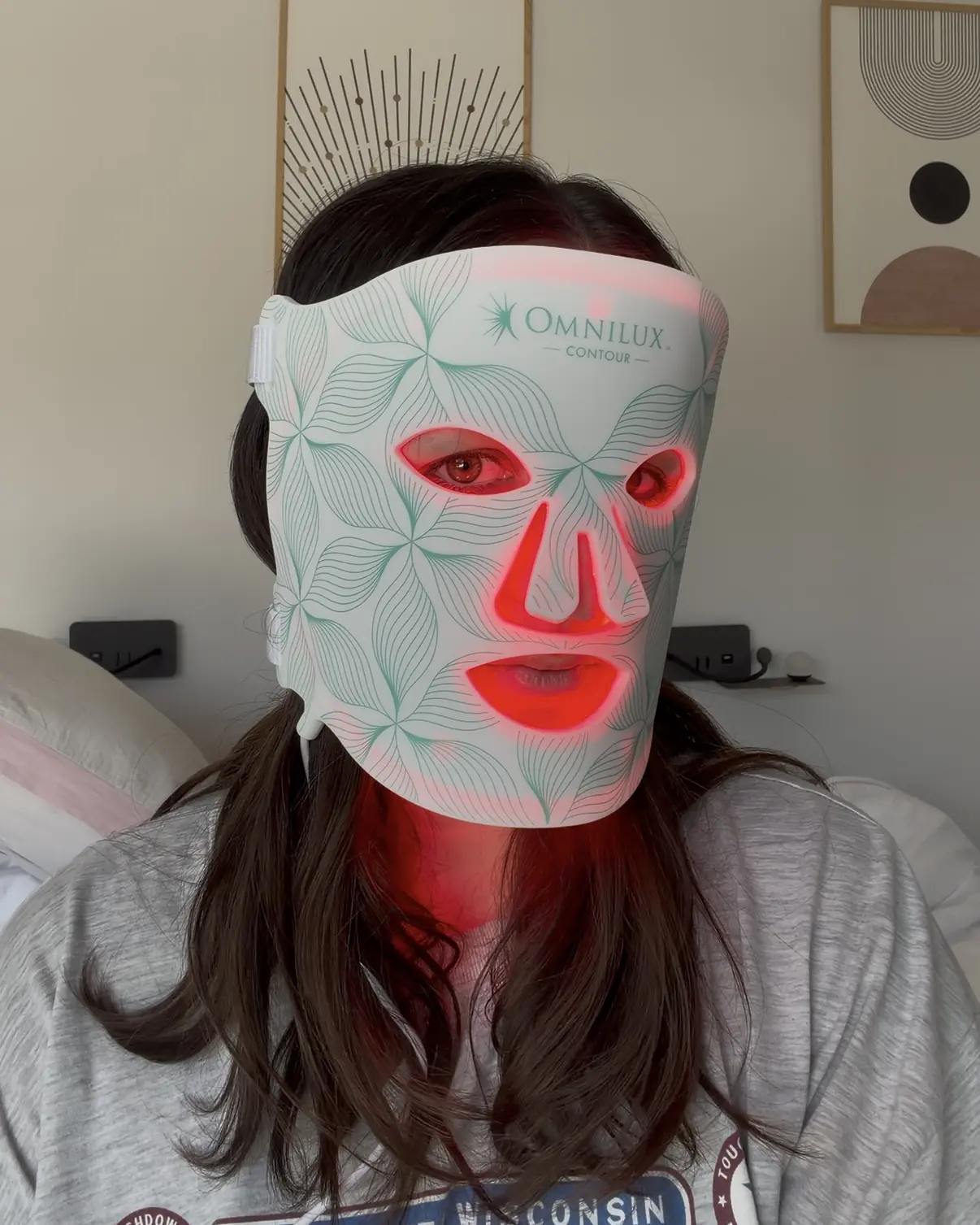
The Omnilux Contour Face is the LED mask that some media present as the “dermatologist” one, and it’s also the flat flexible panel that half the market has copied since. I wore it for 8 weeks, 5 sessions of 10 minutes a week, 40 sessions in total.
So here is my own Before & After, the LED count Omnilux publishes and nobody reads, and my full review of the Omnilux LED mask.
52/100
Shelved since August 202640 sessions over 8 weeks and I have no good results. The light itself is honest, since Omnilux runs 633 nm and 830 nm only and skips the color wheel most brands sell. But 66 emitters on a flat panel are not enough to properly cover the face.
Buy it if
- You want a device that sticks to red and near-infrared instead of selling you 7 colors.
- You want a light and foldable LED mask to travel with.
Skip it if
- You want light on your jaw, your chin, or the lines above your lip.
- You expect the 96% on the product page to come from a study of this LED mask.
- You prefer to wear eye protection, since Omnilux ships none in the box.
- You already own a denser LED mask.
What I tested: the Omnilux Contour Face LED mask
I bought the Omnilux Contour Face on Amazon for $439.99, and Omnilux has no idea this review exists. There’s no affiliate link anywhere on this page.
Omnilux puts the light output at ~30 mW/cm², so I used it 5 evenings a week, 10 minutes each, 40 sessions across 8 weeks, in the single mode the Contour Face offers. If you want the arithmetic that turns a published irradiance into a session count, it is in how I test LED masks.
I stopped at 8 weeks rather than 12 because that’s my rule: 12 weeks is for a device that has started to give me something worth following, and this one hadn’t. I’ve kept the mask, though, since I want to keep talking about it on video on my socials… Because there is clearly an overhype on this one.
Results: 2.5/5
My Before & After Omnilux LED Mask
After 40 sessions I have no before and after I’d defend. My tone is even worse in week 8 compared to week 1, the lines at the corners of my eyes were where I left them, and the pores of my skin are bigger…
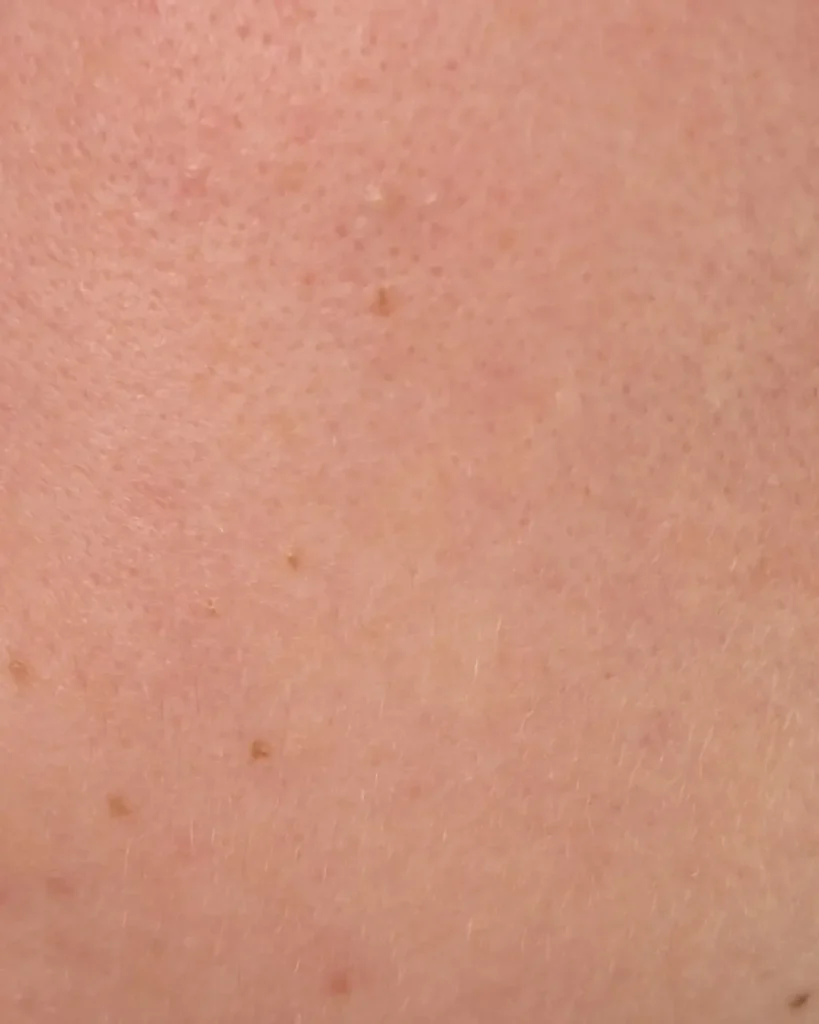
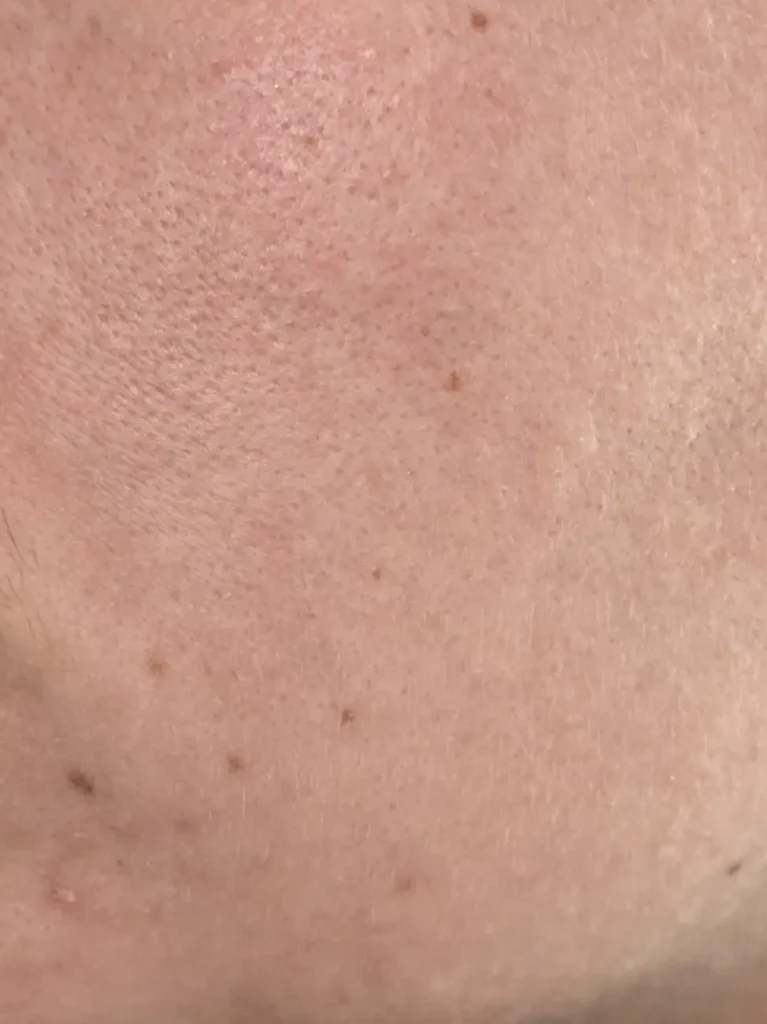
This decrease is not because of Omnilux, but rather because outside my testing windows I use an LED mask with 300 emitters and 600 LEDs, and for these 8 weeks I put it away and ran the Omnilux instead (you can see the difference between both here).
My skin looked slightly duller by the end, which I read as a return to normal rather than a negative effect from the Omnilux. If you’ve been running a denser LED mask for a year and you swap it for this one, expect the same thing.
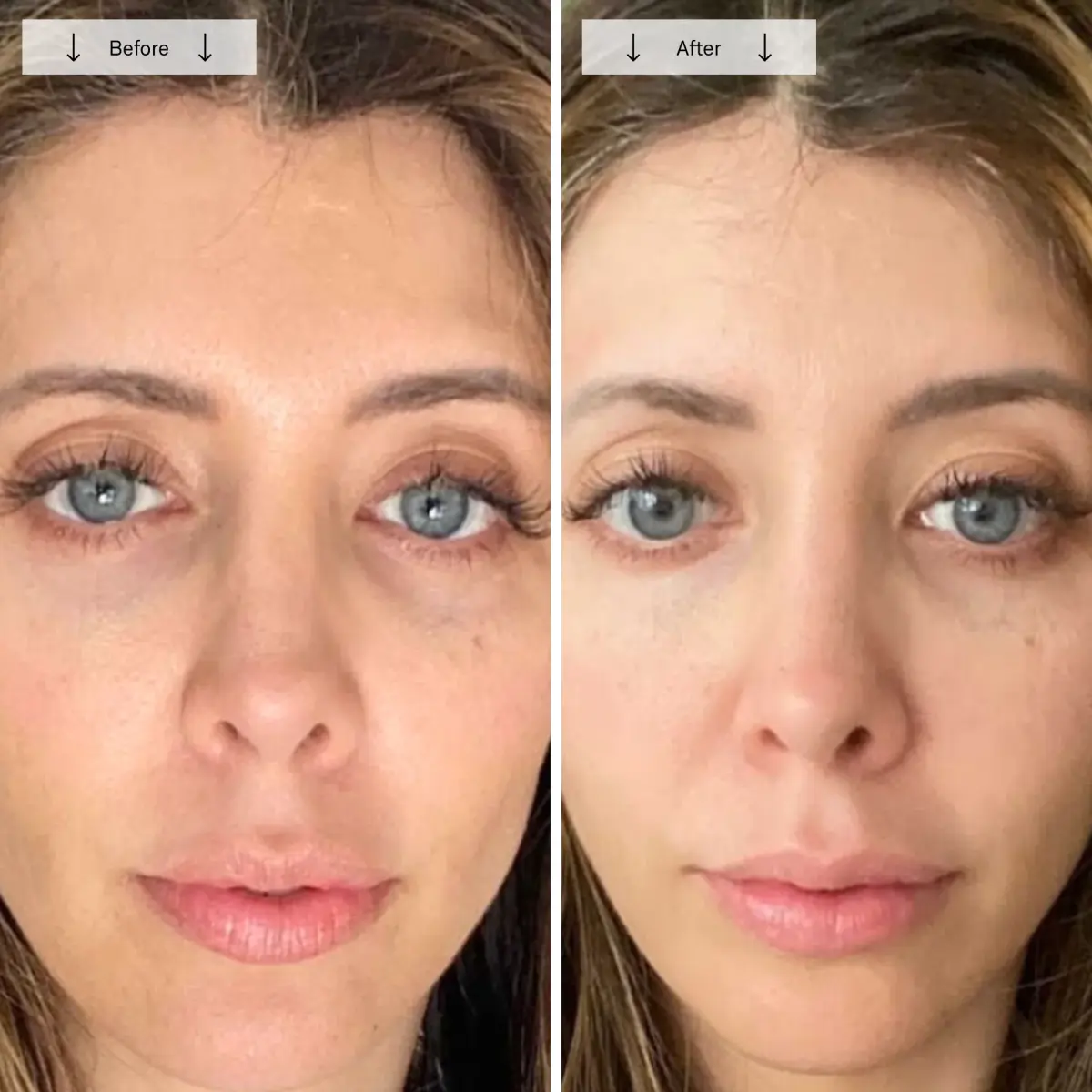
Omnilux Own Before & After
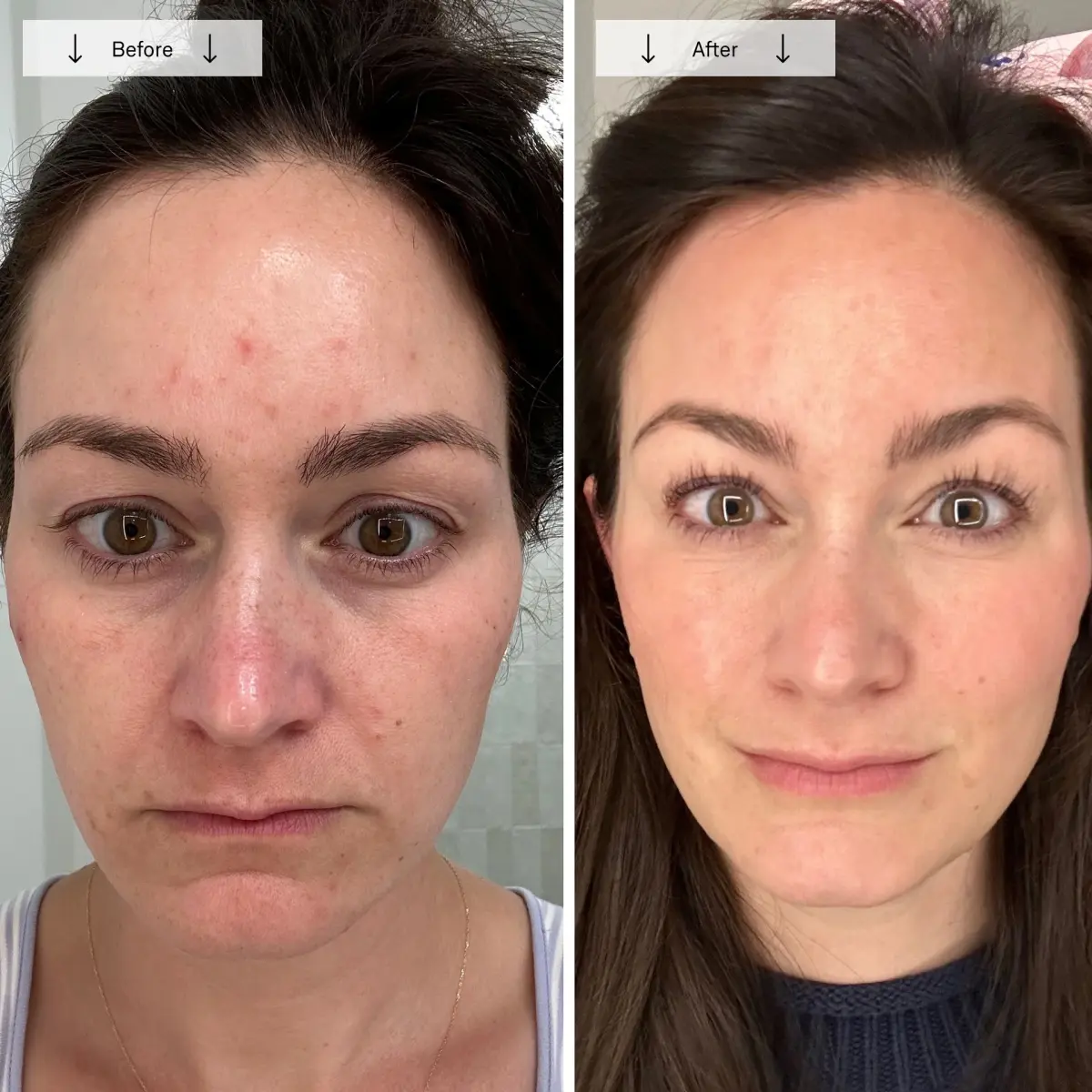
Omnilux publishes before and afters, and none of them are usable. The images on the product page carry no session count, no interval between the two shots, no lighting conditions and no name, and several read like photos customers sent in. A customer photo isn’t worthless, but a customer photo with nothing attached to it can’t tell you whether you’re looking at 4 weeks of light, a different bathroom bulb or a different angle.
Omnilux Study Results
Omnilux ran a study between April and August 2018 on 28 people aged 30 to 65, 25 of whom finished, at 3 sessions of 10 minutes a week for 4 weeks. The instruments are used are VISIA photography, a Cutometer for elasticity, a Corneometer for hydration, a Mexameter for pigment, a Visioscan for surface roughness, and the Larnier wrinkle grading scale. So this is correct and I appreciate it !
But there are gaps in the method: every subject wore an Omnilux hydrogel face mask underneath the LED mask for every session, described in the summary as a way to maximize the absorption of skincare products during treatment. Omnilux sells that hydrogel mask for $29. So the 37.6% reduction in the number and width of wrinkles belongs to light plus an occlusive hydrating sheet mask, and nothing in the study separates the two.
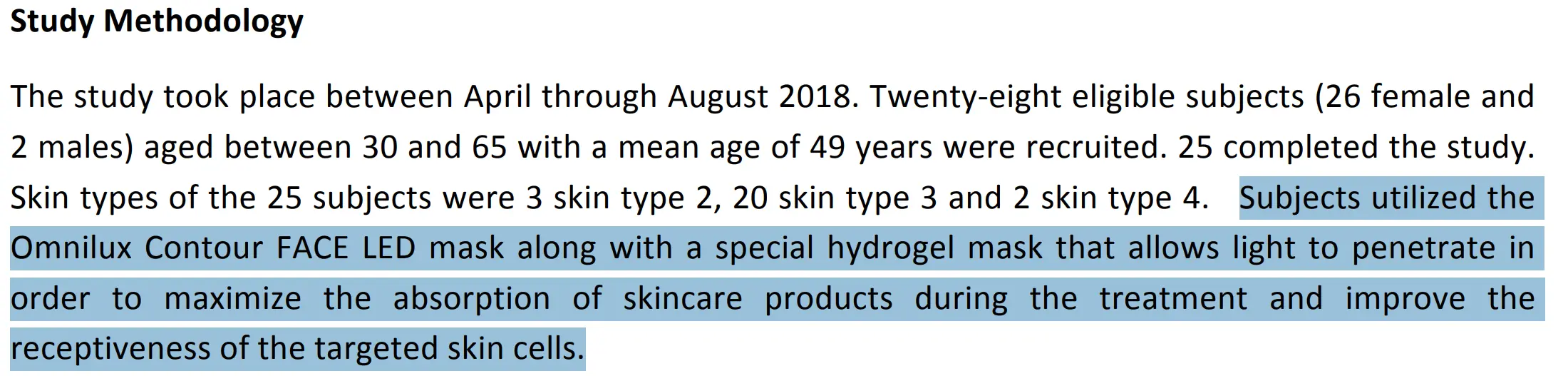
The elasticity is the one that gives it away. It comes out 21.4% higher immediately after the very first 10 minute session, before anyone could plausibly have made collagen, and a hydrating sheet mask is exactly what moves a Cutometer that fast. There’s no control group, no blinding of the subjects and no statistics anywhere in the document, so nothing here tells you what the light did on its own.
So 2.5 out of 5. A 4 week study whose headline figures are self-reported, before and afters with no conditions.
Irradiance: 3/5
Omnilux does publish its light output, which already puts it ahead of a good part of the market, but you have to go looking. It isn’t in the specs and it isn’t on the box: it’s an answer inside the FAQ accordion at the bottom of the product page, and it reads “Our Omnilux Contour Face device provides an energy output of ~30mW/cm2.”
The problem is that there’s no measurement condition, so you don’t know whether the 30 was read at the surface of the panel, at the skin, or at some distance in between, and on a flat LED mask that gap is an issue on its own.
Take the number at face value anyway and the session works out. 10 minutes at 30 mW/cm² deposits about 18 J/cm², which is under the 30 J/cm² that the published work tends to use, and it’s why Omnilux’s own advice of 3 to 5 sessions a week only really holds at the top of that range.
- Omnilux Contour Face 30
- Nooance Elite X600 50
- CurrentBody Skin Series 2 30
- iRestore Illumina not disclosed
30 mW/cm² is the floor of the band I consider useful, and the CurrentBody Skin Series 2 publishes exactly the same number without a measurement distance either. Against that, the Nooance Elite X600 publishes 50 mW/cm² and says where it was calibrated, which is the level I recommend.
The Omnilux keeps a note of 3 on the irradiance because a published number, even a soft one, beats the silence you get from other brands such as iRestore.
Coverage: 2/5
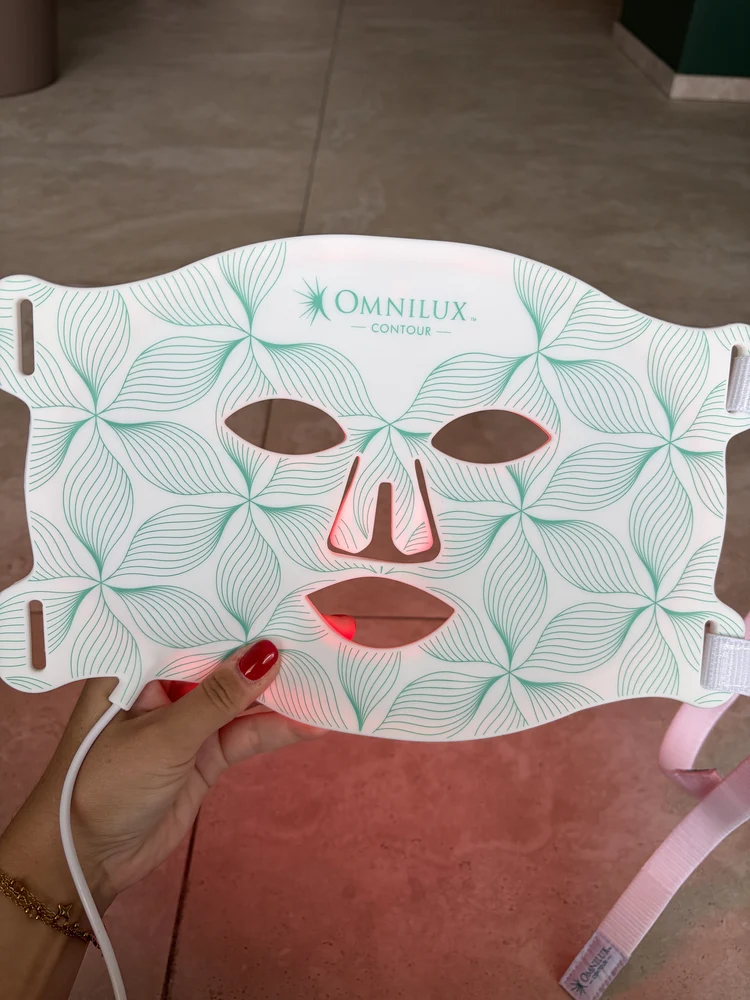
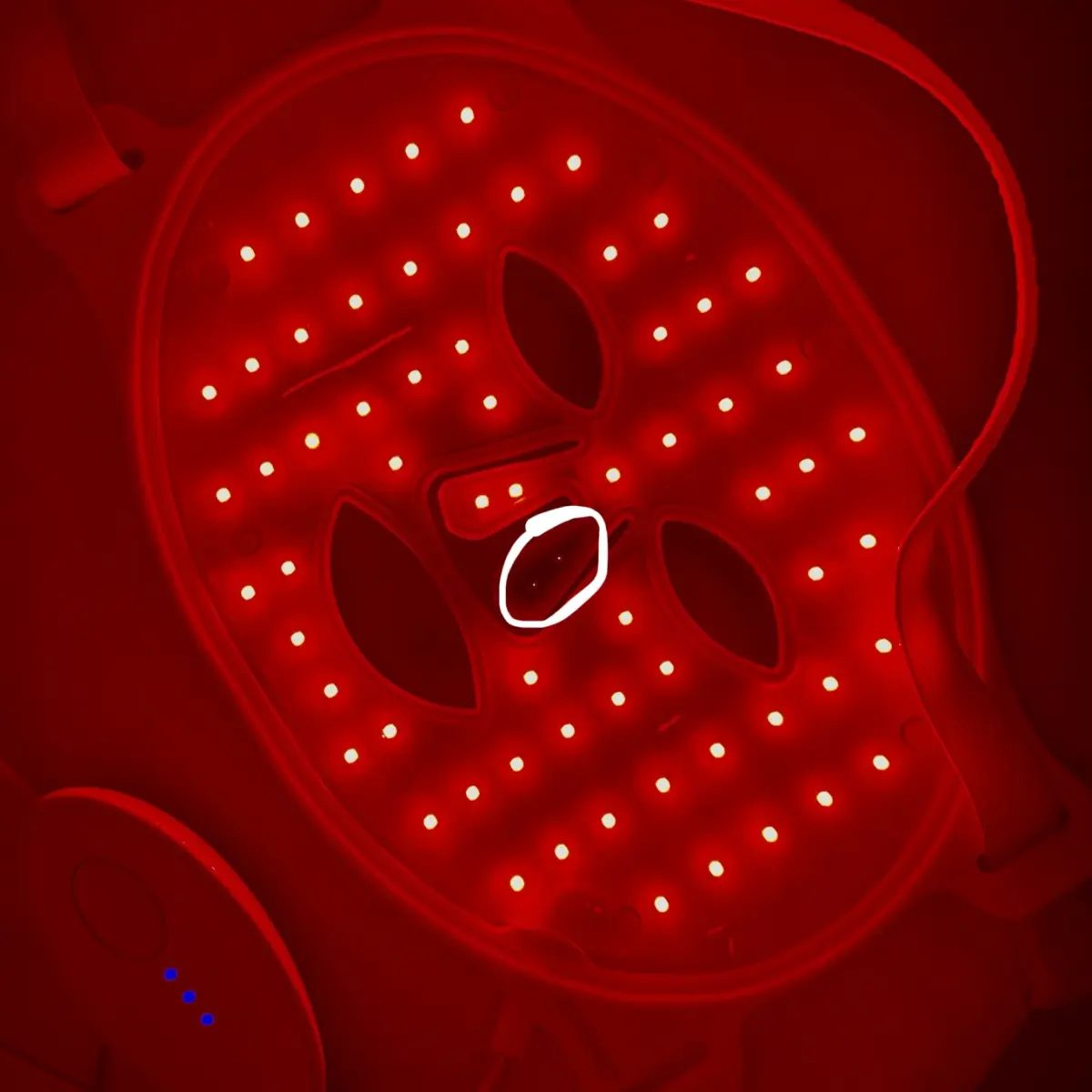
The Omnilux LED mask has 132 LEDs, 66 red and 66 near-infrared, enclosed in 66 dual chip bulbs. So the count of 132 is real, but what you are wearing is 66 light sources, which is low in today’s market.
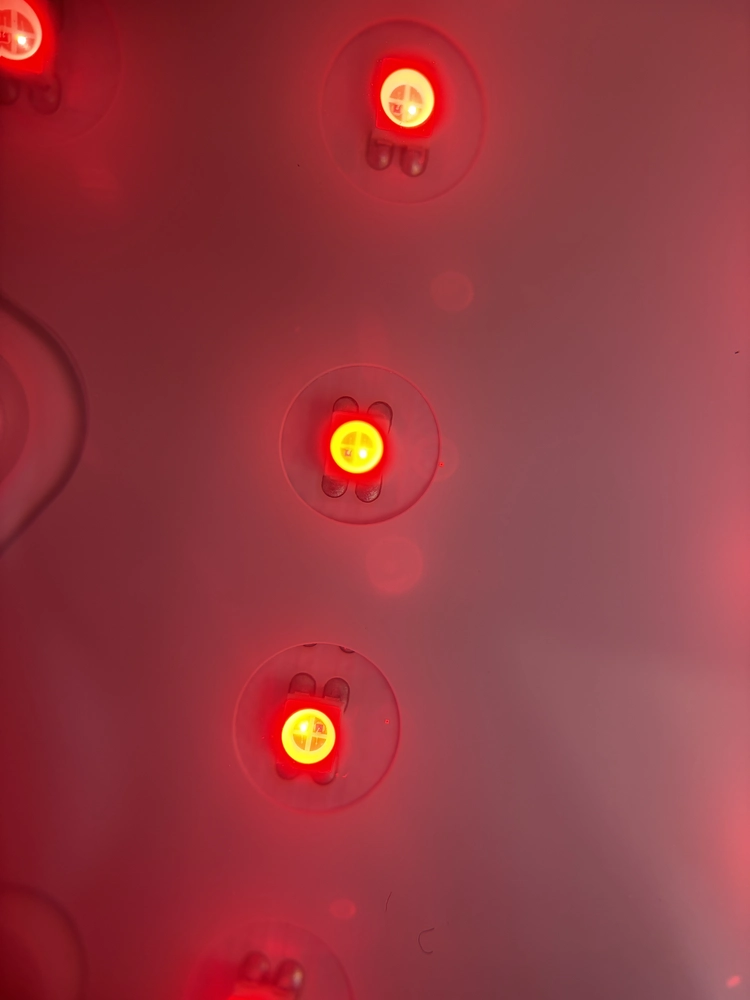
One bulb, two chips: the red and the near-infrared share a housing, so 132 LEDs light 66 spots.
66 is the one of the lowest count of anything I’ve scored, and density isn’t a marketing argument, it’s a key element for results. Each LED throws a cone that’s brightest on its axis and falls away toward the edge, so the only way to lay an even dose across a face is to space the emitters close enough that the edge of one beam overlaps the edge of the next.
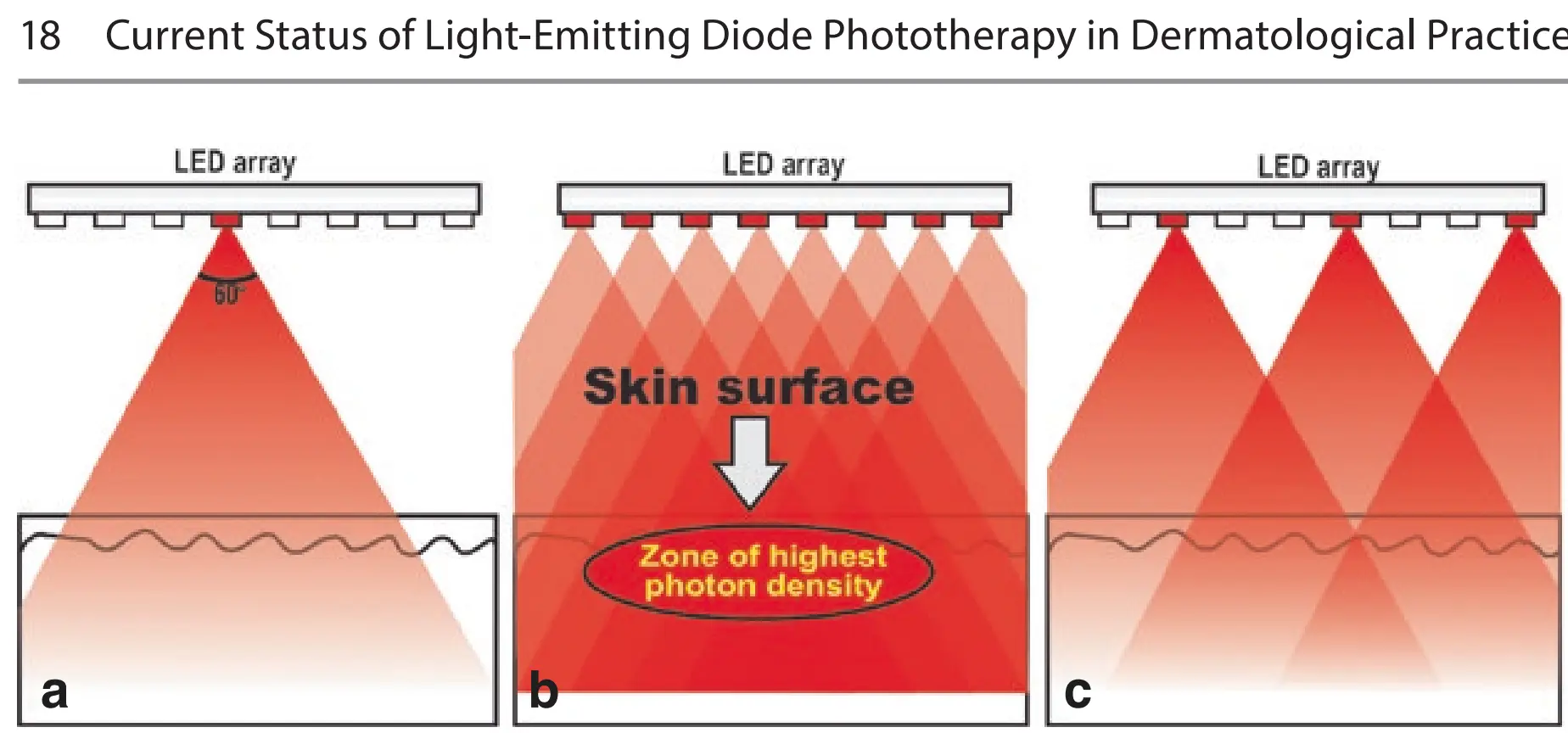
At 66 emitters spread over a whole face, the Omnilux sits on the wrong side of that line. The skin it does cover isn’t getting an even dose. A patch sitting directly under a bulb and a patch sitting between two bulbs are treated at different intensities during the same 10 minutes, with many gaps in this case.
Here’s the Omnilux LED mask to a denser LED mask, so you can better understand the point of LED density.
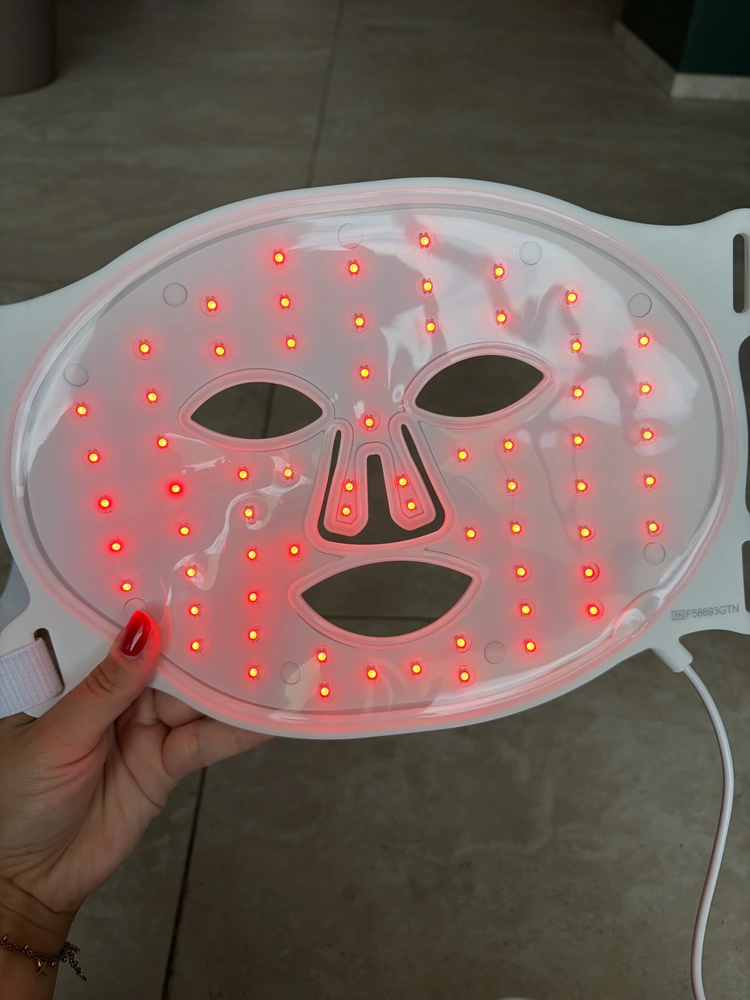
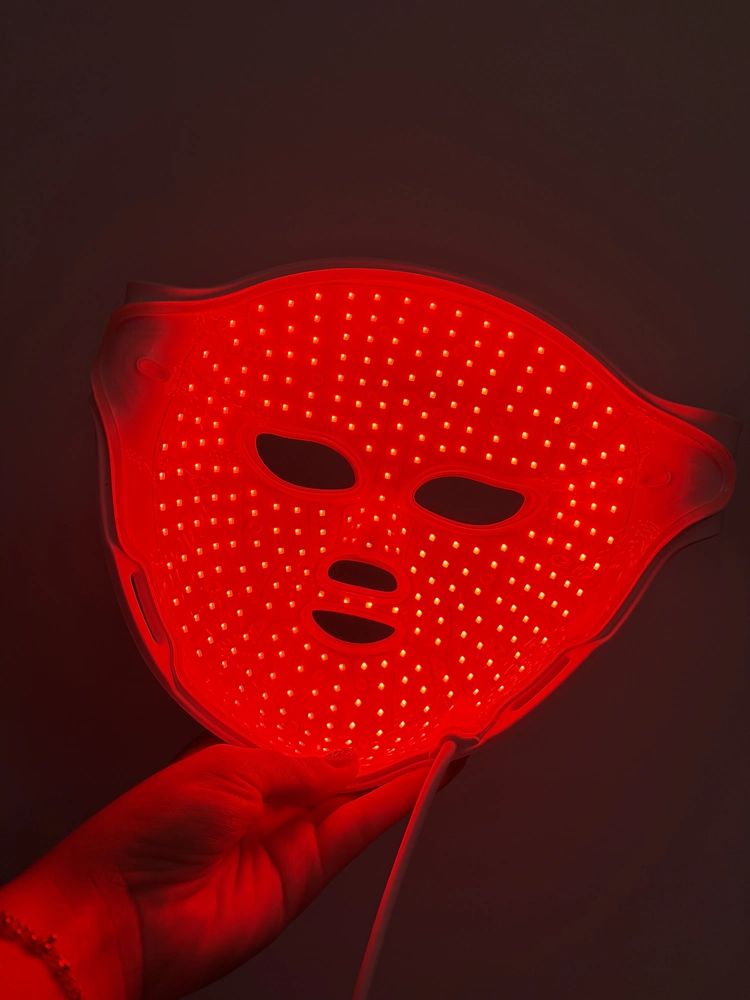
On the right, the Nooance Elite X600 (my review here), from a French brand, runs 300 emitters carrying 600 LEDs, roughly 4.5 times the Omnilux count, and the individual points stop being individual points. That’s the mask I go back to between tests.
Which parts of my face got no light from the Omnilux Contour Face?
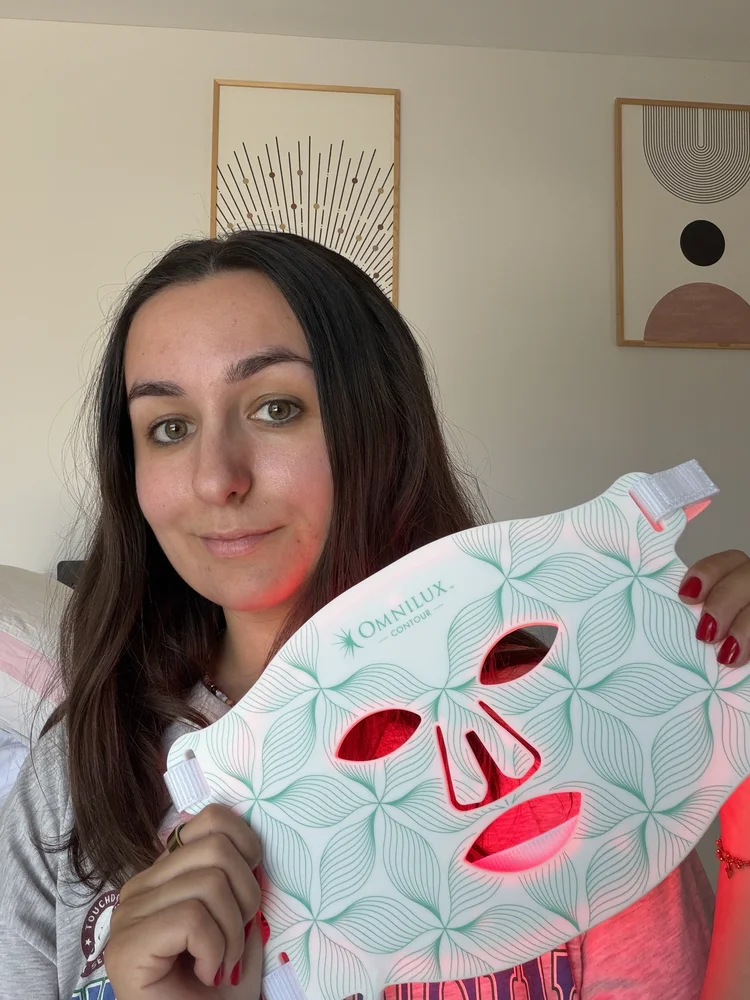
The Omnilux is genuinely flexible, but flexible is not the same as fitted: the panel is flat, so it bridges from cheekbone to cheekbone and leaves no contact between the LED mask and my face. Light that crosses air before reaching skin arrives weaker, and that penalty lands on the jaw, the chin, the underside of the chin and the sides of the nose.
The gap that annoys me is that there’s no LED above the upper lip, which is where smoker’s lines form and one of the first places people start looking at in the mirror in their forties.
Around the eyes there are a few bulbs, but a few bulbs across an orbital rim isn’t coverage, and crow’s feet are the second thing people come to red light for. Buying a wrinkle device that skips both of those is a strange trade.
2 out of 5. It sits below the iRestore Illumina on emitter count and above it on fit, since the iRestore’s rigid shell hovers even further off the face.
Proof: 3/5
What Omnilux publishes about the Contour Face
- Published: Wavelengths in nm: 633 nm and 830 nm
- Published: Dose per session calculable: about 18 J/cm² in 10 minutes
- Missing: FDA clearance number printed by the brand
- Published: A clinical study on this exact model
- Published: That study documented: sample, duration, instruments, downloadable summary
- Published: Photobiological safety: conforms to IEC/EN 62471
- Published: Warranty and support: 2 years, plus published contraindications
Proof: 3/5
The study looked promising: named instruments, a stated sample, a stated duration and a summary you can download. It comes down a full point anyway, because Omnilux presents its own evidence wrongly in two independent ways.
Where does the Omnilux 96% come from?
On the LED Contour Face product page, the block “Clinical studies are the proof you need to feel confident” show three numbers: 96% skin felt firmer and younger, 96% fine lines were less visible, 95% skin was brighter and plumper. And the relevant study: “A 7-Week, Open-Label Study Evaluating the Efficacy and Safety of 415-nm/633-nm Phototherapy for Treating Mild-to-Moderate Acne in Adolescents and Adults, Ablon G.”
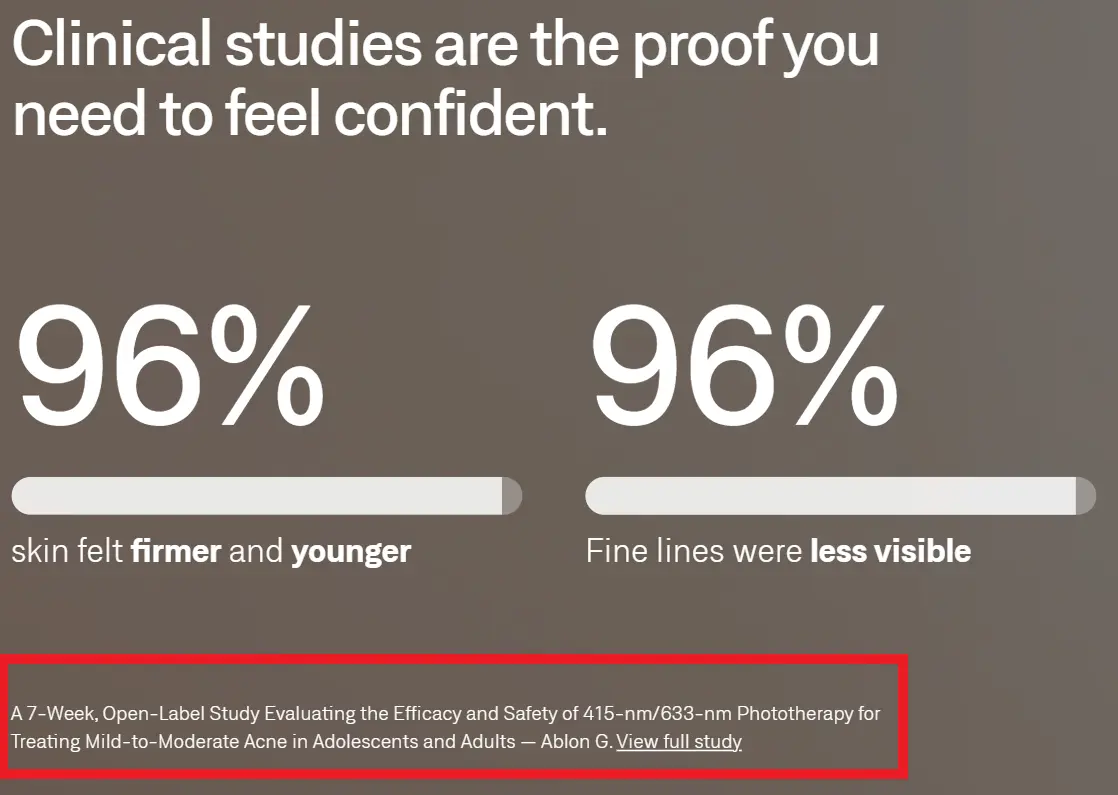
That paper has nothing to do with this LED mask because it studies acne, not wrinkles, with a different model of 415 nm blue light combined with 633 nm red, whereas the Contour Face emits no blue light at all.
So the evidence printed under three anti-aging claims is a trial of another product, for another condition, at a wavelength this LED mask doesn’t have.
The odd part is that Omnilux does have a study of the Contour Face, and hosts it as a PDF on another page of the same site. So I read it, to see whether the three percentages were at least right.
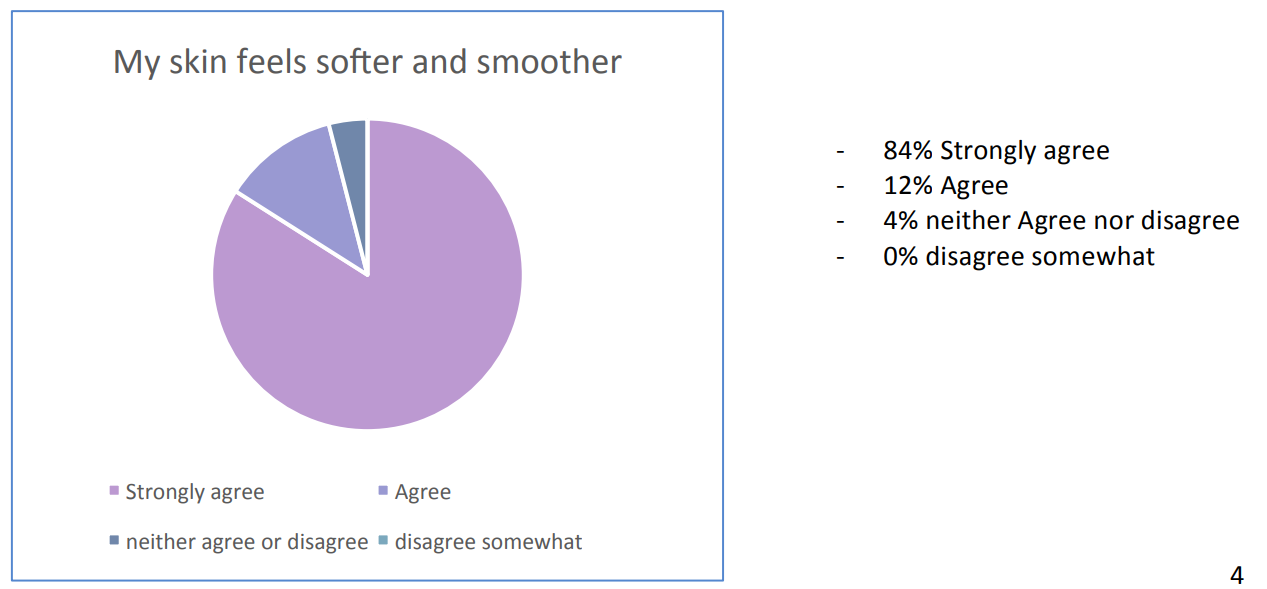
They aren’t in it, and the numbers shared in the study are based on self-evaluation, so it has not as much value as instrumental ones led in clinical study… Plus, as explained earlier, the study was done with the use of the LED mask WITH hydrogel masks…
Anyway, the numbers Omnilux puts on the product page are not the numbers in the study Omnilux ran, and I can’t tell you where they came from, because the document that would explain them is the one they don’t match.
One more point: the study says in plain words that “no significant improvement in pigmentation was observed at either time point”.

Who actually holds the Omnilux FDA clearance?
Omnilux writes FDA-cleared, and indeed the Contour Face is covered by K191629, decided on 12 September 2019, product code OHS, 21 CFR 878.4810, class II. The applicant is Ismart Marketing Svcs, Ltd. and the device is named on the file as faceLITE.
That’s not a scandal on its own, since plenty of brands sell a design cleared under someone else’s name. But the FDA establishment registrations that carry Omnilux Contour list more than 20 brand names between them, including faceLITE, Deesse Pro Express, ELEMIS Red Light Mask, LUMA PRO, Smoothskin DuoLux, City Beauty, PRIORI, Dp Dermaceuticals, and CurrentBody Skin…
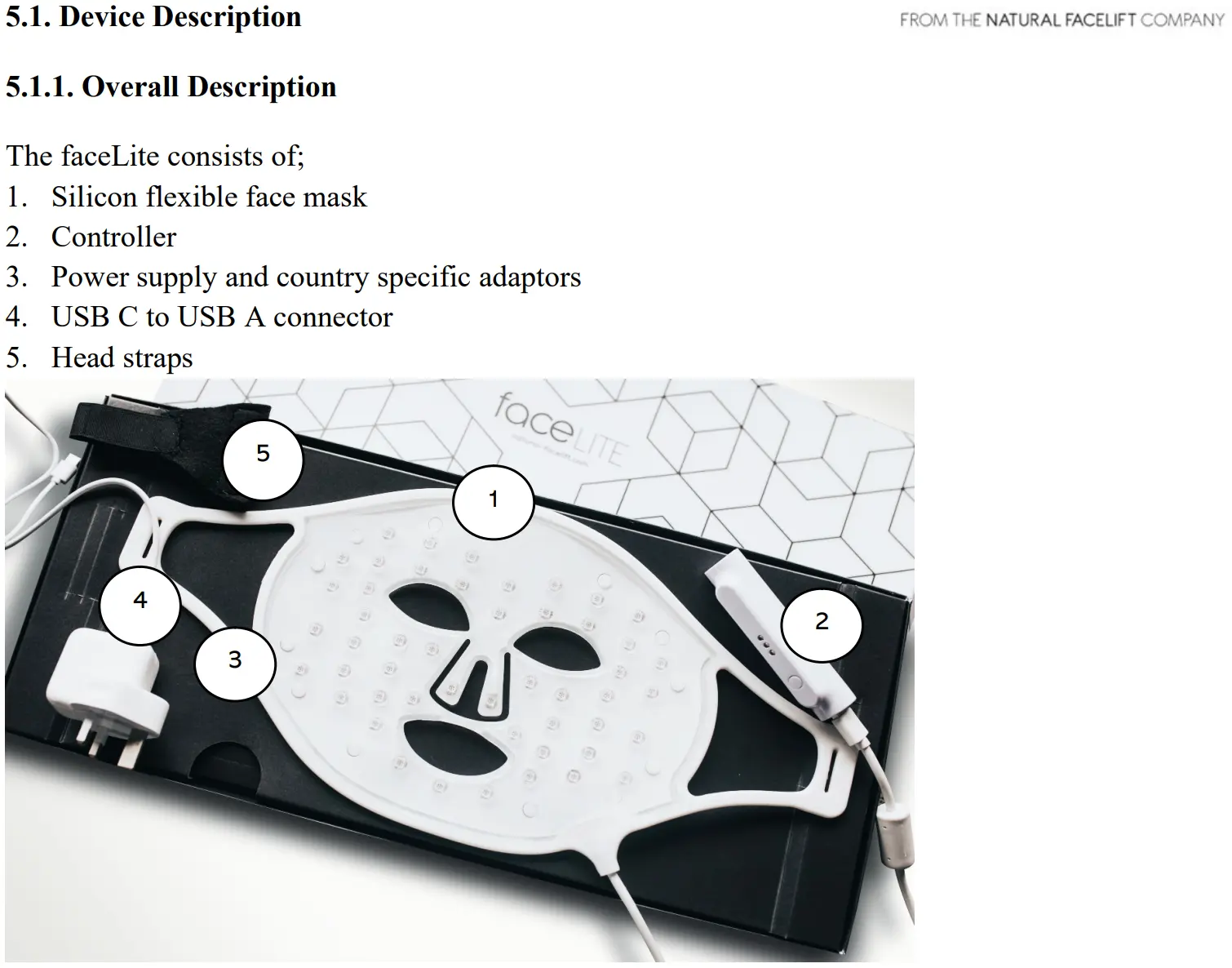
So the clearance you’re paying a premium for is a 2019 file held by a British marketing company and shared across two dozen labels. They tell you nothing about whether it works. You can check both of these yourself: the 510(k) record for K191629 gives the file and the applicant, and the openFDA registration listing gives the brand names.
Comfort: 3/5
The panel itself is the best thing about this LED mask. It’s light, it’s soft, it folds into a drawer or a suitcase without complaint, and after 10 minutes I never wanted it off my face. The strap does let it creep down over a session, so I’d reseat it once around the halfway mark, but that’s a small thing.
The controller is where the $439 stops being visible. It feels cheap in the hand next to the panel it’s driving, and there’s no timer on it.
Do you need eye protection with the Omnilux Contour Face?
Omnilux says no, and it says so from a real position: the Contour Face has been tested to IEC/EN 62471, the photobiological safety standard, and it emits no blue light, which is where most of the documented eye concerns in LED therapy sit.
I lasted a week without eye protection. The light is tiring to sit under, and by the end of a session my eyes felt like I’d been staring at a screen too long, so from week 2 I wore the opaque goggles I use for in-clinic treatments. Personally I’d rather wear protection than trust a standard.
The cost of that choice is the whole appeal of a home LED mask. With goggles on I couldn’t answer an email, read, or move around the house, so 10 minutes became 10 minutes of sitting still doing nothing. Every other LED mask I’ve scored come with built-in shields, supplied rings or a visor.
Value: 2/5
$395 direct, $439.99 on Amazon. For that, the box contains a flexible panel with 66 emitters, a controller without a timer, a pouch, and no eye protection.
The iRestore Illumina costs $399 and carries 120 LEDs, so it’s cheaper with nearly twice the emitters, and I still shelved it. The Nooance Elite X600 costs more and carries 300 emitters, a molded shell and a published calibration distance.
What you’re really paying for is the name. Omnilux has 20 years of professional systems behind it and it’s the brand dermatologists cite, and I understand why that’s reassuring. But the clinical history belongs to the clinic machines, and the file behind this one says faceLITE.
Safety & support: 3/5
The warranty runs 2 years, the IEC/EN 62471 conformity is stated in plain words rather than implied, and the product page links a user guide, a quick start guide, a contraindications sheet and a drug interactions sheet. Photosensitizing medication is the most common reason someone shouldn’t be under red light.
But if you don’t like the product, you have 30 days to return it, the product must come back unopened and unused, and there’s a $15 return fee. An unopened LED mask is one you haven’t tried, so in practice there’s no trial period here at all: open the box and you own it. On a device the brand itself says takes 4 weeks to show anything, a return window you can only use before you start is not a return window…
Who shouldn’t buy the Omnilux Contour Face
Skip this one if you recognize yourself
- You came for the lines above your lip. There is no LED over that strip of skin, so no amount of consistency will put light on it.
- You came for your jawline or a softer chin. A flat panel bridges over both, and the light crosses air before it reaches you.
- You want to wear eye protection during your sessions. None is included, so you either buy your own or spend the 10 minutes with nothing to do.
- You already own an LED mask with 100 emitters or more. That swap is the experiment I ran on myself, and it cost me 8 weeks and a duller complexion.
- You take a photosensitizing medication. Omnilux publishes a drug interactions sheet for exactly this reason, and it’s worth reading before you order rather than after.
Am I still using the Omnilux Contour Face?
Updated August 2026. No. I finished the 40th session and went straight back to my usual LED mask, and my tone came back over the next two weeks. I’ve kept the Omnilux rather than returning it, because I want to keep filming what 66 emitters actually light up, and that’s a demonstration that works far better on video than in a photograph.
What I still want to know about the Omnilux LED mask
Mostly I want the study run again without the hydrogel mask. As it stands, the only Contour Face data anyone has describes light plus an occlusive sheet mask on 25 people with no control group. Omnilux has 20 years of published work behind its clinic systems, so it knows exactly how a controlled trial is supposed to look.
- A denser grid with light points above the upper lip and better placement around the nose, jaw and chin.
- A shaped panel that keeps the listed output close to more of the face.
- Eye protectors in the box for people who find the light tiring.
- A controller with a visible session countdown.
- A controlled, independently identified study on Contour Face without a hydrogel confounder.
Omnilux Contour Face LED mask: your questions
How many LEDs does the Omnilux Contour Face really have?
132 LED chips housed in 66 dual chip bulbs, which Omnilux states in its own FAQ. So the number of points of light on your face is 66, and each one carries a 633 nm red chip and an 830 nm near-infrared chip.
What is the irradiance of the Omnilux Contour Face?
Omnilux publishes ~30 mW/cm² in the FAQ on its product page, without saying at what distance it was measured. That works out to roughly 18 J/cm² over a 10 minute session, and the same ~30 figure is given for the Contour Neck & Décolleté, the Contour Glove and Omnilux Men.
Do I need eye protection with the Omnilux Contour Face?
Omnilux says no, on the basis that the device conforms to IEC/EN 62471 and emits no blue light, and it ships none in the box. I wore my own goggles from week 2 onward, because I found the light tiring to sit under, and I’d rather have the choice than be told I don’t need one.
Does the Omnilux Contour Face have a clinical study?
Yes, a consumer study run in 2018 on 28 people, 25 of whom finished, at 3 sessions a week for 4 weeks, with named instruments and a downloadable summary. It has no control group, and every subject wore an Omnilux hydrogel mask underneath the LED mask, so it measures light plus a sheet mask rather than light on its own.
Is the Omnilux Contour Face FDA approved?
No. It’s FDA-cleared, which is a different and much lighter process, under file K191629 from September 2019. That file is held by Ismart Marketing Svcs Ltd in the UK, names the device faceLITE, and covers more than 20 brands of LED mask.
How long does it take to see results with the Omnilux Contour Face?
Omnilux says 4 weeks. I ran 40 sessions over 8 weeks at 5 sessions of 10 minutes a week and photographed nothing I’d defend, on a face that had been running a denser LED mask beforehand.
Test log
- Exact model
- Omnilux Contour Face, US version, 633 nm and 830 nm, single mode
- How I got it
- Bought on Amazon from a third party seller, $439.99. No affiliate link, no contact with the brand
- Test window
- 8 weeks, 40 sessions
- Sessions
- 5 evenings a week, 10 minutes, frequency set from the published 30 mW/cm²
- Photo protocol
- Same camera, same lamp, same distance, Sunday mornings, no makeup
- Protocol deviations
- Sessions 1 to 5 run without eye protection, sessions 6 to 40 with opaque goggles
- Brand data checked
- omniluxled.com product page and FAQ, Reviews & Results page, the Omnilux Contour FACE Clinical Study Summary PDF, clinical bibliography, returns and warranty policy, all checked 25 August 2026
- Public records checked
- FDA 510(k) K191629, openFDA establishment registrations 3013481783 and 3014737458, MAUDE reports MW5117775, MW5156924 and MW5171575, checked 25 August 2026
- Customer ratings
- Amazon 4.0/5 on 74 ratings, omniluxled.com 4.5/5 on 2,227 reviews, both read 25 August 2026

About Emilie
I have tested LED masks since 2023. I buy the devices, use them for weeks, and read the spec sheets nobody reads, because this market runs on numbers most brands never publish. Not a dermatologist, and I say so whenever a question needs one.