
I buy the devices I test unless the article says otherwise. Some links and discount codes on this site are paid links: if you buy through one, I earn a commission. It never changes a score or a verdict.
Irradiance is the amount of light an LED mask puts on your skin, in mW/cm². It’s the number that decides whether a 10-minute session does anything at all, and it’s also the one most brands avoid printing! Of all the LED masks I’ve tested, only a couple of brands say where their irradiance was measured, and one of them measured it at the LED…
Here’s what the figure means, how to turn it into a dose, where to look when a brand hides it, and 4 LED masks I’ve tested as examples.
Irradiance: One of the 7 criteria on my grid
Irradiance is one of the 7 criteria every LED mask review on this site is scored on. Several of you asked me what each one measures and why, so I’ve written a page per criterion instead of re-explaining them in each review. Here are the 7, in the order of my grid from my How I test page:
- Results, 24% of the score
- Irradiance, 16% of the score, this page
- Coverage, 14% of the score
- Proof, 14% of the score
- Comfort, 12% of the score
- Value, 12% of the score
- Safety & support, 8% of the score
What irradiance means on an LED mask
Irradiance is a power per surface: how many milliwatts of light reach each square centimeter of skin. Brands also call it light output or power density. Two LED masks can both print 633 nm on the box and be very different on this figure, because the wavelength says what color the light is, and the irradiance says how much of it actually arrives.
Be careful because many brands don’t share the irradiance, but the power in milliwatts for the whole device, or a battery in watts. That isn’t irradiance, because it doesn’t say how the power is spread over your face.
From mW/cm² to the dose your skin receives
Irradiance alone doesn’t treat anything, as its effectiveness depends on the duration of skin exposure. Multiply the irradiance by the session length and you get the dose in J/cm², the unit used in studies (dose = mW/cm² × seconds ÷ 1,000).
So 30 mW/cm² for 10 minutes is about 18 J/cm², and 50 mW/cm² for the same 10 minutes is about 30 J/cm².
That’s why the session length matters as much as the headline figure. An LED mask at 70 mW/cm² that stops after 3 minutes delivers less than a 30 mW/cm² mask running its full 10 minutes! A weaker LED mask isn’t disqualified, it just needs more sessions per week, which is how I set my test protocol: 3 sessions a week around 50 mW/cm², 5 around 30, and 5 when nothing is published, because I don’t assume a hidden number is a good one. The table is on my How I test page.
For me, the useful range is 30 to 50 mW/cm² at the skin. Below that, you’re paying in evenings. Above that, you’re not getting more results, just a warmer mask on your face.
Where the irradiance was measured changes everything
30 mW/cm² at the LED level and 30 mW/cm² at the skin level are two different things. Light spreads as soon as it leaves an LED, so every millimeter of air between the mask and your skin is intensity lost.
On a rigid shell that sits 1 cm off the face, the irradiance printed was never the figure on your skin (I come back to this in every review of a rigid mask).
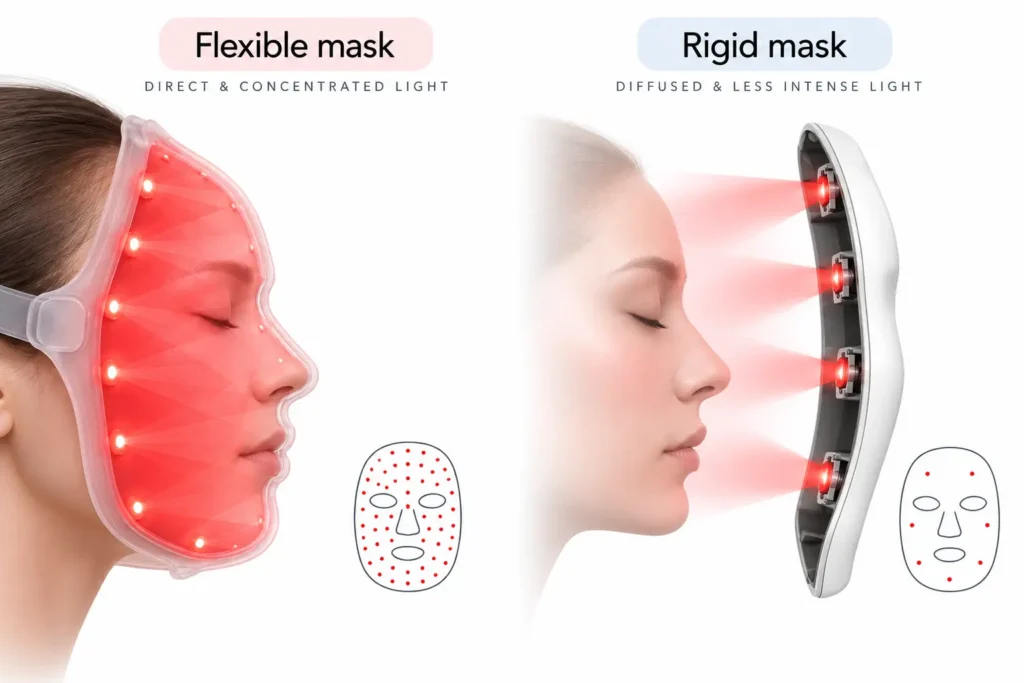
So the first thing I look for next to a figure is the measurement condition. A measurement on the skin or at a specific distance is fine with me, as long as it’s stated.
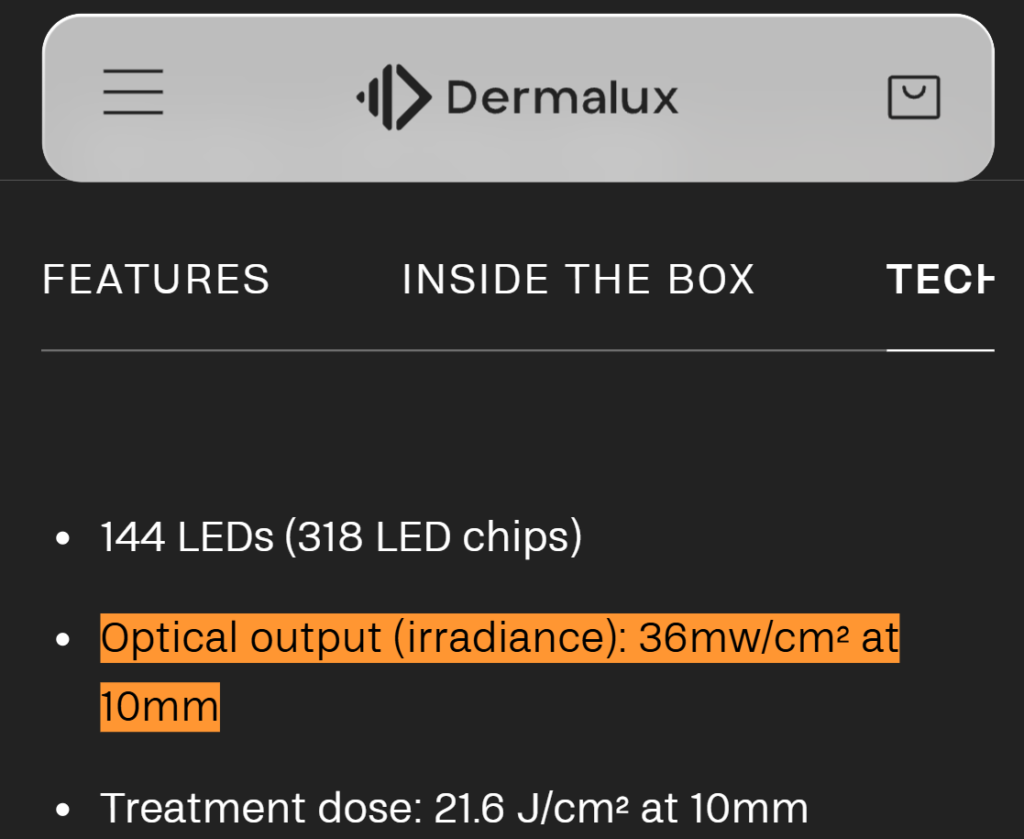
For example, Nooance indicates that its value of 50 mW/cm² was measured on the skin, Dermalux displays 36 mW/cm² at 10 mm, and Shark specifies that its value of 128 mW/cm² corresponds to a measurement at the LED source… This simple detail completely changes the interpretation of the 128 mW/cm² value!
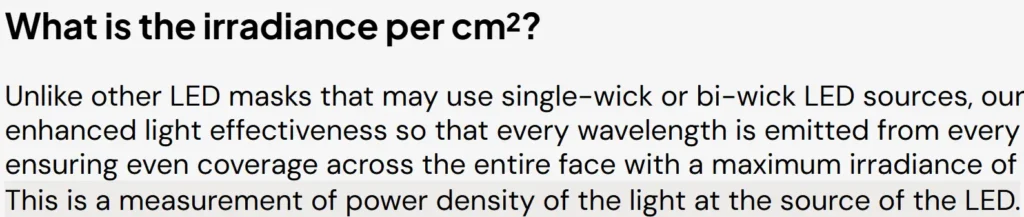
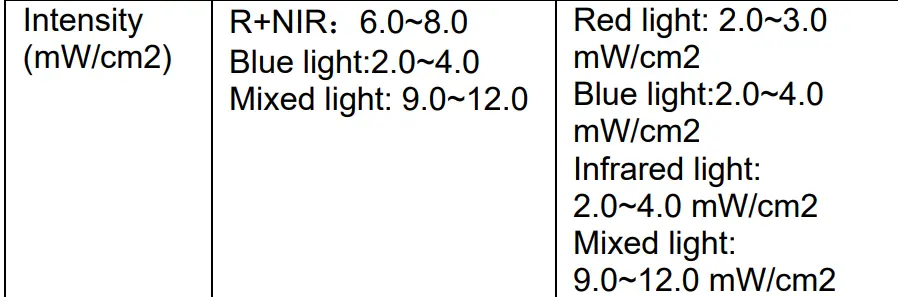
When the product page says nothing, I open the brand’s FDA 510(k) summary, because brands often give the regulator the figure that never reaches their website. It’s also where a figure can fall apart. Nanoleaf prints 91.9 mW/cm² on its product page, and its own FDA file (K243555) reads 6 to 8 mW/cm².
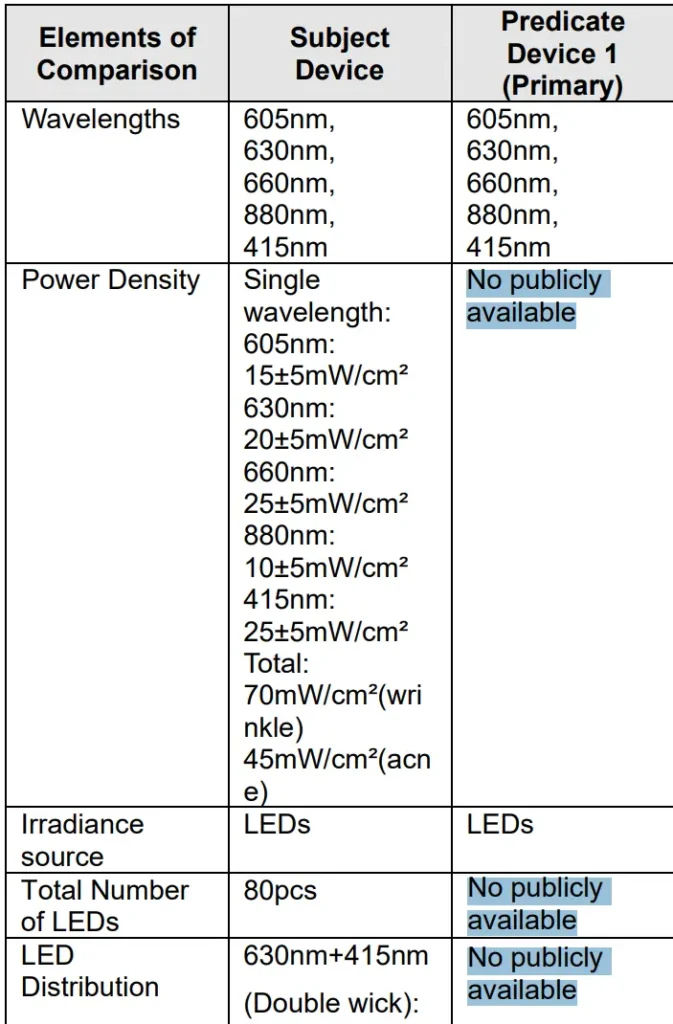
Qure publishes nothing at all, and its file (K230042) adds up to 70 mW/cm² in wrinkle mode, so the brand has the data and doesn’t share it…
What the research says about the dose
The controlled trial I use as a reference for red light on skin is a 2009 review (Biphasic Dose Response in Low Level Light Therapy) on the biphasic dose response: too little light does nothing, and past a point, more light stops helping and can even do the opposite.
The LED masks with a study on the exact model, the CurrentBody Series 2 and the Nooance masks, run 10-minute sessions at 30 to 50 mW/cm², so 18 to 30 J/cm² per session. Nothing in the research rewards an LED mask advertising 120 mW/cm² or more, and in my opinion a figure like that is mostly marketing.
4 LED masks I assessed on irradiance
- Shark CryoGlow 128
- Nooance Elite X600 50
- Dermalux LED Face Mask 36
- CurrentBody Series 2 30
- Dr. Dennis Gross FaceWare Pro not disclosed
Best: Nooance Elite X600
Nooance publishes 50 mW/cm² and states that the reading was taken in direct contact with the skin, which helps because it is a molded silicone shell that really sits on the face. That’s the only case where a contact figure means what it says.
10 minutes at that level is about 30 J/cm², so 3 sessions a week were enough during my test. It scored 4.5/5, it’s the LED mask I still use today, and you can read my review of the Nooance Elite X600 for the details.
Okay: CurrentBody Series 2
CurrentBody prints 30 mW/cm² on its spec sheet, red and near-infrared combined, the same convention Nooance uses for its 50. 10 minutes is 18 J/cm², so I wore it more often than the X600 (5 sessions a week). But the spec sheet doesn’t say where that 30 was read, and on a flexible shell that sits close to the face, I’d have liked to know…
It’s at the low end of the useful range, but printed in plain sight: 3.5/5. More in my CurrentBody Series 2 review.
Mid: Shark CryoGlow
Shark’s 128 mW/cm² is the biggest figure on this page, but it’s a total across every wavelength, read at the source of the LED. The rigid shell keeps the LEDs well off the face, so the 128 describes the LED itself, not what your skin receives, and nobody can tell you how much is left after the air gap.
To be honest, I’d rather have a smaller number measured at the skin. Still, Shark wrote the condition down when most brands don’t, so 3/5. My Shark CryoGlow review goes into it.
Worst: Dr. Dennis Gross FaceWare Pro
Dr. Dennis Gross publishes no irradiance anywhere: product page, manual, FAQ, nothing. Its FDA summary doesn’t give a number either, and 3-minute sessions are presented as enough with nothing to back that up. At $455, that’s asking you to trust the brand on the most important number of an LED mask, and I don’t recommend it: 1/5. My Dr. Dennis Gross LED mask review explains the rest.
The irradiance of every mask, with its measurement condition when the brand gives one, sits on the grid of my LED mask picker, and the masks that publish the full figure are also the ones that score best in my ranking of the best LED masks.
The mistakes I see buyers make with irradiance
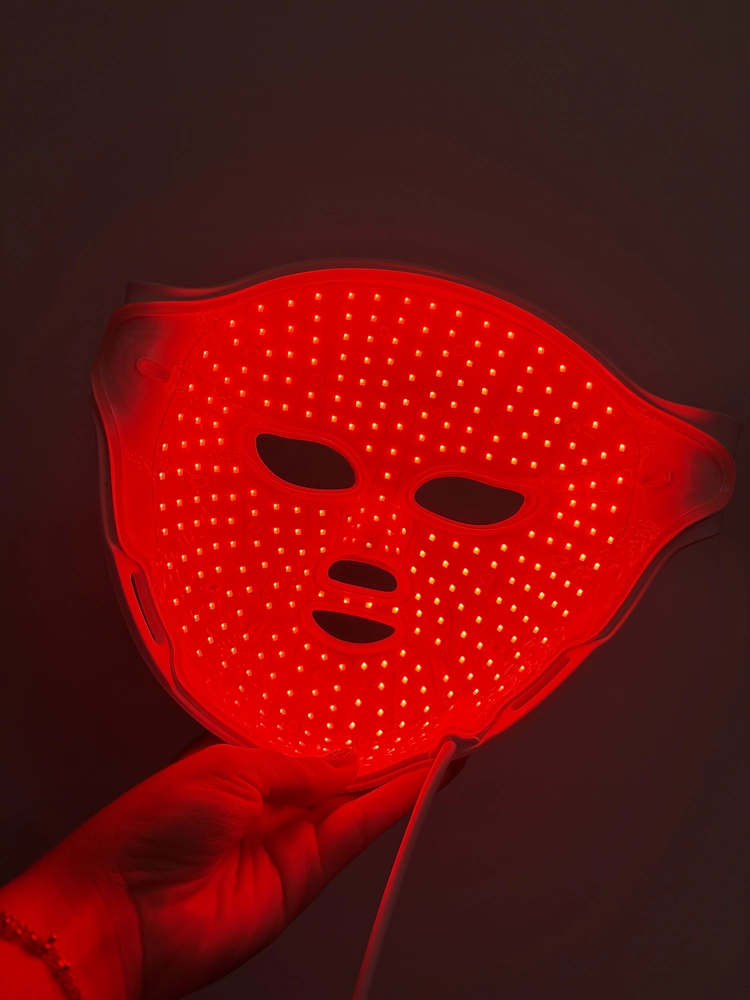
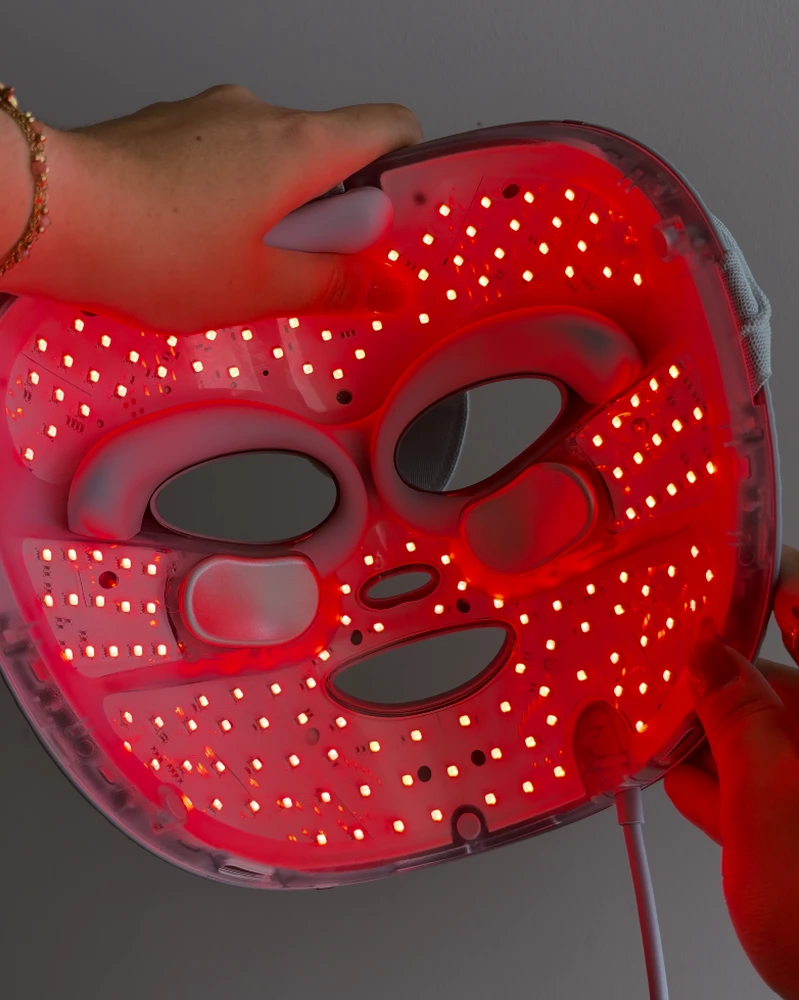
Taking the brighter LED mask for the stronger one. A phone camera adjusts its exposure, and a bare LED panel always looks impressive in a dark bathroom. I film every mask lit up to show density and gaps, which is a better indicator for coverage.
Comparing two figures measured in two places. 128 mW/cm² at the LED against 50 at the skin isn’t a comparison. If two brands don’t state the same condition, the bigger number tells you nothing.
Forgetting the timer. A 3-minute program at 70 mW/cm² delivers less than a 10-minute one at 30. Always read the session length next to the irradiance.
Judging irradiance without coverage. The dose only lands under a light point, so a strong figure on 70 points still leaves most of the face in the dark. Coverage is the next criterion on my grid, and it weighs almost as much as this one.
LED mask irradiance: your questions
What is a good irradiance for an LED mask?
Between 30 and 50 mW/cm² at the skin, with the measurement condition stated. 10 minutes at 50 mW/cm² is about 30 J/cm², which is at the top of what the research uses, and 10 minutes at 30 mW/cm² is about 18, which you compensate with more sessions a week.
Is a higher irradiance better?
No. Light therapy has a biphasic dose response: past a point, more light stops helping and can do the opposite. An LED mask advertising 120 mW/cm² or more is mostly warming your face for nothing, and a figure that high is usually read at the LED, not on the skin.
How do I calculate the dose from the irradiance?
Multiply the irradiance in mW/cm² by the session length in seconds and divide by 1,000. A 10-minute session is 600 seconds, so 30 mW/cm² gives 18 J/cm² and 50 mW/cm² gives 30 J/cm². If the brand publishes no irradiance, you can’t calculate the dose, and that’s exactly the problem.
What if the brand doesn’t publish any irradiance?
I look in the brand’s FDA 510(k) summary, which often lists the figure mode by mode. If there’s nothing there either, I write “not disclosed” in the review and I don’t recommend the mask. The brand knows the number, it just doesn’t share it.
Sources
- Brand figures
- Nooance, CurrentBody, Shark, Dermalux, Nanoleaf, Qure and Dr. Dennis Gross product pages, manuals and FAQs, as read for each review linked above
- FDA files
- 510(k) summaries K260150 (Nooance), K250966 (CurrentBody), K242796 (Shark), K243555 (Nanoleaf), K230042 (Qure), K183247 (Dr. Dennis Gross)
- Studies
- Wunsch and Matuschka, Photomedicine and Laser Surgery, 2014, PMC3926176, 136 volunteers, 30 sessions, irradiances of 6 to 13 mW/cm², control group not randomized. Huang, Chen, Carroll and Hamblin, Dose-Response, 2009, PMC2790317
- Checked
- November 2026

About Emilie
I have tested LED masks since 2023. I buy the devices, use them for weeks, and read the spec sheets nobody reads, because this market runs on numbers most brands never publish. Not a dermatologist, and I say so whenever a question needs one.